
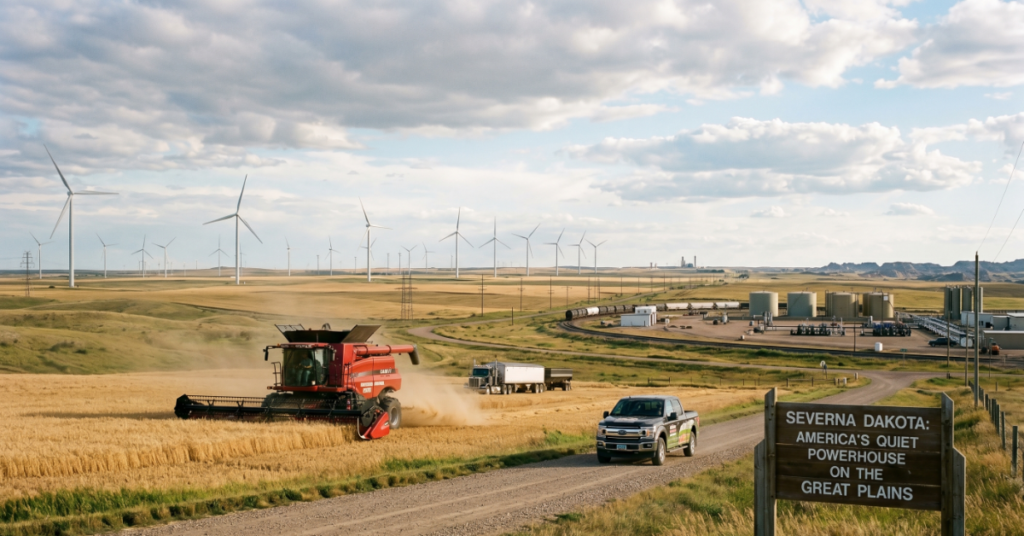
Severna Dakota, known in English as North Dakota, is a state located in the northern Great Plains region of the United States along the Canadian border. Although it is often overlooked compared to larger American states, severna dakota has become increasingly important because of its agricultural strength, oil production, and strategic energy infrastructure. The state combines massive rural landscapes with fast-growing energy corridors, creating a unique balance between traditional farming culture and industrial expansion.
The capital city is Bismarck, while Fargo serves as the largest urban center and economic hub. According to recent U.S. Census estimates, the population remains under one million residents, making it one of the least populated states in America. Despite this, the state generates substantial economic value through farming exports, petroleum extraction from the Bakken Formation, and renewable energy development.
Visitors often associate severna dakota with endless plains and severe winters, but the state offers far more complexity. Western regions contain dramatic badlands, wildlife reserves, and the well-known Theodore Roosevelt National Park. Eastern areas are dominated by fertile farmland and university cities. This contrast shapes the culture, politics, and economy of the region.
Over the last decade, North Dakota has experienced cycles of rapid economic growth tied to oil prices, followed by labor shortages and infrastructure pressure. Those shifts continue to influence housing, transportation, environmental policy, and migration patterns across the state.
Geography and Climate of Severna Dakota
Severna Dakota covers approximately 183,000 square kilometers, ranking among the larger U.S. states by land area. The geography changes noticeably from east to west.
Eastern Farmland Regions
Eastern counties are flatter and wetter due to the Red River Valley. This region supports intensive agriculture and contains many of the state’s largest farming operations. Wheat, corn, soybeans, sugar beets, and sunflowers dominate the landscape.
Western Badlands and Energy Fields
Western severna dakota features rugged terrain, eroded hills, and dramatic rock formations. The area became nationally recognized because of the Bakken oil boom that accelerated after 2008. Theodore Roosevelt National Park also sits in this western section.
Seasonal Climate Conditions
The climate is continental, meaning winters are extremely cold while summers can become very hot. January temperatures frequently fall below freezing for extended periods. Snowstorms and blizzards occasionally disrupt transportation and agricultural operations.
Summer conditions are more favorable for tourism and farming activity. However, severe thunderstorms and tornadoes remain periodic risks during warmer months.
Climate Comparison Table
| Region | Winter Conditions | Summer Conditions | Main Economic Activity |
| Eastern Plains | Heavy snow, icy winds | Warm and humid | Agriculture |
| Central Corridor | Cold and dry | Moderate heat | Services and transport |
| Western Badlands | Harsh winters | Hotter and drier | Oil and tourism |
Why Severna Dakota Is So Sparsely Populated
Population density remains one of the defining characteristics of the state. Large distances between towns, limited urbanization, and a historically agricultural economy all contributed to slow population growth.
Several factors explain this trend:
- Harsh winter weather discourages migration
- Limited major metropolitan areas reduce corporate concentration
- Agricultural mechanization reduced rural labor demand
- Young professionals often relocate to larger U.S. cities
Even during the Bakken oil boom, population growth concentrated mostly around western energy towns such as Williston. When oil prices declined after 2014, some temporary workers left the region.
An important demographic reality is aging rural communities. Many small towns face school consolidation, healthcare shortages, and declining local businesses. State policymakers continue attempting to attract younger residents through tax incentives and infrastructure development.
The Economy of Severna Dakota
The economy relies heavily on natural resources and agriculture. Unlike states dominated by finance or technology sectors, severna dakota remains closely connected to land use and commodity markets.
Agriculture as an Economic Foundation
North Dakota consistently ranks among America’s leading producers of:
- Wheat
- Durum wheat
- Sunflowers
- Canola
- Soybeans
- Honey
Large-scale mechanized farming allows high output despite the relatively small population.
Major Economic Sectors
| Sector | Estimated Importance | Key Products or Services |
| Agriculture | Very High | Wheat, soybeans, livestock |
| Energy | Very High | Oil, natural gas, lignite |
| Manufacturing | Moderate | Farm equipment, food processing |
| Healthcare | Growing | Regional medical services |
| Tourism | Moderate | National parks, hunting, outdoor recreation |
Oil and Energy Production
The Bakken Formation transformed the state economy during the shale revolution. Hydraulic fracturing and horizontal drilling enabled companies to access previously unreachable oil reserves.
Industry analysts observed rapid increases in wages, truck traffic, temporary housing demand, and pipeline construction during the peak expansion years between 2010 and 2015. State tax revenues also increased dramatically.
However, dependence on fossil fuel markets creates volatility. Falling oil prices can quickly reduce employment and state revenue projections.
Original Insight: Infrastructure Strain
One overlooked issue during the oil boom was local infrastructure fatigue. Rural highways originally designed for agricultural traffic suddenly handled heavy industrial equipment and tanker trucks daily. County governments struggled to finance repairs quickly enough, creating long-term maintenance costs that persisted after drilling slowed.
Culture, Heritage and Religion
The cultural identity of severna dakota reflects strong German and Scandinavian immigration patterns from the late nineteenth century.
Scandinavian and German Influence
Communities across the state still preserve:
- Lutheran church traditions
- Nordic festivals
- Traditional foods
- Heritage museums
- Agricultural community events
Fargo and Bismarck developed more diverse populations over time, yet many rural counties maintain strong ancestral connections.
Religious Landscape
North Dakota contains one of the highest church-per-capita rates in the United States. Lutheran denominations remain especially influential due to Scandinavian settlement history.
Religion continues shaping community organization, education discussions, and local politics in many rural areas.
Original Insight: Community Stability
Researchers studying rural Midwestern states often focus on economic decline, but severna dakota demonstrates unusually strong volunteer networks and local civic participation compared to many declining rural regions. Churches, agricultural cooperatives, and county fairs continue functioning as social infrastructure, helping smaller towns maintain cohesion despite population pressures.
Tourism and Natural Attractions
Tourism is not the dominant industry, but it remains economically important for western regions.
Theodore Roosevelt National Park
Theodore Roosevelt National Park attracts visitors because of its dramatic badlands landscapes, wildlife viewing opportunities, and hiking trails.
Bison, wild horses, prairie dogs, and elk are commonly seen throughout the park.
Fargo
Fargo is the state’s largest city and a regional cultural center. It contains universities, museums, restaurants, and growing technology startups.
Bismarck
Bismarck serves as the political capital and an important transportation hub along the Missouri River.
Outdoor Recreation
Popular activities include:
- Hunting
- Fishing
- Camping
- Snowmobiling
- Hiking
- Birdwatching
Tourism Comparison Table
| Destination | Main Attraction | Best Season |
| Theodore Roosevelt National Park | Badlands scenery and wildlife | Summer and early fall |
| Fargo | Urban culture and events | Year-round |
| Bismarck | History and riverfront recreation | Spring through fall |
| Lake Sakakawea | Fishing and boating | Summer |
Risks and Trade-Offs Facing Severna Dakota
Despite economic strengths, the state faces structural challenges.
Climate Vulnerability
Agriculture depends heavily on stable weather patterns. Droughts, flooding, and extreme temperature swings create uncertainty for farmers.
Workforce Shortages
Healthcare facilities, schools, and technical industries increasingly report labor shortages. Rural hospitals face particular pressure.
Energy Dependence
Heavy reliance on oil and gas exposes the state budget to commodity market swings.
Original Insight: Renewable Energy Tension
North Dakota is simultaneously expanding wind energy while remaining deeply connected to fossil fuel extraction. This creates a political and economic contradiction rarely discussed nationally. Many counties financially benefit from both industries at the same time, leading to unusual bipartisan support for selective renewable projects without abandoning petroleum development.
The Future of Severna Dakota in 2027
Several long-term trends are likely to shape the state over the next few years.
Renewable Energy Expansion
Wind farms continue growing across the plains because of favorable geography and strong wind conditions. Federal clean-energy incentives may accelerate investment.
Agricultural Technology
Precision agriculture tools, satellite mapping, and automated machinery are becoming increasingly common on large farms.
Population and Migration Questions
State officials continue attempting to attract workers and retain university graduates. Success will depend on:
- Housing affordability
- Broadband infrastructure
- Healthcare access
- Employment diversification
Energy Transition Challenges
Oil production will likely remain central to the economy through 2027, but regulatory pressure and changing energy markets could gradually shift investment priorities.
A realistic outlook suggests severna dakota will remain economically resilient but demographically fragile. Growth is possible, though concentrated mainly around urban corridors and energy regions.
Key Takeaways
- Severna Dakota combines agricultural strength with significant energy resources.
- The Bakken shale boom transformed western communities economically and socially.
- Severe climate conditions remain a major factor shaping daily life and migration patterns.
- Rural depopulation continues challenging small-town sustainability.
- Tourism potential is growing due to national park visibility and outdoor recreation demand.
- Renewable energy development may become a larger economic driver by 2027.
- Strong local cultural identity remains one of the state’s defining characteristics.
Conclusion
Severna Dakota occupies a distinctive place within the United States. It is geographically vast, economically important, and culturally rooted in agricultural traditions that still influence daily life. While the state lacks the population density and global visibility of larger American regions, its contribution to food production and domestic energy remains substantial.
The combination of oil wealth, fertile farmland, and natural beauty creates opportunities that many rural states no longer possess. At the same time, severna dakota faces serious long-term challenges tied to demographic decline, climate variability, and economic dependence on volatile commodity markets.
What makes the state particularly interesting is its balance between continuity and adaptation. Farming communities with deep historical traditions now coexist alongside advanced drilling technology, renewable energy projects, and modern logistics infrastructure. That tension will likely define the next phase of North Dakota’s development.
For travelers, researchers, and policymakers alike, severna dakota offers a revealing example of how rural America continues evolving in the twenty-first century.
FAQ
Why is severna dakota so cold during winter?
The state experiences a continental climate with little geographic protection from Arctic air masses coming south from Canada. Flat terrain also allows cold winds to move freely across the plains.
What is the largest city in Severna Dakota?
Fargo is the largest city and serves as a commercial, educational, and healthcare center for the region.
What natural resources does Severna Dakota have?
The state possesses significant oil, natural gas, lignite coal, fertile farmland, and wind energy potential.
Which national parks are located in Severna Dakota?
Theodore Roosevelt National Park is the most famous national park in the state and attracts visitors for its badlands landscapes and wildlife.
Is severna dakota a good place for agriculture?
Yes. Fertile soil, large open farmland, and advanced mechanized farming systems make the state one of America’s major agricultural producers.
How important is oil production to the state economy?
Oil production is extremely important, especially in western regions connected to the Bakken Formation. State revenues and employment levels are strongly influenced by energy markets.
Methodology
This article was prepared using publicly available data from the U.S. Census Bureau, North Dakota state economic reports, energy industry publications, and National Park Service materials. Historical and demographic trends were cross-checked against government statistics and regional reporting.
Economic analysis considered oil market cycles, agricultural production patterns, and infrastructure development observed across the state since the Bakken shale expansion period. Tourism and cultural information were validated using official regional tourism resources and park documentation.
Limitations include rapidly changing commodity prices and evolving population estimates, which may shift future economic projections.
References
- U.S. Census Bureau. (2024). North Dakota population estimates. Retrieved from https://www.census.gov/
- National Park Service. (2025). Theodore Roosevelt National Park. Retrieved from https://www.nps.gov/
- U.S. Energy Information Administration. (2025). Bakken region crude oil production. Retrieved from https://www.eia.gov/
- North Dakota Department of Commerce. (2024). Economic development and workforce reports. Retrieved from https://www.commerce.nd.gov/
- United States Department of Agriculture. (2025). North Dakota agricultural statistics. Retrieved from https://www.usda.gov/ Top of Form