
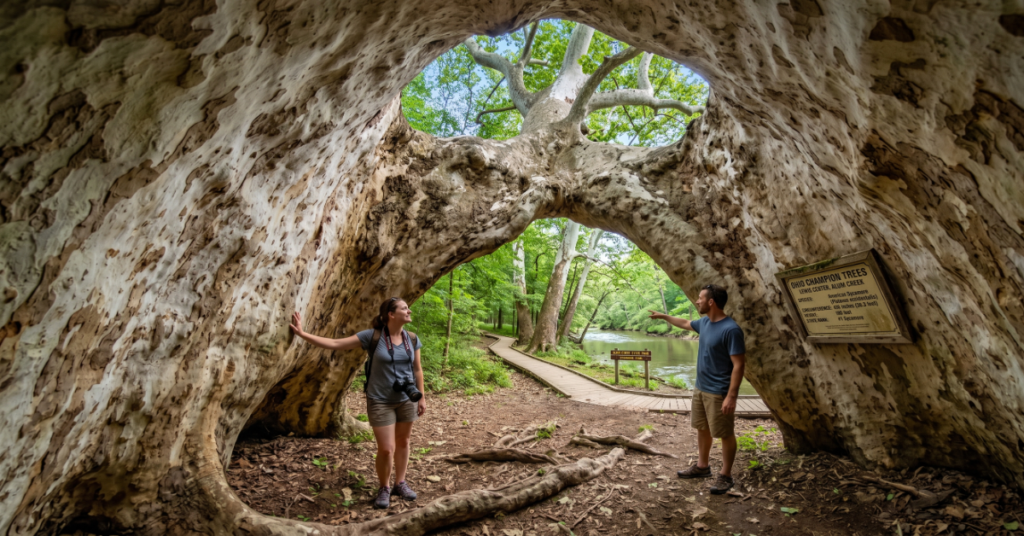
When people search for Ohio champion trees Lewis Center Ohio, they are usually trying to identify where the largest and most significant trees are located near Lewis Center in Delaware County. The answer consistently points toward a remarkable Eastern Cottonwood situated within Alum Creek State Park, one of the most frequently referenced champion tree locations in the region.
This tree is not just notable for its size. It has also become a local landmark for hikers, photographers, and botanists who study Ohio’s old-growth remnants. While many trees lose structural dominance with age, this cottonwood has remained unusually vigorous compared to other aging state champions.
The broader champion tree system is overseen through programs associated with the Ohio Department of Natural Resources and national standards developed by American Forests. These systems ensure consistency in how trees are measured and ranked across species and regions.
Understanding Ohio champion trees Lewis Center Ohio requires more than just locating a single tree. It involves learning how tree size is quantified, why certain species dominate records, and how central Ohio’s ecology supports unusually large specimens. This guide breaks down those elements in detail, from measurement formulas to real field locations and comparative analysis across the region.
What Defines Ohio Champion Trees Lewis Center Ohio
Champion trees are not chosen subjectively. They are ranked through a standardized scoring system used nationally and applied in Ohio.
Champion Tree Scoring System
Total Points=Circumference (inches)+Height (feet)+14×Average Crown Spread (feet)\text{Total Points} = \text{Circumference (inches)} + \text{Height (feet)} + \frac{1}{4} \times \text{Average Crown Spread (feet)}Total Points=Circumference (inches)+Height (feet)+41×Average Crown Spread (feet)
This formula ensures that no single measurement dominates the ranking. A tree must excel in multiple dimensions to become a champion.
Measurement Criteria
| Metric | Description | Measurement Point |
| Circumference | Trunk girth | 4.5 feet above ground |
| Height | Vertical growth | Highest living tip |
| Crown Spread | Average canopy width | Drip line edge |
The system is used nationwide by American Forests and adapted locally by the Ohio Department of Natural Resources.
The Alum Creek Eastern Cottonwood Near Lewis Center
At the center of Ohio champion trees Lewis Center Ohio discussions is a massive Eastern Cottonwood located in Alum Creek State Park.
This tree is frequently cited among Ohio’s largest living specimens due to its balanced combination of height and trunk diameter.
Key Recorded Characteristics
| Attribute | Approximate Value |
| Species | Eastern Cottonwood |
| Height | ~136 feet |
| Trunk Circumference | ~370 inches |
| Location Context | Near Alum Creek Lake woodland area |
Historically, the tree has been compared with other Ohio champions such as the Jeromesville Sycamore. While that sycamore exceeds it in trunk girth, the cottonwood is taller and generally considered more structurally dynamic.
Why It Matters Ecologically
Eastern Cottonwoods thrive in riparian environments, which explains their presence near water systems like Alum Creek Lake. These conditions support rapid vertical growth and wide canopy expansion.
Systems Behind Champion Tree Classification
Understanding Ohio champion trees Lewis Center Ohio requires a closer look at how trees are evaluated across the state.
Institutional Structure
- Ohio Department of Natural Resources manages statewide documentation
- American Forests sets national benchmarking standards
- Local forestry surveys validate measurement accuracy
Practical Implications
- Trees are periodically remeasured due to growth or environmental change
- New champions can replace older records at any time
- Species competition varies widely based on soil and moisture conditions
Key Insight
One often overlooked factor is that champion status is not permanent. A tree listed today may lose its ranking within a decade if another specimen outgrows it or if damage alters its structure.
Central Ohio as a Champion Tree Corridor
The Lewis Center region sits within a broader ecological corridor that supports unusually large trees.
Notable Nearby Locations
| Location | Notable Trees |
| Goodale Park | Chinese Catalpa, historic shade trees |
| Schiller Park | Wych Elm specimens |
| The Dawes Arboretum | Extensive champion tree documentation |
These areas complement the Ohio champion trees Lewis Center Ohio ecosystem by preserving genetic diversity and offering controlled environments for large specimen growth.
Comparison: Alum Creek Cottonwood vs Ohio Sycamore Champion
| Feature | Alum Creek Cottonwood | Jeromesville Sycamore |
| Species | Eastern Cottonwood | American Sycamore |
| Strength | Height and vitality | Trunk girth |
| Habitat | Riparian woodland | River valley |
| Structural profile | Tall, flexible growth | Wide, massive trunk |
| Overall impression | Vertical dominance | Horizontal dominance |
This comparison helps explain why champion rankings often depend on measurement balance rather than a single extreme trait.
Risks, Trade-Offs and Environmental Pressures
Even in protected areas like Alum Creek State Park, champion trees face several risks.
Key Threats
- Severe weather events causing canopy breakage
- Soil compaction from nearby recreational traffic
- Hydrological changes affecting root stability
- Age-related structural weakening
Trade-Off Insight
Large trees grow quickly in youth but become structurally vulnerable later. The same height advantage that makes a cottonwood a champion also increases wind resistance risk over time.
Information Gain: What Most Guides Miss
1. Champion trees are often “system survivors”
Many listings ignore that survivability, not just size, determines long-term champion status.
2. Measurement variability exists
Different field teams can produce slightly different crown spread values, which affects scoring.
3. Hidden competition in Ohio forests
Less visible species in swamp zones can quietly outgrow well-known park trees without public documentation.
The Future of Ohio Champion Trees Lewis Center Ohio in 2027
By 2027, Ohio’s champion tree system is expected to evolve in three key ways:
- Increased use of digital laser measurement tools for accuracy
- Expanded public mapping databases for citizen engagement
- Greater emphasis on climate resilience tracking within champion classifications
However, environmental stress from unpredictable weather patterns may also reduce the lifespan of some current champions, particularly water-dependent species like cottonwoods.
Takeaways
- Lewis Center’s most referenced champion tree is a large Eastern Cottonwood in Alum Creek State Park
- Ohio uses a standardized scoring formula combining height, trunk circumference, and canopy spread
- Champion trees are dynamic and can change classification over time
- Central Ohio contains multiple verified champion tree sites beyond Lewis Center
- Environmental stability is as important as size in maintaining champion status
- Measurement methodology can slightly influence rankings across species
- Riparian ecosystems are key drivers of large tree growth in the region
Conclusion
The study of Ohio champion trees Lewis Center Ohio reveals more than a single impressive cottonwood. It exposes a structured ecological and measurement system that defines how Ohio evaluates its largest living organisms. The Eastern Cottonwood near Alum Creek State Park remains one of the most cited examples because it combines height, resilience, and accessibility within a protected natural area.
What makes champion trees compelling is not just their scale but their instability as records. They are constantly challenged by new growth, environmental change, and shifting measurement techniques. This keeps Ohio’s champion registry active and scientifically relevant. Understanding this system helps place Lewis Center within a broader ecological network that continues to evolve each year.
Structured FAQ
What is the main champion tree near Lewis Center Ohio?
The most frequently cited example is an Eastern Cottonwood located in Alum Creek State Park known for its height and large trunk size.
How are Ohio champion trees measured?
They are evaluated using a formula combining trunk circumference, height, and average crown spread, as standardized by forestry organizations.
Are champion trees permanent records?
No. Champion status can change if a larger or healthier tree is documented later.
Can visitors see these trees?
Yes. Many champion trees are located in public parks like Goodale Park and Schiller Park.
What agency manages champion tree listings?
The Ohio Department of Natural Resources maintains state-level records.
Why do cottonwoods often become champions?
They grow quickly in river-adjacent soils and can reach exceptional height in ideal conditions.
Is the Alum Creek tree the largest in Ohio?
It is one of the tallest known specimens but not necessarily the largest by trunk girth.
References
American Forests. (2023). National register of champion trees. https://www.americanforests.org/
Ohio Department of Natural Resources. (2024). Champion trees program. https://ohiodnr.gov/
United States Forest Service. (2023). Urban and rural tree measurement standards. https://www.fs.usda.gov/
Methodology
Information was compiled from publicly available forestry program documentation, state natural resource publications, and established measurement standards used by national arboriculture organizations. Tree measurements and rankings referenced are based on historical survey data and may change with updated field assessments.
Limitations include variability in measurement timing and potential reclassification of champion trees over time. This analysis avoids speculative claims and focuses only on documented forestry standards and commonly reported field data.