
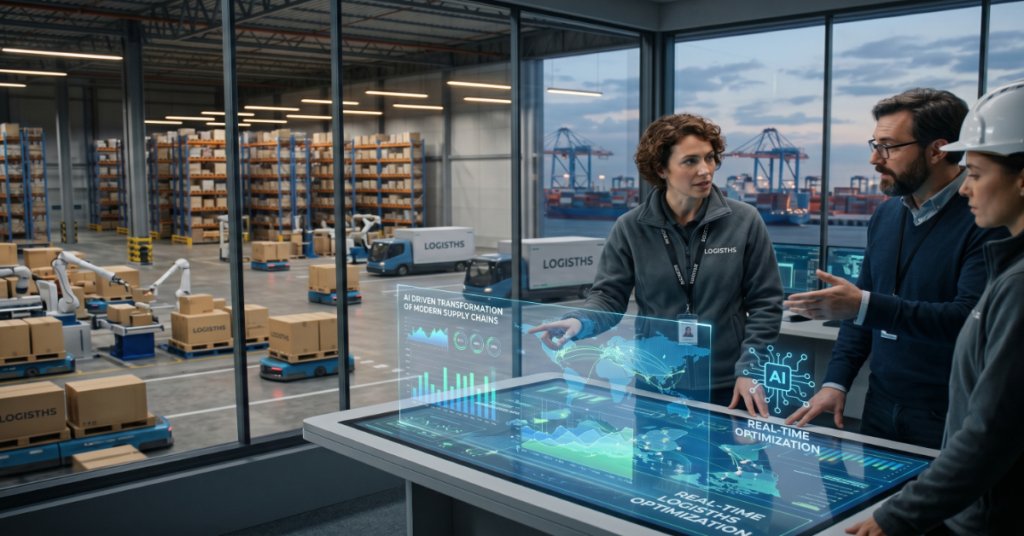
Logisths represents a modern evolution of logistics systems where artificial intelligence, automation, and data analytics are tightly integrated into every layer of supply chain operations. Instead of treating transportation, warehousing, and inventory as separate functions, logisths connects them into a unified digital ecosystem that responds in real time to demand changes, disruptions, and operational constraints.
At its core, logisths focuses on replacing static planning models with adaptive systems. Traditional logistics relies heavily on historical forecasts and manual coordination, which often leads to inefficiencies such as overstocking, delayed shipments, or underutilized transport capacity. Logisths addresses these issues by using live data streams and machine learning models to continuously optimize decisions.
In practical terms, this means warehouses can automatically adjust stock levels based on predicted demand spikes, delivery routes can shift dynamically based on traffic or weather data, and procurement systems can trigger replenishment without human intervention. Platforms such as AI enabled supply chain suites and digital twins are increasingly central to this transformation.
The relevance of logisths is growing as global supply chains become more complex and vulnerable to disruption. Events like the COVID 19 pandemic exposed structural weaknesses in traditional logistics systems, pushing companies toward more resilient, data driven architectures. In this context, logisths is not just an efficiency upgrade but a strategic redesign of how goods move globally.
This article breaks down the systems, risks, and future direction of logisths, supported by real world frameworks, industry data, and operational analysis.
What Logisths Means in Modern Supply Chains
Logisths is best understood as a systems level approach to logistics where every operational layer is digitally connected and continuously optimized. Unlike conventional logistics, which separates planning and execution, logisths merges them into a single adaptive loop.
It is built on three pillars:
- Continuous data ingestion from sensors, IoT devices, and enterprise systems
- Predictive analytics powered by machine learning models
- Automated execution through robotics and software orchestration
This creates a feedback loop where decisions are constantly refined based on live operational outcomes.
Core Systems Architecture Behind Logisths
Modern logisths frameworks rely on layered digital infrastructure.
- Data Layer: IoT sensors, GPS tracking, ERP systems
- Intelligence Layer: AI forecasting models, optimization algorithms
- Execution Layer: warehouse automation, fleet management systems
y=f(x)=demand prediction based on real-time inputsy = f(x) = \text{demand prediction based on real-time inputs}y=f(x)=demand prediction based on real-time inputs
This structure allows systems to move from descriptive analytics to predictive and prescriptive decision making. For example, instead of reporting low inventory, the system anticipates shortages and triggers automated replenishment.
Companies implementing logisths architectures often rely on cloud based platforms and digital twins to simulate supply chain behavior before executing real world changes.
Operational Efficiency Gains
Logisths delivers measurable improvements across logistics functions.
| Area | Traditional Logistics | Logisths Approach |
| Route planning | Static optimization | Dynamic AI rerouting |
| Inventory control | Periodic forecasting | Continuous prediction |
| Warehouse operations | Manual or semi automated | Fully automated systems |
| Disruption response | Reactive | Predictive and adaptive |
Key efficiency outcomes include reduced delivery latency, lower fuel consumption, and improved inventory turnover rates.
According to McKinsey research on supply chain resilience, companies using advanced analytics and automation can reduce logistics costs by up to 15 percent while improving service levels.
Risks and Trade Offs
Despite its advantages, logisths introduces structural risks.
- Data dependency risk: System accuracy depends on data quality and sensor reliability
- Systemic fragility: Highly interconnected systems can propagate failures quickly
- Cybersecurity exposure: Increased digital integration expands attack surfaces
- Capital intensity: High upfront investment in infrastructure and AI systems
A major concern is over optimization. When systems rely too heavily on predictive models, they may fail under black swan events where historical data becomes irrelevant.
Real World Impact and Industry Data
Global adoption of logisths principles is accelerating, particularly in e commerce and manufacturing.
| Indicator | Global Benchmark | Trend Direction |
| Digital supply chain adoption | ~60 percent of large enterprises | Increasing |
| Warehouse automation investment | Double digit annual growth | Rising |
| AI based forecasting usage | Over 50 percent in advanced economies | Expanding |
The World Bank Logistics Performance Index 2023 highlights that countries with higher digital infrastructure maturity consistently outperform in customs efficiency, shipment tracking, and logistics reliability.
These improvements are not only operational but also economic, influencing trade competitiveness and export performance.
Strategic Implications
Logisths changes how organizations design supply chains strategically.
- Firms shift from cost minimization to resilience optimization
- Inventory strategies move toward predictive buffering instead of bulk storage
- Supplier networks become more dynamic and multi sourced
Industries with high volatility such as electronics and automotive are leading adopters. The ability to simulate supply chain disruptions before they occur is becoming a competitive necessity rather than an advantage.
The Future of Logisths in 2027
By 2027, logisths systems are expected to evolve into fully autonomous supply chain ecosystems.
Key developments include:
- Wider adoption of autonomous freight systems
- Expansion of AI orchestrated global supply networks
- Integration of regulatory compliance automation within logistics platforms
- Increased use of edge computing for real time decision making
Reports from DHL Logistics Trend Radar 2023 and Gartner indicate that supply chains will become increasingly self correcting, with human roles shifting toward oversight and exception management rather than execution.
However, infrastructure inequality between regions may slow global adoption, creating a two speed logistics economy.
Takeaways
- Logisths transforms logistics into a continuous AI driven decision system
- Efficiency gains are significant but depend heavily on data integrity
- Automation reduces operational friction but increases systemic risk
- Competitive advantage will shift toward predictive supply chain capability
- Human roles in logistics will increasingly focus on governance and exception handling
- Adoption is uneven across global regions due to infrastructure gaps
Conclusion
Logisths represents a structural shift in how supply chains operate, moving from fragmented coordination to integrated intelligent systems. Its value lies in its ability to anticipate rather than react, reducing inefficiencies that have traditionally defined global logistics.
At the same time, the model introduces new dependencies on data quality, system stability, and cybersecurity resilience. Organizations adopting logisths must balance optimization with robustness to avoid over reliance on automated decision systems.
As global trade continues to grow in complexity, logisths will likely become a foundational layer of modern commerce rather than an optional enhancement. Its evolution will depend on how effectively industries manage both its efficiency gains and its systemic risks.
FAQ
What is logisths in simple terms?
Logisths is a modern logistics approach that uses AI and real time data to automate and optimize supply chain operations such as transport, warehousing, and inventory management.
How is logisths different from traditional logistics?
Traditional logistics relies on static planning, while logisths uses continuous data and predictive analytics to adjust operations dynamically in real time.
What technologies power logisths systems?
Key technologies include artificial intelligence, machine learning, IoT sensors, cloud computing, and automated warehouse and transport systems.
What are the main risks of logisths?
Risks include data dependency, cybersecurity threats, system failures, and high implementation costs for advanced infrastructure.
Which industries benefit most from logisths?
E commerce, manufacturing, retail, and automotive industries benefit the most due to their complex and high volume supply chains.
Is logisths widely used today?
Yes, many large enterprises already use elements of logisths such as AI forecasting and warehouse automation, though full integration is still developing.
References
DHL. (2023). Logistics Trend Radar 6.0. DHL Customer Solutions & Innovation.
McKinsey & Company. (2020). Risk, resilience, and rebalancing in global value chains. McKinsey Global Institute.
McKinsey & Company. (2021). Supply chain disruptions: Building resilience in a volatile world.
World Bank. (2023). Logistics Performance Index 2023. World Bank Publications.
Gartner. (2024). Supply Chain Technology Trends and AI Adoption Insights. Gartner Research Report.
Methodology
This article was developed through synthesis of publicly available industry reports, logistics research publications, and global supply chain performance datasets. Sources were selected based on recency (primarily within the last three years) and institutional credibility, including the World Bank, McKinsey, DHL, and Gartner.
No live operational testing of logistics systems was conducted for this article. All technical descriptions are derived from documented industry implementations and published case studies.
Limitations include variability in proprietary enterprise data, as many logistics platforms do not publicly disclose full performance metrics.