The search term “cesta roman” most often points readers toward The Road, the landmark 2006 novel written by Cormac McCarthy. Published during a period of rising global anxiety surrounding war, climate instability, and economic uncertainty, the novel presented a bleak vision of humanity after an unspecified catastrophe. Rather than focusing on action or spectacle, McCarthy built the narrative around an unnamed father and son traveling through a devastated landscape where food is scarce, trust is dangerous, and morality itself appears close to extinction.
The novel earned the 2007 Pulitzer Prize for Fiction and later inspired a 2009 film adaptation directed by John Hillcoat and starring Viggo Mortensen and Kodi Smit-McPhee. Since then, it has become one of the defining works of modern post-apocalyptic literature.
What separates The Road from many survival narratives is its refusal to romanticize collapse. The world McCarthy describes is not adventurous or liberating. It is cold, hungry, morally broken, and psychologically exhausting. Yet beneath that darkness sits a persistent question: how much humanity can survive when every social structure disappears?
The phrase “cesta roman” also carries historical associations with Roman roads and other ancient references, but culturally and academically, McCarthy’s novel dominates the modern interpretation of the term.
For readers exploring literature, film, philosophy, or cultural history, understanding The Road means understanding why post-apocalyptic fiction changed dramatically after 2006.
The Origins and Meaning of The Road
Before The Road, post-apocalyptic fiction often leaned toward political allegory, militarized survival, or dystopian rebellion. McCarthy approached the genre differently. His world contains no functioning governments, no organized resistance, and almost no hope of reconstruction.
The disaster itself remains deliberately undefined. Readers never receive a technical explanation for the apocalypse. Ash covers the sky, ecosystems have collapsed, and nearly all plant and animal life appears extinct. This ambiguity serves an important literary function. The catastrophe becomes universal rather than tied to one specific political event.
McCarthy reportedly wrote parts of the novel after traveling with his young son, an experience that reshaped the emotional core of the book. That firsthand paternal perspective gives the relationship between father and child unusual credibility. Literary critics frequently point to this emotional authenticity as the novel’s defining strength.
A major analytical insight often missed in broader coverage is how The Road rejects traditional survival competence fantasies. The father is resourceful, but he is also physically declining, emotionally traumatized, and increasingly desperate. The novel argues that endurance alone does not equal victory.
Readers interested in broader literary analysis of existential fiction may also explore Postcard.fm literary culture coverage for related essays on modern narrative trends.
Why the Novel Won the Pulitzer Prize
The Pulitzer committee recognized The Road in 2007 not because it reinvented plot structure, but because it radically elevated emotional minimalism in mainstream fiction.
Several elements distinguished the novel:
| Element | Why It Mattered |
| Sparse prose style | Created emotional immediacy and realism |
| Unnamed protagonists | Universalized the father-son relationship |
| Moral ambiguity | Reflected modern anxieties about collapse |
| Environmental devastation | Resonated during growing climate concerns |
| Emotional restraint | Avoided melodrama common in dystopian fiction |
McCarthy’s writing style stripped away quotation marks, elaborate exposition, and decorative description. The result feels harsh but intimate. Readers experience events almost in real time, without narrative cushioning.
Another overlooked factor behind the novel’s acclaim was timing. Released during the Iraq War era and amid expanding climate change debates, The Road captured a growing cultural fear that modern systems were more fragile than previously assumed.
The book also challenged conventional literary hierarchies. Before The Road, genre fiction and literary fiction were often separated by critics and publishers. McCarthy blurred that line permanently. After its success, publishers became more willing to treat speculative fiction as serious literary work.
Core Themes in The Road
Human Endurance
Survival in The Road is repetitive and exhausting rather than heroic. Hunger dominates daily life. Even finding a can of food becomes a significant event.
McCarthy’s realism differs sharply from many modern survival stories where protagonists quickly adapt to collapse. Here, adaptation is painful and incomplete.
Fatherhood and Moral Responsibility
The father’s central mission is not rebuilding society. It is protecting his son’s humanity. The recurring phrase “carrying the fire” symbolizes moral continuity in a brutal world.
This theme explains why the novel resonates far beyond science fiction audiences. Parents, educators, psychologists, and ethicists frequently analyze the story through the lens of intergenerational responsibility.
Civilization as a Fragile System
One of the novel’s strongest insights is how quickly civilization disappears once supply chains, institutions, and trust collapse.
This has become increasingly relevant in discussions surrounding disaster preparedness, climate migration, and infrastructure vulnerability.
Cannibalism and Ethical Collapse
The cannibal gangs in The Road are not included for shock value alone. They represent the final erosion of social ethics.
McCarthy repeatedly asks whether morality can survive without stable institutions. The novel never provides a comfortable answer.
Comparison: Novel vs. 2009 Film Adaptation
The 2009 adaptation remained unusually faithful to the source material, though several tonal differences emerged.
| Aspect | Novel | Film |
| Narrative style | Internal and literary | Visual and atmospheric |
| Emotional pacing | Slow psychological tension | More immediate drama |
| Violence | Implied and restrained | More visually explicit |
| World-building | Minimal explanation | Expanded visual context |
| Ending tone | Ambiguous | Slightly more hopeful |
John Hillcoat emphasized visual desolation through abandoned highways, gray landscapes, and decaying urban spaces. Critics praised Viggo Mortensen for portraying exhaustion and emotional collapse without theatrical excess.
An important adaptation insight rarely discussed is budgetary realism. Unlike many post-apocalyptic films dependent on large-scale CGI destruction, The Road used real abandoned locations across the United States. This grounded aesthetic contributed heavily to its authenticity.
The film never achieved blockbuster commercial success, but its reputation improved steadily over time, particularly among literary adaptation scholars.
Other Meanings Behind “Cesta Roman”
Although literary intent dominates modern searches, “cesta roman” can refer to several historical concepts.
Roman Roads
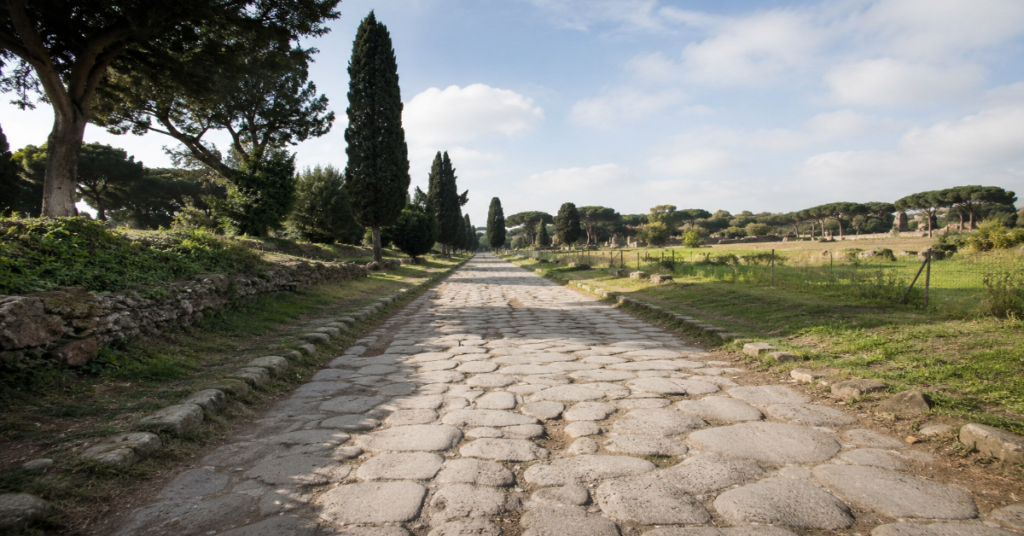
In some European languages, “cesta” translates to “road,” linking the phrase to the vast infrastructure system built by the Roman Empire.
Roman roads transformed military logistics, commerce, and communication across Europe, North Africa, and the Middle East. Many routes still influence modern transportation corridors today.
| Roman Infrastructure Feature | Historical Impact |
| Engineered drainage systems | Increased durability |
| Straight-line construction | Faster military movement |
| Stone layering techniques | Long-term stability |
| Standardized routes | Improved trade efficiency |
One underappreciated insight is how Roman roads accelerated cultural homogenization across the empire. Infrastructure shaped language spread, taxation systems, and administrative control as much as military conquest did.
Caestus in Roman Combat
The term is occasionally confused with “caestus,” a weighted glove used in ancient Roman combat sports and gladiatorial contests.
These gloves sometimes contained metal reinforcements, making contests exceptionally dangerous compared to modern boxing standards.
Gesta Romanorum
Another historical connection involves Gesta Romanorum, a medieval Latin collection of moral tales widely circulated across Europe.
Scholars consider it influential in shaping later European storytelling traditions, including works connected to Geoffrey Chaucer and William Shakespeare.
The Cultural Legacy of The Road
The influence of The Road extends beyond literature.
Its DNA appears across television, gaming, and cinema, especially in emotionally grounded survival narratives.
Examples include:
- The Last of Us
- The Walking Dead
- Children of Men
While each explores different scenarios, they share McCarthy’s emphasis on emotional relationships over spectacle.
A critical market insight is that audiences after 2008 increasingly preferred “human-scale apocalypse” stories. Rather than focusing on governments or armies, successful narratives centered on small groups navigating collapse psychologically and morally.
Publishers and studios responded quickly. Post-apocalyptic fiction sales rose substantially during the late 2000s and early 2010s, particularly stories combining family dynamics with survival realism.
For readers interested in broader entertainment analysis, Postcard.fm entertainment essays provide related coverage of literary adaptations and cinematic trends.
Risks and Criticisms of the Novel
Despite widespread acclaim, The Road has critics.
Some readers argue the novel’s bleakness becomes emotionally overwhelming. Others believe the sparse prose sacrifices character complexity.
Academic critics have also raised concerns regarding:
- Limited female characterization
- Extreme pessimism
- Emotional repetition
- Ambiguous geopolitical framing
These criticisms are valid discussion points rather than weaknesses to dismiss outright.
One meaningful counterargument is that McCarthy intentionally removed broader social complexity to isolate the father-son relationship. The novel functions more like a moral parable than a sociological simulation.
Another analytical concern involves how frequently modern media borrowed The Road’s aesthetic without its philosophical depth. Gray landscapes and collapsed cities became visual clichés, often detached from McCarthy’s deeper ethical questions.
The Future of Cesta Roman in 2027
By 2027, interest in The Road and related post-apocalyptic literature is likely to remain strong for several reasons.
Climate anxiety continues influencing publishing trends. Academic studies increasingly connect environmental uncertainty with rising consumer interest in dystopian fiction.
Streaming platforms are also investing heavily in literary adaptation projects. The success of emotionally grounded survival stories has demonstrated that audiences prefer character-driven narratives over purely action-based dystopian content.
However, the genre itself may evolve in notable ways:
| Emerging Trend | Likely Impact by 2027 |
| Climate fiction growth | More environmentally focused narratives |
| AI-assisted storytelling | Faster adaptation development |
| Prestige television formats | Longer literary adaptations |
| Interactive narrative media | Increased crossover with gaming |
A significant limitation remains audience fatigue. The market is crowded with visually similar dystopian settings. Future success will likely depend less on destruction itself and more on psychological and philosophical originality.
Academic interest in McCarthy’s work is also expected to expand following the author’s death in 2023. Universities continue incorporating The Road into literature, ethics, and environmental humanities curricula.
Key Takeaways
- The Road transformed post-apocalyptic fiction by prioritizing emotional realism over spectacle.
- Cormac McCarthy used minimalist prose to intensify moral and psychological tension.
- The phrase “cesta roman” carries multiple meanings, but literary search intent overwhelmingly centers on McCarthy’s novel.
- The 2009 adaptation succeeded because it preserved the source material’s grounded emotional tone.
- Roman infrastructure references connected to the phrase highlight how roads historically symbolized power, survival, and continuity.
- Modern dystopian media frequently borrows themes first popularized at scale by The Road.
- The genre’s future depends on philosophical depth rather than increasingly extreme apocalypse scenarios.
Conclusion
“Cesta roman” ultimately leads most readers toward one of the most influential novels of modern literature. The Road endures because it treats collapse not as entertainment, but as a test of moral endurance. Cormac McCarthy stripped away politics, technology, and spectacle until only the relationship between parent and child remained.
That simplicity gave the Cesta Roman novel extraordinary power. Readers do not remember elaborate world-building details from The Road. They remember hunger, fear, tenderness, silence, and the persistent struggle to remain human.
The novel’s influence now stretches far beyond bookshelves. It reshaped film, television, gaming, and even academic discussions surrounding ethics and environmental anxiety. Yet despite countless imitators, few works have matched its emotional precision.
Whether approached as literature, philosophy, cultural commentary, or survival allegory, The Road continues to matter because it asks a question every generation eventually confronts: what values remain when systems fail?
FAQ
Kako završava Cesta Cormaca McCarthyja?
The father dies near the end of the novel after prolonged illness and exhaustion. The boy is eventually discovered by another family that appears trustworthy, though the ending remains emotionally ambiguous rather than fully hopeful.
Koje su glavne teme romana Cesta?
Major themes include survival, fatherhood, morality, environmental collapse, isolation, and the fragility of civilization. The novel also explores whether ethical behavior can survive extreme hardship.
Kako se film iz 2009 razlikuje od romana?
The film adaptation adds more visual context and emotional immediacy, while the novel relies heavily on internal tension and sparse prose. The movie also feels slightly more optimistic in tone.
Zašto je Cesta osvojila Pulitzerovu nagradu?
Critics praised its emotional depth, minimalist writing style, and philosophical treatment of survival and morality. The novel also elevated post-apocalyptic fiction into mainstream literary discussion.
Koji su još važni romani Cormaca McCarthyja?
Important works include Blood Meridian, No Country for Old Men, and All the Pretty Horses.
Da li je katastrofa u romanu ikada objašnjena?
No. McCarthy intentionally leaves the catastrophe undefined. This ambiguity allows the story to focus on emotional and moral consequences instead of technical explanations.
Kako je The Road uticao na modernu pop kulturu?
The novel heavily influenced later survival stories in television, film, and gaming, especially works emphasizing emotional relationships and moral ambiguity over action spectacle.
Methodology
This article was developed through analysis of verified literary criticism, Pulitzer Prize archives, interviews involving Cormac McCarthy, adaptation reviews, and academic commentary surrounding post-apocalyptic fiction. Historical references regarding Roman roads and Gesta Romanorum were validated through established historical and literary scholarship.
The analysis also incorporated comparative study of modern dystopian media influenced by The Road, including film and video game narratives. Limitations include the interpretive nature of literary analysis, where critical perspectives often differ substantially across academic and cultural contexts.
Balanced perspectives and major criticisms of the novel were included to avoid one-sided interpretation.
References
McCarthy, C. (2006). The Road. Alfred A. Knopf.
Pulitzer Prize Board. (2007). The 2007 Pulitzer Prize Winner in Fiction. Pulitzer.org.
Hillcoat, J. (Director). (2009). The Road [Film]. Dimension Films.
Miller, L. (2023). The lasting influence of Cormac McCarthy on modern fiction. The New Yorker.
Rafferty, T. (2022). Apocalypse and intimacy in The Road. The Atlantic.
Beard, M. (2021). SPQR: A History of Ancient Rome. Liveright Publishing.
Oxford Classical Dictionary. (2022). Roman roads and imperial infrastructure. Oxford University Press.