Neatlanta is best understood as a cultural shorthand for Atlanta’s contemporary evolution. It describes the city as it feels now: historically rooted, fast-growing, visually expressive and increasingly shaped by new patterns of work, food, art, housing and public space.
The term is not a formal planning category. City Hall does not use it as an official policy label. Still, it captures something useful. Atlanta is no longer only the capital of Georgia, the home of major corporations or the symbolic center of modern Black political and cultural power. It is also a city negotiating the consequences of success.
Metro Atlanta continues to grow. The Atlanta Regional Commission reported that the 11-county region reached about 5.22 million residents in 2024 after adding 62,700 people in one year. The same agency projects the larger 21-county region could add 1.8 million people by 2050, reaching roughly 7.9 million residents.
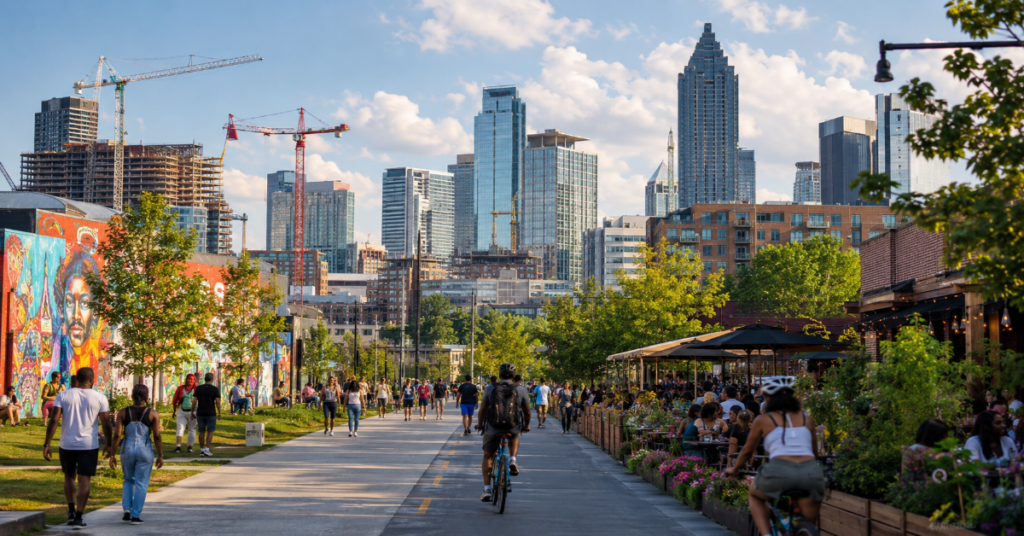
That growth is visible in new apartments, trail corridors, restaurant districts, creative workspaces and street-level art. It is also visible in traffic, rising rents, contested development and anxiety about who gets to remain in the neighborhoods being celebrated.
This is why Neatlanta matters. It is not just a catchy name. It is a way to examine Atlanta’s identity at a turning point.
What Neatlanta Means
Neatlanta combines two ideas: Atlanta as a place of legacy and Atlanta as a place in motion.
The legacy side includes the city’s civil rights history, historically Black colleges and universities, music influence, Southern food traditions, sports culture and long-standing neighborhood identities. The future-facing side includes the BeltLine, mixed-use development, film production, startup activity, modern restaurants, adaptive reuse and cultural branding around creativity.
That blend is what gives the term its usefulness. It does not describe one neighborhood or one industry. It describes an urban mood.
A practical definition would be:
Neatlanta is the emerging identity of Atlanta as a city where history, creative culture, urban redevelopment, technology and lifestyle-driven neighborhood change increasingly overlap.
That definition matters because it avoids reducing the city to either nostalgia or hype. Atlanta is not simply “old South meets new tech.” It is more complex than that. The city’s contemporary story is shaped by migration, Black cultural power, infrastructure strain, corporate investment, food diversity, public art and the politics of land.
Atlanta’s Growth Is the Foundation
The Neatlanta idea would not exist without growth.
Population growth changes how a city looks, moves and talks about itself. More residents mean more housing demand, more restaurant openings, more transit pressure, more cultural mixing and more conflict over land use.
Metro Atlanta’s growth is not only a city story. It is regional. The Atlanta Regional Commission’s 2024 estimate placed the 11-county region at 5,221,074 residents. The broader 21-county forecast points toward 7.9 million residents by 2050.
| Growth Indicator | Latest Reported Figure | Why It Matters |
| 11-county Atlanta region population, 2024 | 5,221,074 | Shows current regional scale |
| Added residents, April 2023 to April 2024 | 62,700 | Confirms continued growth |
| 21-county projected population by 2050 | 7.9 million | Signals long-term planning pressure |
| Projected new residents by 2050 | 1.8 million | Explains housing, transit and infrastructure urgency |
The practical implication is direct: Atlanta’s identity is being reshaped by scale. A city can feel creative and energetic when growth is manageable. It can feel fragmented when growth outruns housing, transportation and public services.
That tension sits at the center of Neatlanta.
The BeltLine as the Most Visible Symbol
No project represents Atlanta’s reinvention more clearly than the Atlanta BeltLine.
The BeltLine is a 22-mile loop of trails, parks, transit ambition, public art and redevelopment built around former rail corridors. Its influence reaches beyond recreation. It has changed how residents imagine movement, neighborhood access and urban life in a historically car-dependent region.
In 2024, Atlanta BeltLine Inc. reported that 85% of the 22-mile mainline trail was either complete or under construction. The project has also tied its public-space mission to affordable housing goals, reporting progress toward creating or preserving 5,600 affordable housing units by 2030.
| Neatlanta Element | BeltLine Example | Benefit | Trade-Off |
| Public space | Trails and parks | More walkable civic life | Uneven access across neighborhoods |
| Culture | Murals and installations | Outdoor creative identity | Art can become branding for real estate |
| Housing | Affordable housing targets | Some anti-displacement protection | Demand still pushes prices up |
| Mobility | Trail connectivity | Alternatives to driving | Transit vision remains incomplete |
| Economic activity | Restaurants, retail and offices | Local business growth | Higher commercial rents |
The BeltLine shows both the promise and the problem. It has made Atlanta feel more connected, visual and pedestrian-friendly. It has also intensified concerns about displacement in communities near the corridor.
That is one of the most important insights for this article: Neatlanta is not only an aesthetic. It is a land-use story.
Public Art and Street-Level Identity
Atlanta’s contemporary identity is unusually visual.
Murals, bridge paintings, trail installations and public art corridors turn everyday infrastructure into cultural messaging. Along the BeltLine, especially, public art gives redevelopment a human texture. It tells visitors that Atlanta’s transformation is not only about buildings, but about expression.
This matters because public art changes how people emotionally read a city. A blank underpass says neglect. A painted underpass says someone cared enough to mark the space. That does not solve inequality, but it changes the public realm.
The risk is that art can be used as a softener for displacement. Murals can make a neighborhood feel vibrant just as long-time residents are priced out. A serious reading of Neatlanta has to hold both truths: public art is a real cultural asset and it can also become a marketing layer for speculative development.
Food Culture as a Civic Signal
Atlanta’s food scene has become one of the strongest signals of its new identity.
The city’s dining culture is not limited to traditional Southern food. It now stretches across Korean barbecue, Chinese dim sum, Mexican restaurants, vegan kitchens, fine dining, barbecue, soul food, Caribbean food, coffee shops, breweries and chef-driven neighborhood restaurants. Eater’s 2026 Atlanta dining guide describes a broad culinary landscape across areas such as Buford Highway, Decatur, Inman Park, West Midtown, Old Fourth Ward and Summerhill.
The Michelin Guide has also increased national attention on Atlanta’s restaurant scene. Its official Atlanta listings include starred restaurants, Bib Gourmand selections and inspector-reviewed restaurants.
Food matters here because it reveals migration, entrepreneurship and neighborhood change. Restaurants are often among the first businesses to define a district’s new reputation. They can preserve cultural memory, introduce new communities and attract investment. They can also become early indicators of rising rents.
A strong Neatlanta food story is not simply “Atlanta has great restaurants.” The better insight is that food is one of the city’s most visible negotiation points between authenticity, tourism, local identity and commercial reinvention.
Technology, Business and the Airport Economy
Atlanta’s reinvention is also economic.
The city has long been a logistics and corporate hub. Hartsfield-Jackson Atlanta International Airport remains one of the most important assets in the region’s economy. Airports Council International data cited by the airport in 2024 again recognized ATL as the world’s busiest airport by passenger traffic and aircraft movements for 2023.
That airport role feeds corporate travel, conventions, logistics, hospitality and global connectivity. It also supports Atlanta’s appeal to companies that need access to national and international markets.
The Metro Atlanta Chamber’s 2024 regional profile described the 29-county metro area as home to more than 6.2 million people and noted the region’s major population increase among U.S. metro areas.
Technology fits into this because Atlanta’s economy is not trying to copy Silicon Valley exactly. Its advantage is more hybrid: logistics, fintech, media, health, education, film, enterprise software and corporate operations. That mix gives the city resilience, but it also creates uneven opportunity. High-growth jobs do not automatically translate into affordability or mobility for service workers, artists and long-time residents.
Risks and Trade-Offs
The strongest version of Neatlanta is inclusive, walkable, creative and economically dynamic. The weakest version is polished branding over unresolved inequality.
The risks are clear.
First, housing affordability remains the central pressure point. BeltLine housing progress is real, but regional demand is larger than any single corridor can solve. In 2026, Atlanta BeltLine Inc. reported reaching 79% of its 5,600-unit affordable housing goal, with 4,425 units created or preserved to date. That is meaningful progress, but the wider region still faces a much larger housing challenge.
Second, mobility remains uneven. Trails improve quality of life, but they do not replace a comprehensive transit system. Atlanta’s car dependence still shapes commute times, household costs and access to jobs.
Third, cultural branding can flatten real communities. Neighborhoods become easier to market when their history is simplified into murals, restaurants and nightlife. That can make the city more attractive to visitors while making it less legible to the people who built its identity.
Fourth, growth can create a two-speed city: one Atlanta of new apartments, airport connectivity and creative amenities, and another Atlanta dealing with rent burden, transit gaps and school inequality.
Comparison: Old Atlanta, New Atlanta and Neatlanta
| Lens | Old Atlanta | New Atlanta | Neatlanta |
| Core identity | Civil rights legacy, Southern capital, corporate city | Growth hub, film city, restaurant city, tech market | Blended identity linking history, culture and reinvention |
| Urban form | Car-centered, downtown and neighborhood nodes | Mixed-use districts, trails, adaptive reuse | Walkability as lifestyle and branding |
| Cultural expression | Music, churches, HBCUs, sports, legacy institutions | Murals, festivals, film, digital creators, culinary scenes | Public culture as part of everyday city experience |
| Main opportunity | Regional influence | National visibility | A more complete civic identity |
| Main risk | Underinvestment and segregation | Displacement and affordability pressure | Turning real culture into surface-level branding |
This comparison shows why the term is useful. Neatlanta is not a replacement for Atlanta’s history. It is a way to describe the current layering of that history with contemporary redevelopment.
The Future of Neatlanta in 2027
By 2027, Neatlanta will likely be shaped by three measurable forces: housing delivery, public-space completion and event-driven visibility.
The BeltLine will remain central. With the mainline trail already largely complete or under construction as of 2024, the next phase will depend on whether trail expansion is matched by affordability, transit planning and equitable commercial development.
Regional population pressure will also remain. ARC’s 2050 forecast gives local governments a clear warning: Atlanta’s future depends on preparing for millions more residents across the region, not only inside the city limits.
The 2026 FIFA World Cup will likely leave a short-term visibility effect, especially around downtown, hospitality, airport movement and global media attention. The official City of Atlanta site has already highlighted ATL26 Human Rights Legacy Initiatives ahead of the tournament.
By 2027, the key question will not be whether Atlanta is growing. It will be whether Atlanta can make growth feel civic rather than extractive. If housing, mobility and public space advance together, Neatlanta may become a useful description of a maturing city. If not, it may become another lifestyle label that hides unequal outcomes.
Takeaways
- Neatlanta works best as a cultural lens, not as an official definition.
- Atlanta’s growth is real, regional and long-term, which makes planning discipline essential.
- The BeltLine is the clearest symbol of the city’s transformation because it combines trails, art, housing and development pressure.
- Food and public art are not side stories. They are central to how residents and visitors experience the city’s identity.
- Technology and airport connectivity strengthen Atlanta’s economy, but they do not automatically solve affordability.
- The city’s future credibility depends on whether reinvention protects the people and neighborhoods that made Atlanta culturally powerful.
- By 2027, the strongest measure of progress will be balance: growth plus access, creativity plus permanence, visibility plus equity.
Conclusion
Neatlanta is an unofficial word for a very real transition. It captures the Atlanta people see in murals, restaurants, BeltLine walks, startup offices, airport connections and fast-changing neighborhoods. But the term only has value if it stays honest about the pressure underneath the style.
Atlanta’s contemporary identity is not being built by one project, one mayor, one restaurant district or one creative class. It is being built through overlapping systems: population growth, housing policy, culture, mobility, business investment and neighborhood memory.
The city’s opportunity is significant. Few American cities combine Atlanta’s civil rights legacy, Black cultural influence, corporate base, airport connectivity, food scene and creative energy. The challenge is just as serious. If growth weakens affordability and displaces the communities that gave Atlanta its identity, the Neatlanta story becomes thinner.
At its best, Neatlanta is not a slogan. It is a test of whether Atlanta can evolve without losing itself.
FAQ
What does Neatlanta mean?
Neatlanta refers to Atlanta’s emerging contemporary identity, blending historic culture, urban growth, public art, food, technology and neighborhood reinvention. It is not an official government term, but it describes how many people experience the city’s current transformation.
Is Neatlanta an official name for Atlanta?
No. Neatlanta is not an official name used by the City of Atlanta or regional planning agencies. It is better understood as a cultural or editorial term that captures Atlanta’s modern evolution.
Why is the BeltLine important to Neatlanta?
The BeltLine is important because it combines many parts of Atlanta’s transformation: trails, public art, redevelopment, housing goals, parks and neighborhood connectivity. It is one of the clearest physical examples of the city’s changing identity.
Is Neatlanta mostly about real estate?
No. Real estate is part of the story, but the concept is broader. It includes lifestyle, culture, food, public space, technology, art and civic identity. The risk is that real estate marketing can sometimes oversimplify those deeper cultural layers.
How does Atlanta’s food scene fit into Neatlanta?
Food reflects Atlanta’s diversity, migration, entrepreneurship and changing neighborhoods. From fine dining to Buford Highway restaurants and soul food institutions, the dining scene shows how old and new Atlanta overlap.
What are the biggest risks behind Neatlanta?
The biggest risks are housing unaffordability, displacement, traffic, uneven transit access and cultural branding that benefits developers more than residents. A credible Neatlanta story has to address those trade-offs directly.
Will Neatlanta still matter in 2027?
Yes, if the term continues to describe real urban change rather than surface-level branding. By 2027, its relevance will depend on housing outcomes, BeltLine progress, cultural investment and whether growth remains accessible.
Methodology
This article was drafted from the supplied Postcard.fm production brief, which defined the core keyword, keyword detail, structure, E-E-A-T requirements, FAQ requirements, visual strategy and metadata rules.
Public claims were checked against sources including the Atlanta Regional Commission, Atlanta BeltLine, City of Atlanta, Michelin Guide, Discover Atlanta, Metro Atlanta Chamber and airport-related reporting. Population figures, BeltLine progress, affordable housing goals and restaurant recognition were included only where current public sources supported them.
Limitations: Neatlanta is not an official civic term, so the article treats it as an emerging cultural concept rather than a formally defined urban planning category. Internal Postcard.fm links were identified through public search, but a site editor should verify final live URLs before publication. A human editor should also confirm all citations, update time-sensitive numbers and add any genuine firsthand reporting before publishing.
References
Atlanta BeltLine. (2025, March 27). Now available: Atlanta BeltLine, Inc.’s 2024 annual report.
Atlanta BeltLine. (2026, April 2). Atlanta BeltLine surpasses nearly 80 percent of affordable housing goal.
Atlanta Regional Commission. (2024, July 10). ARC 2024 population estimates show Atlanta region adds 62,700 residents in past year.
Atlanta Regional Commission. (n.d.). Population and employment forecasts.
City of Atlanta. (n.d.). Official website of the City of Atlanta.
Eater Atlanta. (2026). An eater’s guide to dining and drinking around Atlanta.
Hartsfield-Jackson Atlanta International Airport. (2024, July 17). Hartsfield-Jackson remains world’s busiest airport.
Michelin Guide. (n.d.). Atlanta Michelin restaurants.
Metro Atlanta Chamber. (2024). Metro Atlanta profile.