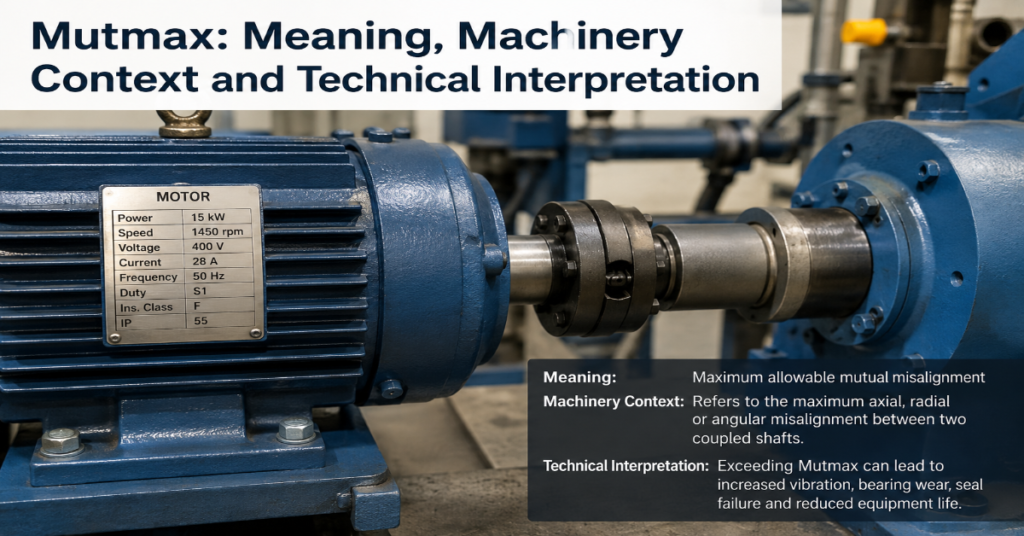
Mutmax is a search term with more than one meaning. For many users, it points toward Mutmax Makina, a Turkish woodworking and furniture machinery business associated with Bursa and CNC wood processing equipment. For others, it appears to function as shorthand around maximum matching, maximal matching or mutual matching concepts used in algorithmic discussions.
That split matters because the same word can lead readers into very different information paths. A workshop owner may be looking for equipment, service details, cutting machines or CNC woodworking tools. A student or developer may be trying to understand text segmentation, graph matching or dictionary-based tokenization. Search engines do not always know which intent comes first.
The available public record supports the machinery meaning more clearly. Makina Türkiye lists Mutmax Makine Ahşap İşleme Makinaları as a manufacturer and seller connected to woodworking machinery, drilling and screwing machines, cutting machines, copy wood lathes, sanding machines and sizing machinery. It also lists the company’s founding year as 2009 and places it in Bursa, Turkey.
The technical meaning is less brand-specific. In computer science and natural language processing, related terms such as maximum matching, maximal matching, bidirectional maximal matching and MaxMatch describe rule-based or graph-based matching approaches. These are real concepts, but “mutmax” is not a widely standardized academic term. That is the core problem this article solves: it separates the industrial meaning from the technical interpretation and explains how to read the term accurately.
For context, Postcard.fm has covered similar cases where search variants create confusion around technology, brands or digital language, including articles on company homepage lookup systems and Turkish digital text handling. (Postcard)
What Mutmax Means in Search
The simplest definition is this: mutmax is a mixed-intent term.
It can mean:
| Interpretation | Likely Searcher | What They Want | Confidence |
| Mutmax Makina | Industrial buyers, machinery researchers | Woodworking machinery, CNC equipment, supplier details | High |
| Maximum or maximal matching | Students, developers, NLP readers | Algorithm explanation, segmentation logic, matching theory | Medium |
| Mutual maximum matching | Technical readers using informal shorthand | A bidirectional or reciprocal matching idea | Low to medium |
| Undefined brand-like term | General users | Meaning, origin, credibility, safety | Medium |
The machinery meaning is easier to verify because business directory and mapping sources identify Mutmax as an industrial entity in Bursa. Yandex Maps lists Mutmax Ahşap İşleme Makinaları in Bursa’s Yıldırım district and identifies it as a machinery engineering firm, with a listed phone number and web reference.
The technical meaning requires more care. “Maximum matching” and “maximal matching” are established terms, but they are not identical in every context. In graph theory, a maximum matching is the largest possible matching by size. A maximal matching is one where no more edges can be added without breaking the matching property. In word segmentation, “maximal matching” often refers to a greedy longest-match method that checks a vocabulary and selects the longest token candidate. The U.S. Naval Academy’s MaxMatch lab describes it as a greedy segmentation approach requiring access to a vocabulary.
Mutmax as a Machinery Term
The strongest documented meaning is industrial. Makina Türkiye describes Mutmax Makine as a company founded in Bursa in 2009 and active in woodworking machinery, CNC wood processing machines and furniture machinery. The same source frames the business around quality, performance, efficiency and economy.
That places the term inside a practical manufacturing context. Buyers searching for it may be trying to compare machines, locate the supplier, check after-sales service or confirm whether a product is suitable for workshops producing doors, panels, furniture parts, wooden profiles or custom components.
Machinery categories connected to the term
| Machinery Area | Practical Use | Buyer Concern |
| CNC wood processing | Automated cutting, routing, shaping | Precision, software compatibility, maintenance |
| Wood cutting machines | Panel sizing, timber cutting, workshop throughput | Blade stability, safety features, dust control |
| Copy wood lathes | Repeated turning of similar wooden parts | Repeatability, operator skill, setup time |
| Sanding machines | Surface preparation and finishing | Consistency, dust extraction, abrasive cost |
| Drilling and screwing machines | Assembly and furniture production | Alignment accuracy, cycle time, service access |
The important insight is that “Mutmax Makina” should be evaluated like any machinery supplier, not like a consumer brand. Industrial purchasing depends on spare parts availability, safety documentation, warranty clarity, operator training and service response time. A cheaper machine can become expensive if it increases downtime or lacks local technical support.
How to Verify the Machinery Meaning
A serious buyer should avoid relying only on search snippets. The public footprint suggests a real machinery business, but procurement needs direct verification.
Start with three checks:
- Confirm the legal business identity, address and tax or registration details.
- Request product manuals, machine specifications and warranty terms before payment.
- Ask for references from workshops using the same model under similar production loads.
Makina Türkiye lists the firm as a manufacturer, exporter, wholesaler, retailer and after-sales service provider. That is useful, but it should still be verified directly before purchase.
The strongest practical test is not whether a machine looks impressive in photos. It is whether the seller can document spindle power, motor configuration, PLC system, working dimensions, safety guards, emergency stop design, dust extraction requirements, electrical standards and service procedures.
Mutmax as a Technical Term
The technical side is more complicated. Searches around mutmax may lead to topics such as maximum matching, maximal matching and bidirectional maximal matching.
In natural language processing, dictionary-based segmentation is used when text does not contain clear word boundaries or when hashtags and compound strings need to be split. The MaxMatch approach checks candidate substrings against a vocabulary and picks a longest valid match. The U.S. Naval Academy describes Maximum Matching as a greedy segmentation algorithm that requires a target-language vocabulary.
Bidirectional maximal matching takes that idea further by comparing forward and backward segmentation. A 2022 paper on Khmer word segmentation describes BiMM as a combination of forward maximal matching and backward maximal matching, used to improve segmentation where word boundaries are difficult.
A 2025 study on dictionary-based word segmentation also discusses forward maximum matching, backward maximum matching and bidirectional maximum matching, while highlighting how Trie and Double-Array Trie structures can improve segmentation efficiency.
Technical comparison table
| Term | Meaning | Common Domain | Risk of Confusion |
| Maximum matching | Largest matching by size | Graph theory, optimization | Can be confused with maximal matching |
| Maximal matching | Cannot be extended by adding another valid match | Graph theory, NLP naming variants | May not be size-optimal |
| MaxMatch | Greedy longest-match segmentation | NLP, tokenization, hashtag splitting | Depends heavily on vocabulary |
| Bidirectional maximal matching | Forward and backward longest-match comparison | Word segmentation | Still rule-based and dictionary-limited |
| Mutual maximum matching | Informal phrase, not consistently standardized | Search shorthand, discussions | Needs context before use |
The key editorial position is simple: do not treat “mutmax” as a formal algorithm name unless a source defines it that way. Use the precise term required by the discipline.
Why the Confusion Exists
Search confusion often happens when a term is short, brand-like and semantically flexible. Mutmax looks like a company name, but it also resembles a compressed technical phrase. That gives it three traits search engines find difficult:
| Factor | Effect on Search Results |
| Short spelling | Few contextual clues for ranking |
| Brand-like form | Search may prioritize company or directory pages |
| Technical similarity | Algorithm pages may appear nearby |
| Regional language context | Turkish business pages may compete with English explainers |
| Low mainstream coverage | Thin or duplicated pages can rank easily |
This is not unusual. Postcard.fm’s article on “ğş” shows how language, search systems and character handling can distort meaning when users type variants, abbreviations or non-standard forms. (Postcard)
The same pattern applies here. When a term is not anchored by a dominant official source, the meaning gets shaped by user behavior. Search volume creates content demand, content demand creates explainers and explainers can reinforce ambiguity unless they separate verified facts from interpretation.
Strategic Implications
For industrial buyers, the implication is risk management. A search result is not a procurement file. Machinery purchases affect production capacity, safety, labor efficiency and maintenance cost. Before engaging any supplier, buyers should request written specifications and verify whether the machine matches their workshop’s voltage, floor space, dust collection setup and operator skill level.
For technical readers, the implication is terminology discipline. A student writing about maximum matching should not casually use mutmax unless their instructor, codebase or paper defines it. The safer approach is to write “maximum matching,” “maximal matching,” “MaxMatch” or “bidirectional maximal matching” depending on the exact method.
For publishers, the implication is editorial clarity. An article about this keyword should serve both intents but not blend them into one vague definition. That is where many search-driven explainers fail.
Risks and Trade-Offs
There are three main risks.
First, supplier confusion. If users assume every result refers to the same company, they may contact the wrong source, compare unrelated machinery or rely on incomplete directory data.
Second, technical mislabeling. In algorithms, small wording differences matter. Maximum matching and maximal matching are not interchangeable in graph theory. In NLP, greedy longest matching can be fast and simple, but it can fail when the dictionary is incomplete or when several segmentations appear equally valid.
Third, SEO overproduction. When a rising keyword has unclear meaning, low-quality pages often repeat the same claims without verification. This makes the search result page look more confident than the evidence actually supports.
Data Insight: What Each User Should Check
| User Type | Best Next Step | Evidence Needed |
| Machinery buyer | Contact supplier directly | Product manuals, warranty, service details |
| Workshop owner | Compare production requirements | Cycle time, safety, maintenance cost |
| Student | Use formal algorithm terminology | Course notes, papers, documentation |
| Developer | Check code or library definition | Function behavior, vocabulary format |
| Publisher | Separate meanings clearly | Source citations, uncertainty notes |
The practical insight is that “meaning” is not enough. The next action changes based on the searcher. A buyer needs due diligence. A developer needs definitions. A publisher needs evidence.
The Future of Mutmax in 2027
By 2027, the term will likely become more polarized rather than fully unified.
On the industrial side, Turkish manufacturing and export-oriented machinery businesses will continue competing for visibility as buyers search across directories, social platforms and maps. The public data already shows Mutmax Makina appearing across business directory and mapping contexts, which suggests discoverability matters to its commercial footprint.
On the technical side, dictionary-based segmentation will remain useful in constrained environments, even as neural language models dominate many NLP workflows. Rule-based matching methods are still attractive when systems need transparency, low latency, small resource usage or explainable behavior. The 2025 research on dictionary-based segmentation points to continuing interest in Trie and Double-Array Trie optimization, especially for efficient word segmentation.
The uncertain part is whether mutmax itself becomes a recognized shorthand. That depends on repeated use in documentation, codebases or academic writing. At present, the evidence supports the underlying technical concepts, not the shorthand as a standardized term.
Key Takeaways
- Mutmax should be read as a context-dependent term, not a single fixed definition.
- The machinery meaning is better documented through Turkish business and mapping sources.
- The algorithmic interpretation is best understood through maximum matching, maximal matching and bidirectional maximal matching.
- Industrial buyers should verify supplier claims through documents, references and after-sales support.
- Technical users should avoid informal shorthand when formal precision is needed.
- Search ambiguity is likely to continue because the term is short, brand-like and underdefined.
- The best article strategy is to explain both meanings while clearly labeling what is verified and what is interpretive.
Conclusion
Mutmax sits at the intersection of industrial search behavior and technical interpretation. The strongest verified meaning points to Mutmax Makina, a Bursa-based woodworking machinery business associated with CNC wood processing and furniture machinery. That meaning matters for buyers, workshops and suppliers looking for practical equipment information.
The technical meaning is real in a different way. Maximum matching, maximal matching and bidirectional maximal matching are established concepts, especially in graph theory and natural language processing. But “mutmax” itself should be treated carefully unless a specific source defines it.
That distinction protects readers from two mistakes: assuming a machinery term is an algorithm and assuming an informal technical abbreviation is a verified brand. The right answer depends on the searcher’s intent, the source being used and the evidence behind the claim.
FAQ
What does mutmax mean?
It usually refers either to Mutmax Makina, a woodworking machinery-related business in Turkey or to informal shorthand around maximum or maximal matching concepts. The correct meaning depends on the search context.
Is Mutmax Makina a real company?
Public directory and mapping sources list Mutmax Makine Ahşap İşleme Makinaları in Bursa, Turkey, with activity related to woodworking and furniture machinery. Buyers should still verify legal details, warranty terms and service support directly.
Is mutmax an algorithm?
Not as a widely standardized academic term. It may be used informally to refer to maximum matching, maximal matching or mutual matching, but technical writing should use the precise formal term.
What is maximum matching?
In graph theory, maximum matching means a matching with the largest possible number of edges. In NLP-related segmentation discussions, similarly named longest-match methods may refer to dictionary-based token selection.
What is MaxMatch in NLP?
MaxMatch is a greedy word segmentation approach that uses a vocabulary and selects the longest matching token candidate. It is often used in teaching examples for hashtag or word segmentation.
What is bidirectional maximal matching?
Bidirectional maximal matching compares forward and backward matching results. It is used in word segmentation tasks where text lacks clear word boundaries, such as Khmer or Chinese segmentation research.
Should I use mutmax in technical documentation?
Only if your source, codebase or project defines it clearly. Otherwise, use maximum matching, maximal matching, MaxMatch or bidirectional maximal matching.
Methodology
This article was produced from publicly available business directory data, mapping results, NLP teaching material and academic or technical sources on maximum matching and bidirectional maximal matching. The machinery section was validated against Makina Türkiye and Yandex Maps entries. The technical section was checked against the U.S. Naval Academy MaxMatch teaching page and recent dictionary-based segmentation research.
Known limitation: no direct hands-on machine testing, supplier interview or factory visit was conducted for this draft. Before publication, a human editor should contact Mutmax Makina directly, verify legal registration, confirm product specifications and check any current official website or catalog. The technical section should also be reviewed by an NLP or algorithms editor if the article is intended for a developer audience.
Suggested disclosure: This article was drafted with AI assistance and reviewed and verified by the Postcard.fm editorial team. All data, citations and claims should be independently confirmed before publication.
References
Makina Türkiye. (n.d.). Mutmax Hakkında. Makina Türkiye. (makinaturkiye.com)
Makina Türkiye. (n.d.). Mutmax Makine Ahşap İşleme Makinaları. Makina Türkiye. (makinaturkiye.com)
Sassano, M. (2014). Deterministic word segmentation using maximum matching with fully lexicalized rules. Association for Computational Linguistics. (ACL Anthology)
U.S. Naval Academy. (n.d.). MaxMatch algorithm: Twitter hashtag segmentation. (usna.edu)
Yandex Maps. (n.d.). Mutmax Ahşap İşleme Makinaları. (Yandex)
Zhang, B. (2025). Research on dictionary-based word segmentation algorithms. International Journal of Advanced Network, Monitoring and Controls. (Paradigm)