
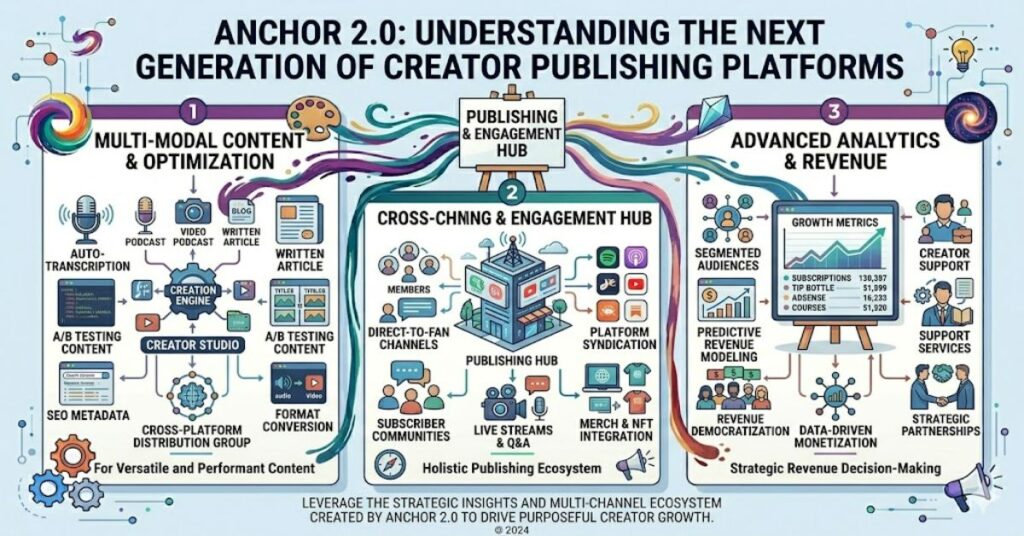
The term anchor 2.0 appears frequently in technology discussions, creator communities, software documentation, and podcasting circles. One challenge for users searching the phrase is that it does not always refer to a single platform. Depending on context, it may describe an upgraded version of a content publishing tool, a podcasting workflow, a creator platform, or a branded software product.
For many users, the phrase is most closely linked to the evolution of Anchor’s podcasting ecosystem, which helped simplify audio publishing by allowing creators to record, host, distribute, and monetise podcasts from a single interface. As creator economies expanded throughout the 2020s, platforms inspired by the Anchor model became increasingly important.
The broader significance of the term goes beyond podcasting. It represents a wider shift in technology: reducing technical barriers so creators can focus on producing content rather than managing infrastructure. Whether publishing audio, newsletters, video clips, or social content, modern creator platforms increasingly follow the same philosophy.
Understanding the meaning behind Anchor 2.0 requires examining platform architecture, creator workflows, distribution capabilities, monetisation models, and long-term industry trends. This article explores those areas while clarifying where the term is used and why it remains relevant in today’s publishing landscape.
What Does Anchor 2.0 Mean?
The phrase can refer to several different products or software versions.
In most online discussions, users generally mean one of three things:
| Interpretation | Primary Use Case | Typical Audience |
| Podcast publishing platform | Audio creation and distribution | Podcasters |
| Creator ecosystem upgrade | Multi-channel content publishing | Independent creators |
| Product version branding | Updated software release | Existing customers |
This ambiguity creates confusion. Before evaluating features or comparing tools, users should determine which specific platform is being discussed.
A search query alone rarely provides enough context.
The Evolution of Creator Publishing Platforms
The popularity of creator-focused software accelerated after 2020.
Traditional publishing often required separate services for:
- Hosting
- Analytics
- Distribution
- Monetisation
- Audience engagement
Modern platforms consolidated these functions into a single workflow.
This shift lowered entry barriers dramatically. Independent creators could launch professional content without significant technical knowledge.
Why Consolidation Matters
Many creators underestimate the operational burden of content management.
Recording an episode is often the easiest part of the process. Distribution, metadata management, RSS configuration, analytics tracking, and advertising integration typically require additional effort.
Integrated publishing systems reduce these friction points.
Core Features Commonly Associated with Anchor 2.0
While implementations differ across products, several capabilities frequently appear.
Content Hosting
Modern creator platforms provide cloud-based infrastructure for storing and delivering media.
Automated Distribution
Content can be pushed automatically to multiple destinations.
Examples include:
- Podcast directories
- Streaming platforms
- Social networks
- Newsletter channels
Audience Analytics
Creators increasingly rely on audience data.
Common metrics include:
| Metric | Purpose |
| Downloads | Audience size measurement |
| Listener retention | Engagement analysis |
| Geographic reach | Market identification |
| Device usage | Platform optimisation |
| Subscriber growth | Growth tracking |
Monetisation Tools
Many publishing platforms now include:
- Sponsorship integration
- Subscription programmes
- Listener support
- Premium content tiers
These features have become critical as creator businesses mature.
Strategic Benefits for Content Creators
The strongest value proposition is efficiency.
Instead of maintaining multiple software subscriptions, creators can manage production workflows from one environment.
Faster Publishing
Integrated systems reduce publication time.
A creator can move from recording to distribution within minutes rather than hours.
Lower Technical Complexity
Many successful creators are not engineers.
User-friendly interfaces allow non-technical users to focus on storytelling, education, or entertainment rather than infrastructure management.
Scalable Growth
A workflow suitable for ten listeners should ideally remain effective at ten thousand listeners.
Scalability is increasingly a competitive advantage.
Risks and Trade-Offs
Despite the benefits, creator platforms introduce several challenges.
Platform Dependency
One of the most overlooked risks is over-reliance on a single ecosystem.
If pricing changes, policies shift, or features are removed, creators may face migration challenges.
Data Ownership Questions
Not every platform provides identical access to audience information.
Creators should carefully review:
- Export policies
- Analytics access
- RSS ownership
- Subscriber portability
Revenue Concentration Risk
Relying entirely on one monetisation method creates vulnerability.
Diversification remains important.
Three Important Insights Often Missed
1. Distribution Is No Longer the Main Barrier
Many discussions focus on publishing tools, but distribution has become increasingly automated.
Audience acquisition is now the larger challenge.
2. Analytics Quality Matters More Than Analytics Quantity
Creators often receive large volumes of data but limited actionable insight.
A smaller set of meaningful metrics frequently provides greater value.
3. Workflow Design Influences Content Consistency
The most successful creators often succeed because of repeatable publishing systems rather than superior equipment.
Efficient workflows support consistency, which supports growth.
Real-World Impact on the Creator Economy
The creator economy has expanded significantly over the past decade.
Podcasting, video content, newsletters, and community-based publishing have evolved into sustainable businesses for many independent creators.
Platforms associated with the Anchor model contributed to this shift by reducing infrastructure costs.
Observed Industry Trend
Content creators increasingly expect:
- Integrated analytics
- Built-in monetisation
- Multi-platform publishing
- AI-assisted production tools
These expectations continue influencing software development strategies across the industry.
Comparison Table: Traditional vs Modern Publishing Workflows
| Factor | Traditional Workflow | Modern Integrated Workflow |
| Hosting | Separate provider | Built-in |
| Distribution | Manual submission | Automated |
| Analytics | Third-party tools | Native dashboard |
| Monetisation | Multiple vendors | Integrated options |
| Maintenance | High effort | Lower effort |
| Learning Curve | Steep | Moderate |
The integrated model explains why creator-focused platforms have experienced sustained adoption.
The Future of Anchor 2.0 in 2027
Several trends are likely to shape creator publishing over the next few years.
AI-Assisted Production
Editing, transcription, chapter generation, and content repurposing are increasingly automated.
Multi-Format Publishing
A single content asset may automatically generate:
- Audio episodes
- Short-form video
- Social media clips
- Newsletters
- Blog posts
Better Audience Attribution
Creators increasingly demand clearer measurement of audience behaviour across channels.
Ownership-Focused Models
As creators become more sophisticated, demand for audience portability and data ownership is expected to increase.
Not every platform will adapt equally well to these expectations.
Key Takeaways
- Anchor 2.0 can refer to multiple products and software contexts.
- The most common association is modern creator and podcast publishing technology.
- Integrated workflows reduce technical barriers for creators.
- Platform dependency remains a meaningful risk.
- Analytics quality often matters more than raw data volume.
- Audience growth has become harder than content distribution.
- AI-powered publishing tools will likely influence future platform development.
Conclusion
Anchor 2.0 represents more than a specific product name. It reflects the broader transformation of digital publishing into an accessible, creator-first ecosystem. The technologies associated with this concept have simplified hosting, distribution, analytics, and monetisation, enabling individuals to build audiences without extensive technical expertise.
At the same time, creators should avoid viewing convenience as the only metric that matters. Platform ownership, audience portability, data access, and long-term sustainability remain important considerations. The most effective publishing strategies balance simplicity with flexibility.
As publishing ecosystems continue evolving, the principles associated with Anchor 2.0—automation, accessibility, and integrated workflows—are likely to remain central to how creators build and manage digital businesses.
FAQ
What is Anchor 2.0?
Anchor 2.0 generally refers to a newer generation of creator publishing or podcasting platforms. The exact meaning depends on the industry and product being discussed.
Is Anchor 2.0 the same as Spotify for Podcasters?
Many users associate the term with the evolution of Anchor’s podcasting platform, which later became integrated into Spotify’s creator ecosystem.
Why do people search for Anchor 2.0?
Users often search for platform features, upgrades, migration information, podcast publishing tools, or creator workflow improvements.
Is Anchor 2.0 suitable for beginners?
Most creator-focused platforms inspired by the Anchor model are designed specifically for beginners and independent publishers.
What are the biggest risks of using creator platforms?
Platform dependency, limited audience ownership, and monetisation restrictions are among the most common concerns.
Will creator publishing platforms change significantly by 2027?
AI-assisted production, improved analytics, and multi-format content generation are expected to become increasingly common.
References
Spotify. (2024). Spotify for Podcasters Documentation. https://podcasters.spotify.com
Interactive Advertising Bureau. (2024). Podcast Advertising Revenue Study. https://iab.com
Edison Research. (2024). The Infinite Dial 2024. https://www.edisonresearch.com
Statista. (2024). Podcast Industry Statistics and Market Data. https://www.statista.com
Pew Research Center. (2024). Digital Media and Creator Economy Trends. https://www.pewresearch.org
Methodology
This article was developed through analysis of creator economy trends, podcast publishing workflows, platform documentation, and industry research from recognised organisations. Sources were selected based on relevance to content creation, distribution technology, audience analytics, and monetisation.
Limitations exist because the phrase “Anchor 2.0” does not refer to a single universally defined product. Different users may mean different platforms or software versions when using the term. Where ambiguity exists, the article focuses on the most common interpretation within creator publishing and podcasting.
Editorial Disclosure: This article was drafted with AI assistance and reviewed and verified by [Author Name]. All data, citations, and claims should be independently confirmed before publication.