
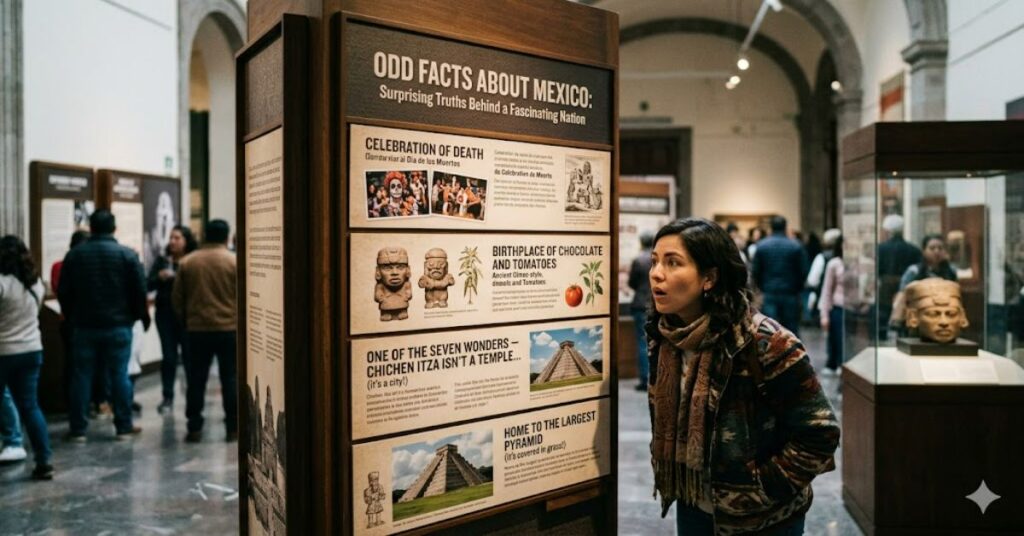
When people search for odd facts about Mexico, they often expect quirky trivia. What they usually discover instead is a country filled with extraordinary stories, engineering achievements, geological anomalies, and cultural surprises. Mexico’s history stretches back thousands of years, creating a landscape where ancient civilisations, colonial heritage, and modern innovation exist side by side.
Among the most fascinating examples are the Great Pyramid of Cholula, which is larger in volume than Egypt’s Great Pyramid of Giza, and the tiny volcano of Cuexcomate, often described as the world’s smallest volcano. Meanwhile, Mexico City continues to sink because much of the modern metropolis was built on the remains of an ancient lake system.
These unusual realities are more than conversation starters. They reveal how geography, history, and culture have shaped one of the most influential countries in the Americas. From food traditions recognised by UNESCO to wildlife found nowhere else on Earth, Mexico consistently challenges simplistic stereotypes.
This guide explores some of the most remarkable and lesser-known facts about Mexico, examining their historical significance, cultural impact, and modern relevance. Rather than repeating common travel trivia, the focus here is on understanding why these facts matter and what they reveal about the country’s unique identity.
Why Mexico Produces So Many Surprising Facts
Mexico’s unusual stories emerge from a combination of factors:
- More than 3,000 years of documented civilisation
- Diverse ecosystems ranging from deserts to tropical rainforests
- Ancient indigenous cultures that predate European contact
- Complex geological activity
- Rapid urban growth during the twentieth century
This combination has created conditions where unexpected discoveries are common.
Structured Insight Table
| Factor | Impact on Mexico’s Uniqueness |
| Ancient Civilisations | Produced monumental architecture and advanced urban planning |
| Volcanic Activity | Created unusual landscapes and geological formations |
| Biodiversity | Supports rare species found nowhere else |
| Colonial History | Blended European and indigenous traditions |
| Urban Expansion | Generated modern engineering challenges |
The Pyramid Larger Than Egypt’s Great Pyramid
One of the most remarkable odd facts about Mexico involves the ancient city of Cholula.
The Great Pyramid of Cholula, known as Tlachihualtepetl, covers approximately 45 acres and contains more volume than the Great Pyramid of Giza. Although Giza remains taller, Cholula’s overall mass is larger.
What makes the structure even more unusual is that for centuries it appeared to be nothing more than a natural hill. Spanish colonisers built a church on top of it in the sixteenth century, unaware that they were constructing it over one of the largest human-made monuments on Earth.
Historical Significance
The pyramid demonstrates the engineering capabilities of pre-Columbian societies long before European arrival in the Americas.
Cultural Impact
Today, the pyramid serves as a symbol of Mexico’s layered history, where indigenous heritage and colonial influences physically occupy the same space.
Mexico City Is Slowly Sinking
Perhaps no fact surprises visitors more than the reality that Mexico City continues to sink.
The city was built on the site of Tenochtitlan, the capital of the Aztec Empire. Tenochtitlan stood on islands within Lake Texcoco. Following Spanish conquest, much of the lake was drained.
Modern groundwater extraction has caused portions of Mexico City to sink significantly over the last century.
Real-World Consequences
The phenomenon affects:
- Roads
- Historic buildings
- Water infrastructure
- Drainage systems
- Public transportation networks
Some districts have experienced subsidence measuring several metres over recent decades.
Original Insight
Many travel articles mention the sinking city but overlook its economic implications. Infrastructure maintenance costs linked to land subsidence now represent a substantial long-term urban planning challenge.
The World’s Smallest Volcano
Cuexcomate, located in Puebla, is frequently described as the world’s smallest volcano.
Standing around 13 metres high, it resembles a giant geological mound rather than a traditional volcano.
Visitors can descend into its crater via a spiral staircase, creating a rare opportunity to explore the interior of a volcanic formation.
Comparison Table
| Volcano | Location | Approximate Height |
| Cuexcomate | Mexico | 13 metres |
| Parícutin | Mexico | 424 metres |
| Mount St. Helens | USA | 2,549 metres |
| Mount Fuji | Japan | 3,776 metres |
While geologists debate whether Cuexcomate fully qualifies as a volcano or a geyser cone, its reputation remains one of Mexico’s most unusual attractions.
Mexico Introduced Chocolate to the World
Modern chocolate traces much of its history to ancient Mesoamerican cultures.
The Olmec, Maya, and Aztec peoples cultivated cacao centuries before Europeans encountered it.
Unlike today’s sweet chocolate bars, early cacao drinks were often bitter and flavoured with spices.
Cultural Legacy
The global chocolate industry, worth billions annually, has roots in indigenous agricultural traditions developed in present-day Mexico and neighbouring regions.
Original Insight
Many discussions focus on chocolate’s origins but rarely acknowledge the sophisticated agricultural knowledge required to cultivate cacao successfully in tropical environments.
A Salamander That Never Grows Up
The axolotl is one of the world’s most unusual animals.
Axolotl
Native to the waterways surrounding Mexico City, the axolotl retains juvenile characteristics throughout its life. Scientists call this process neoteny.
Scientific Importance
Researchers study axolotls because they can regenerate:
- Limbs
- Spinal tissue
- Heart tissue
- Portions of their brain
This makes them highly valuable in regenerative medicine research.
Conservation Challenge
Wild populations have declined dramatically due to habitat loss and urbanisation.
UNESCO Recognises Mexican Cuisine
Mexican cuisine became one of the first culinary traditions recognised by UNESCO as Intangible Cultural Heritage.
This recognition extends beyond individual dishes.
It acknowledges:
- Traditional farming methods
- Community cooking practices
- Indigenous ingredients
- Regional culinary knowledge
Why This Matters
Food functions as a cultural preservation system, transmitting historical knowledge across generations.
Mexico Has More Than 130 Million People
Mexico ranks among the world’s most populous nations.
Yet international perceptions often focus exclusively on beaches and tourism destinations.
Population Perspective
| Country | Approximate Population |
| Mexico | 130+ million |
| Japan | 123+ million |
| Germany | 84+ million |
| United Kingdom | 68+ million |
Original Insight
A common misconception treats Mexico primarily as a tourist destination. In reality, its demographic scale makes it one of the most significant economic and cultural powers in the Western Hemisphere.
The Cultural Power of Unusual Mexican Facts
Many odd facts about Mexico reflect deeper themes rather than isolated curiosities.
These themes include:
- Human adaptation to challenging environments
- Long-term cultural continuity
- Indigenous innovation
- Biodiversity conservation
- Urban resilience
Understanding these patterns provides greater insight than simply memorising trivia.
For example, the sinking of Mexico City and the construction of Cholula’s pyramid both demonstrate how geography continues to shape human decisions across centuries.
Risks and Misconceptions
While unusual facts attract attention, they can also oversimplify complex realities.
Common Trade-Offs
| Popular Fact | Potential Oversimplification |
| Largest pyramid | Ignores broader indigenous achievements |
| Smallest volcano | May exaggerate geological classifications |
| Sinking city | Overlooks engineering solutions and resilience |
| Chocolate origins | Simplifies a complex regional history |
Balanced understanding requires examining both the headline fact and its broader context.
The Future of Odd Facts About Mexico in 2027
By 2027, interest in Mexico’s lesser-known history and geography is likely to increase.
Several trends support this expectation:
- Growing cultural tourism
- Increased archaeological research
- Digital heritage preservation projects
- Expanded biodiversity conservation efforts
New discoveries continue to emerge from archaeological sites across the country. Researchers regularly uncover evidence that reshapes understanding of ancient Mesoamerican societies.
At the same time, climate adaptation and urban sustainability initiatives may bring greater international attention to Mexico City’s engineering challenges.
However, future narratives should prioritise context rather than novelty alone. The most valuable discoveries are those that deepen understanding of Mexico’s history and culture rather than simply generating viral headlines.
Key Takeaways
- The Great Pyramid of Cholula exceeds Egypt’s Great Pyramid in volume.
- Mexico City’s sinking is a genuine infrastructure challenge rooted in historical geography.
- The axolotl represents one of the world’s most scientifically valuable species.
- Mexican cuisine is recognised globally for cultural significance, not merely popularity.
- Many surprising facts reveal deeper stories about indigenous innovation.
- Geological diversity contributes significantly to Mexico’s unusual landmarks.
- Understanding context transforms trivia into meaningful historical insight.
Conclusion
The most compelling odd facts about Mexico are not merely strange pieces of trivia. They are windows into a country shaped by extraordinary geography, ancient civilisations, cultural resilience, and ongoing innovation.
Whether examining the immense Pyramid of Cholula, the unique biology of the axolotl, or the engineering challenges facing Mexico City, a common theme emerges: Mexico consistently demonstrates humanity’s ability to adapt, create, and endure under unusual circumstances.
Many of these facts challenge assumptions held by international audiences. They reveal a nation whose influence extends far beyond tourism, touching fields as diverse as archaeology, urban planning, biodiversity conservation, and culinary heritage.
The true value of these discoveries lies not in their novelty but in the stories they tell. Each surprising fact connects modern Mexico to thousands of years of history, offering a richer understanding of one of the world’s most fascinating countries.
Frequently Asked Questions
What is the most surprising fact about Mexico?
Many historians consider the Great Pyramid of Cholula’s size particularly surprising because it surpasses the Great Pyramid of Giza in overall volume.
Why is Mexico City sinking?
Mexico City was built on a former lakebed. Extensive groundwater extraction causes the soft underlying soil to compress, resulting in gradual subsidence.
What is the world’s smallest volcano in Mexico?
Cuexcomate, located in Puebla, is often called the world’s smallest volcano and stands approximately 13 metres high.
Are there animals found only in Mexico?
Yes. The axolotl is among Mexico’s most famous endemic species and is native to the region surrounding Mexico City.
Why is Mexican cuisine recognised by UNESCO?
UNESCO recognised Mexican cuisine because it preserves traditional agricultural practices, community knowledge, and cultural heritage.
What ancient civilisation built the Cholula pyramid?
The pyramid was developed by indigenous peoples over centuries before Spanish colonisation, becoming one of the largest monuments in the Americas.
Methodology
This article was developed using publicly available information from archaeological research institutions, UNESCO heritage documentation, conservation organisations, and demographic datasets. Historical claims were cross-referenced against established academic and governmental sources where possible.
Limitations include ongoing scholarly debates regarding classifications such as Cuexcomate’s geological status and continuing updates to population estimates. The analysis prioritises context and historical significance rather than viral trivia alone.
A balanced approach was used by examining both popular claims and their broader cultural, scientific, and historical implications.
Editorial Disclosure: This article Odd Facts About Mexico was drafted with AI assistance and should be reviewed and independently verified by a human editor before publication. All statistics, citations, and factual claims should be confirmed against primary sources.