
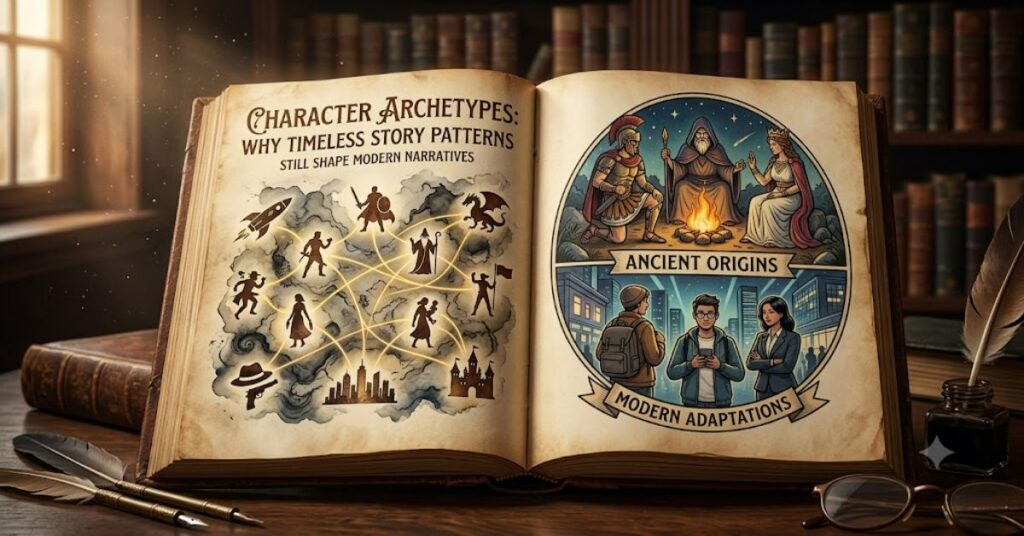
Character archetypes are universal, recurring patterns of behavior, personality traits, and narrative roles that appear across cultures, historical periods, and storytelling traditions. Whether a reader encounters a courageous hero, a wise mentor, or a cunning trickster, these recognizable patterns help create immediate emotional understanding between audiences and fictional characters.
The enduring popularity of archetypal characters is not accidental. Stories from ancient epics, religious texts, folklore, novels, films, and video games repeatedly draw upon similar character structures because human beings naturally respond to familiar patterns. According to Jungian psychology, these recurring figures emerge from the collective unconscious—a shared layer of human experience that influences how people interpret symbols, myths, and narratives.
Yet archetypes are often misunderstood. They are not stereotypes, nor are they fixed personality categories. Instead, they function as narrative frameworks that help storytellers communicate complex ideas efficiently. A well-crafted character may embody multiple archetypes or evolve from one archetypal role into another.
Understanding these patterns is valuable not only for writers but also for educators, marketers, game designers, filmmakers, and anyone interested in human storytelling.
What Are Character Archetypes?
At their core, character archetypes are recurring character models that appear repeatedly in stories.
Jung described archetypes as universal patterns existing within the collective unconscious rather than specific inherited images. These patterns manifest through myths, dreams, literature, and cultural narratives across different societies.
Archetypes vs. Stereotypes
| Archetype | Stereotype |
| Universal narrative pattern | Simplified social assumption |
| Flexible and adaptable | Often rigid and limiting |
| Encourages character growth | Usually static |
| Rooted in storytelling function | Rooted in generalization |
| Can appear across cultures | Often culturally specific |
A mentor archetype, for example, may appear as a wizard, teacher, grandparent, military leader, or AI assistant. The underlying function remains similar even though the external presentation changes.
The Origins of Archetypal Theory
The modern discussion of archetypes is closely associated with Carl Jung’s analytical psychology.
Jung argued that beneath personal memories lies a deeper layer of shared psychological structures known as the collective unconscious. Within this realm exist recurring symbolic patterns, including the hero, shadow, wise old figure, mother, child, and trickster.
Historical Foundations
Long before Jung formalized the concept:
- Ancient Greek myths featured heroic journeys.
- Indigenous oral traditions relied on recurring symbolic figures.
- Religious narratives used archetypal saviors, guides, and adversaries.
- Medieval legends repeated familiar character roles.
Jung’s contribution was providing a psychological explanation for why similar patterns emerge independently across cultures.
The Most Common Character Archetypes
The Hero
The hero pursues a goal despite significant obstacles.
Characteristics include:
- Courage
- Persistence
- Growth through adversity
- Strong sense of purpose
Examples range from mythological warriors to modern cinematic protagonists.
The Mentor
The mentor provides wisdom, guidance, or training.
Typical functions:
- Sharing knowledge
- Preparing the hero
- Offering moral perspective
- Introducing critical tools or skills
The Trickster
The trickster disrupts expectations.
Common traits:
- Humor
- Cleverness
- Rule-breaking behavior
- Unpredictability
Many memorable supporting characters fall into this category.
The Shadow
The shadow represents hidden fears, desires, or destructive impulses.
In some stories, the shadow appears as a villain. In others, it exists within the protagonist’s personality. Jung considered the shadow a major component of psychological development.
The Caregiver
The caregiver prioritizes protection and support.
Traits include:
- Compassion
- Sacrifice
- Responsibility
- Emotional stability
The Ruler
The ruler seeks order, structure, and control.
Positive versions create stability. Negative versions become authoritarian.
Archetypes Across Different Storytelling Mediums
Literature
Classic novels frequently employ archetypal structures to establish themes and character relationships.
Film and Television
Screenwriters often rely on recognizable archetypes because visual storytelling requires rapid audience engagement.
Video Games
Game designers use archetypes to create intuitive character classes and progression systems.
Marketing and Branding
Many organizations adopt archetypal identities:
| Archetype | Brand Function |
| Hero | Achievement and transformation |
| Caregiver | Support and protection |
| Explorer | Freedom and discovery |
| Sage | Knowledge and expertise |
| Rebel | Disruption and change |
This demonstrates how archetypal thinking extends beyond fiction.
Why Audiences Connect With Archetypes
One of the strongest explanations is cognitive efficiency.
Humans constantly search for patterns. Archetypes provide mental shortcuts that help audiences understand characters quickly without extensive exposition.
Real-World Observation
Film industry professionals often discuss character “readability” during script development. A recognizable archetypal framework allows viewers to understand motivations within minutes.
Expert Perspective
Psychologists and literary scholars continue to debate the scientific validity of Jung’s theories. However, the recurring presence of archetypal patterns in global storytelling remains widely documented.
Strategic Advantages of Using Archetypes
For storytellers, archetypes offer practical benefits.
Faster Character Development
Readers instantly recognize familiar narrative functions.
Stronger Emotional Engagement
Audiences understand stakes more quickly.
Cross-Cultural Accessibility
Because many archetypes appear across cultures, stories can travel internationally more easily.
Narrative Structure
Archetypes naturally support plot progression.
Risks and Trade-Offs
Despite their usefulness, archetypes present challenges.
Predictability
Overreliance can produce formulaic stories.
Cultural Simplification
Not all human experiences fit neatly into archetypal categories.
Character Flattening
Writers who rely solely on archetypes may create one-dimensional personalities.
Scientific Debate
While Jung’s work remains influential, many aspects of archetypal psychology are difficult to test empirically using modern scientific methods.
Original Insight #1
The biggest weakness of archetype-based writing is not predictability itself but predictability without contradiction. Audiences accept familiar roles when characters display unexpected internal conflicts.
Original Insight #2
Streaming platforms have increased demand for archetypal recognition because viewers often decide within a single episode whether to continue a series.
Original Insight #3
Global entertainment markets favor adaptable archetypes rather than culture-specific stereotypes, making archetypal storytelling more commercially resilient.
Archetypes in Contemporary Culture
Modern storytelling increasingly blends archetypes.
Examples include:
- Heroes with shadow characteristics
- Mentors who become antagonists
- Villains with sympathetic motivations
- Caregivers pursuing personal ambition
This hybridization reflects changing audience expectations.
Recent computational research has also explored archetypes using large-scale narrative datasets, demonstrating continued academic interest in identifying recurring character patterns.
Structured Insight Table
| Observation | Impact on Storytelling |
| Audiences recognize archetypes quickly | Faster narrative engagement |
| Hybrid archetypes are increasingly common | Greater character complexity |
| Global media consumption is rising | Universal patterns gain value |
| Long-form streaming stories dominate | Archetypes require deeper evolution |
| AI-assisted storytelling is emerging | Consistent character frameworks become more important |
The Future of Character Archetypes in 2027
Looking toward 2027, archetypes are unlikely to disappear. Instead, they will evolve.
Several trends support this conclusion:
- AI-assisted content creation increasingly relies on recognizable narrative structures.
- Global entertainment distribution continues expanding.
- Interactive storytelling formats demand flexible character frameworks.
- Academic research is using computational methods to analyze narrative patterns at scale.
However, future storytelling will probably emphasize archetype combinations rather than isolated categories. Audiences increasingly expect morally complex characters who resist simple classification.
Regulatory pressures surrounding AI-generated media and transparency may also encourage clearer narrative design standards, making archetypal frameworks useful for both human and machine-assisted storytelling.
Uncertainty remains. No evidence suggests a single universal model will dominate future narratives. Instead, adaptation and hybridization appear most likely.
Key Takeaways
- Archetypes function as storytelling frameworks rather than fixed personality types.
- Jung’s theory of the collective unconscious remains the most influential explanation for archetypal patterns.
- The hero, mentor, trickster, shadow, caregiver, and ruler remain among the most common archetypes.
- Effective modern storytelling often combines multiple archetypal roles.
- Archetypes help audiences connect with characters quickly.
- Overuse can lead to predictability and shallow characterization.
- Emerging technologies are expanding how archetypes are analyzed and applied.
Conclusion
Character archetypes remain among the most powerful tools in storytelling because they connect individual narratives to broader human experiences. From ancient myths to contemporary streaming series, audiences consistently respond to familiar patterns of courage, wisdom, sacrifice, rebellion, and transformation.
Their value lies not in rigid formulas but in flexibility. Strong storytellers use archetypes as foundations rather than restrictions. A hero can be flawed. A mentor can fail. A villain can be sympathetic. These variations create originality while preserving the emotional clarity that archetypes provide.
The continuing influence of Jungian ideas, combined with modern narrative research, suggests that archetypes will remain relevant for years to come. As media formats evolve and audiences become more sophisticated, the most successful stories will likely be those that understand archetypal foundations while finding fresh ways to challenge expectations.
FAQ
What are character archetypes in storytelling?
Character archetypes are recurring narrative patterns that represent common roles, motivations, and behaviors found across stories, cultures, and historical periods.
Who created the concept of character archetypes?
The modern theory is most closely associated with Carl Jung, who connected archetypes to the collective unconscious.
Are archetypes the same as stereotypes?
No. Archetypes are flexible narrative frameworks, while stereotypes are simplified assumptions about groups of people.
Why do writers use archetypal characters?
They help audiences quickly understand a character’s role, motivations, and potential journey.
Can a character have multiple archetypes?
Yes. Many modern characters combine traits from several archetypal categories, creating greater complexity.
Do archetypes exist in real life?
While archetypes primarily describe storytelling patterns, many people recognize similar behavioral patterns in leadership, relationships, and social roles.
Are Jung’s archetypes scientifically proven?
Their cultural influence is widely acknowledged, but many aspects of Jung’s psychological theory remain debated within contemporary scientific research.
Methodology
This article was developed using established scholarship on Jungian psychology, contemporary narrative theory, and recent academic research examining archetypal patterns in storytelling. Sources were cross-checked for consistency and relevance. Particular attention was given to primary discussions of Jung’s collective unconscious and modern critiques of archetypal theory.
Limitations:
- Archetypal theory remains debated within contemporary psychology.
- Cultural interpretations vary significantly across regions.
- Some applications of archetypes in media studies remain interpretive rather than empirically verified.
A balanced approach requires recognizing both the practical value of archetypes in storytelling and the limitations of treating them as universal psychological laws.
References
Jung, C. G. (1959). The archetypes and the collective unconscious. Princeton University Press.
Keller, S. M., Samarin, M., Wieser, M., & Roth, V. (2019). Deep Archetypal Analysis. arXiv.
Narang, K., Chung, A., Sundaram, H., & Chaturvedi, S. (2019). Discovering Archetypes to Interpret Evolution of Individual Behavior. arXiv.
Verywell Mind. (2024). Carl Jung: Biography, Archetypes, Theories, Beliefs.
Beauregard, C. G., Zimmerman, J. W., Fehr, A. M. A., Danforth, C. M., & Dodds, P. S. (2026). Archetypes and gender in fiction: A data-driven mapping of gender stereotypes in stories. arXiv.
Editorial Disclosure: This article was drafted with AI assistance and requires human editorial review, citation verification, and fact-checking before publication on Postcard.fm.