
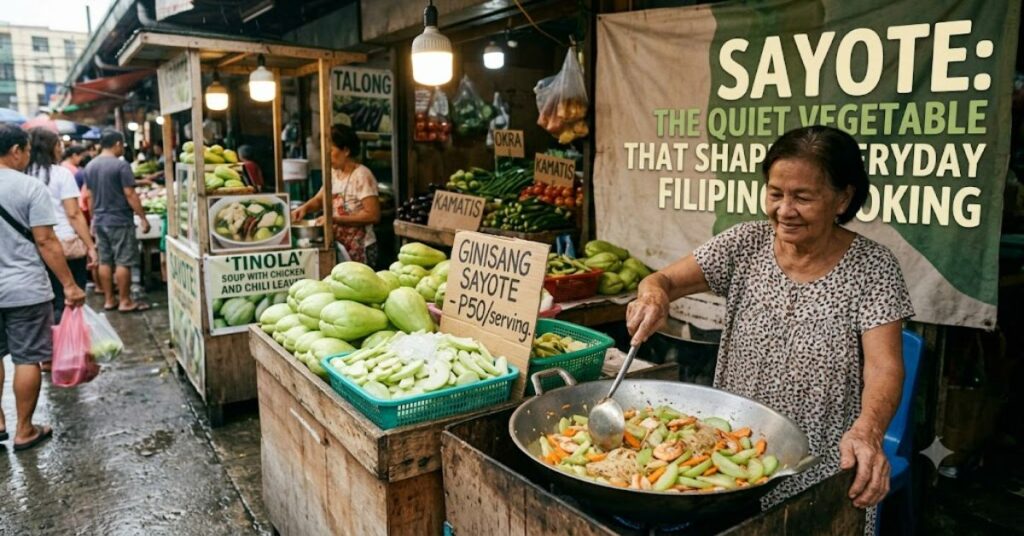
Sayote, also known globally as chayote, is a pear-shaped green vegetable commonly found in Filipino households. In a sayote-focused culinary context, it is valued not for its strong flavor but for its ability to absorb the taste of whatever it is cooked with. This makes it a foundational ingredient in everyday dishes like chicken soup, tinola, and vegetable stir-fries.
Botanically known as Sechium edule, sayote belongs to the gourd family and is believed to have originated in Mesoamerica before spreading to Asia. In the Philippines, it has become deeply integrated into home cooking due to its affordability, long shelf life, and adaptability.
The keyword concept of sayote (historically derived from Nahuatl chayohtli) reflects its dual identity: a globally distributed crop and a locally essential vegetable. In Filipino kitchens, it is rarely the “star” ingredient, but it consistently supports flavor structure and nutritional balance in meals.
Understanding sayote is not just about cooking—it also reveals how food systems adapt imported crops into local traditions, especially in Southeast Asian culinary environments where flexibility and resource efficiency are key.
Botanical and Culinary Profile of Sayote
Sayote is a member of the gourd family, closely related to cucumbers, squash, and melons. It is typically light green with a wrinkled pear shape and a single edible seed inside.
Key Characteristics
| Feature | Description |
| Botanical name | Sechium edule |
| Texture | Crisp when raw, soft when cooked |
| Flavor | Mild, slightly sweet, neutral |
| Edible parts | Fruit, seed, young shoots, leaves |
| Cooking behavior | Absorbs surrounding flavors |
Its neutral profile makes it a “carrier vegetable,” meaning it supports rather than competes with dominant flavors in dishes.
Culinary Uses in Filipino Cooking
In Filipino cuisine, sayote is most commonly used in everyday home meals rather than restaurant fine dining. Its affordability and availability make it a household staple.
Common preparations include:
- Chicken tinola with ginger broth
- Vegetable sauté with garlic and onions
- Mixed vegetable stews
- Light soups paired with fish or pork
In these dishes, sayote functions as a volume ingredient, adding texture without altering the core taste profile.
Nutritional Profile and Health Value
Sayote is often overlooked nutritionally, but it provides a solid foundation of hydration and fiber.
| Nutrient | Benefit |
| Fiber | Supports digestion |
| Vitamin C | Immune support |
| Folate | Cellular health |
| Low calories | Weight-friendly food option |
| Water content | Hydration support |
Because it is low in calories and high in water content, sayote is commonly included in diets focused on weight management and digestive balance.
Economic and Agricultural Role
Sayote plays an important role in small-scale agriculture in the Philippines and other tropical regions. It is relatively easy to grow and requires minimal inputs compared to other crops.
Practical advantages:
- Fast-growing vine plant
- Can be harvested multiple times per season
- Low maintenance cultivation
- Suitable for backyard farming
This makes it a food security crop, especially in rural communities where diversified food sources are essential.
Cultural Significance in Filipino Households
Sayote is deeply embedded in Filipino home cooking culture, particularly in “ulam” (viand-based meals). It represents practicality and resourcefulness rather than luxury or culinary prestige.
It is often used in dishes that emphasize:
- Family meals
- Budget-friendly cooking
- Comfort food traditions
In many households, sayote is associated with warmth and familiarity rather than culinary experimentation.
Comparison: Sayote vs Other Common Vegetables
| Vegetable | Flavor Strength | Texture | Culinary Role |
| Sayote | Very mild | Crisp/soft | Support ingredient |
| Zucchini | Mild | Soft | Versatile base |
| Cucumber | Fresh | Crunchy | Raw consumption |
| Squash | Sweet | Soft | Flavor carrier |
Sayote’s defining feature is its extreme neutrality, which allows it to adapt across different cooking styles.
Hidden Insights About Sayote in Modern Food Systems
1. Flavor Absorption Efficiency
Sayote absorbs spices and broth compounds more efficiently than many gourds, making it ideal for low-fat cooking where flavor extraction is key.
2. Supply Chain Stability
Because it grows quickly and locally in tropical climates, sayote is less dependent on import chains compared to other vegetables.
3. Underutilized Culinary Parts
Most households discard shoots and leaves, but these are edible and nutritionally valuable—representing a missed opportunity in food efficiency.
The Future of Sayote in 2027
By 2027, sayote is likely to gain attention in three main areas:
- Urban farming systems: Rooftop and vertical gardens in Southeast Asia
- Climate-resilient crops: Increased interest in low-resource vegetables
- Plant-based diets: Expanded use in vegetarian and low-calorie meal planning
As food systems adapt to climate pressure, crops like sayote are expected to become more strategically important due to their low resource requirements and adaptability.
Takeaways
- Sayote is a neutral, adaptable gourd used widely in Filipino cuisine
- It plays a key role in affordable, everyday meal structures
- Its agricultural efficiency makes it important for local food security
- Nutritionally, it supports hydration, fiber intake, and low-calorie diets
- Its culinary role is shifting toward modern health-conscious cooking trends
Conclusion
Sayote may appear simple, but its role in food systems is far more significant than its mild flavor suggests. In Filipino households, it functions as a foundational ingredient that supports affordability, nutrition, and culinary flexibility.
Its ability to adapt to different dishes makes it an essential component of everyday cooking rather than a specialty item. As global food systems move toward sustainability and resilience, vegetables like sayot’e gain new relevance beyond traditional kitchens.
Rather than being defined by taste alone, sayot’e represents a broader idea in food culture: utility, adaptability, and quiet nutritional value embedded in everyday meals.
FAQ
What is sayote?
Sayote is a green pear-shaped vegetable from the gourd family, commonly used in Filipino cooking.
Is sayote healthy?
Yes, it is low in calories and contains fiber, vitamin C, and water content.
How do you cook sayot’e?
It can be boiled, sautéed, or added to soups and stews.
What does sayot’e taste like?
It has a very mild, neutral flavor similar to cucumber or zucchini.
Can you eat sayot’e raw?
Yes, it can be eaten raw, though it is more commonly cooked.
Is sayote the same as chayote?
Yes, sayot’e is the Filipino term for chayote (Sechium edule).