
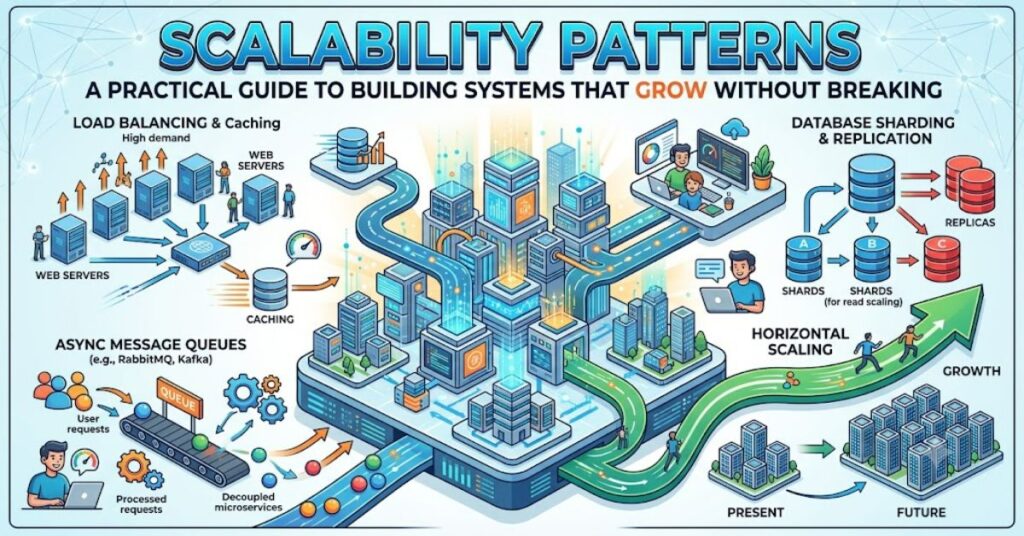
Every successful application eventually reaches a point where a single server is no longer enough. More users sign up, databases grow larger, API requests increase, and background jobs become more demanding. Without careful planning, systems that once performed flawlessly begin experiencing slow response times, downtime, and frustrated users.This is where scalability patterns become essential.
They are repeatable architectural strategies designed to help applications manage increasing workloads without compromising availability or user experience. Whether the growth comes from millions of new customers, expanding datasets, or higher transaction volumes, these patterns provide structured solutions that have been tested across industries.
Today’s largest technology companies—including streaming platforms, e-commerce giants, financial institutions, and SaaS providers—depend on combinations of scaling strategies instead of relying on larger hardware alone. Cloud computing has further accelerated this shift by making distributed infrastructure more accessible than ever before.
This guide explains what scalability patterns are, how they work, when to use them, and the trade-offs every architect and developer should understand before implementing them.
What Are Scalability Patterns?
Scalability patterns are reusable architectural approaches that enable software systems to grow efficiently as demand increases.
Instead of redesigning an application every time traffic doubles, architects implement patterns that allow infrastructure and software components to expand predictably.
Common growth challenges include:
- Increasing user traffic
- Growing databases
- More concurrent requests
- Higher storage requirements
- Expanding microservices
- Global deployments
Good scalability patterns allow these increases without significantly affecting performance.
The Two Primary Scaling Methodologies
Scaling generally falls into two categories.
Vertical Scaling (Scaling Up)
Vertical scaling means adding more resources to a single machine.
Examples include:
- More CPU cores
- Additional RAM
- Faster SSD storage
- Higher network bandwidth
Advantages
- Easy to implement
- Minimal application changes
- Lower operational complexity
Disadvantages
- Hardware limits eventually become a bottleneck
- Larger servers cost significantly more
- Single points of failure remain
Vertical scaling works well for smaller applications or systems with moderate growth expectations.
Horizontal Scaling (Scaling Out)
Horizontal scaling adds more servers rather than larger ones.
Instead of upgrading one machine, workloads are distributed across many servers.
Examples include:
- Web server clusters
- Kubernetes pods
- Auto Scaling Groups
- Distributed databases
Advantages
- Virtually unlimited growth
- Improved fault tolerance
- Better availability
Disadvantages
- Increased architectural complexity
- Data synchronization challenges
- More sophisticated monitoring requirements
Most cloud-native applications prefer horizontal scaling because it aligns well with distributed infrastructure.
Common Scalability Patterns
Load Balancing
A load balancer distributes incoming requests across multiple servers.
Instead of one server becoming overloaded, requests are shared evenly.
Popular algorithms include:
- Round Robin
- Least Connections
- IP Hash
- Weighted Distribution
Benefits include:
- Higher availability
- Reduced latency
- Better resource utilization
Caching
Caching stores frequently requested information closer to users.
Instead of querying the database repeatedly, applications retrieve data from fast memory.
Examples include:
- Redis
- Memcached
- Browser caching
- CDN edge caching
Caching dramatically reduces database pressure.
Database Replication
Replication creates multiple copies of a database.
One server handles writes while several replicas process read operations.
Benefits include:
- Faster queries
- Geographic redundancy
- Disaster recovery
Challenges include replication lag and eventual consistency.
Database Sharding
As databases grow beyond a single server’s capacity, data can be divided across multiple machines.
Each shard stores only part of the data.
For example:
- Customers A–F
- Customers G–M
- Customers N–Z
Advantages:
- Higher throughput
- Improved scalability
- Reduced storage bottlenecks
Trade-offs:
- More complex queries
- Harder maintenance
- Difficult shard balancing
Stateless Services
Stateless applications store no user session information locally.
Session data resides in shared storage or distributed caches.
Benefits include:
- Easier scaling
- Faster deployments
- Better fault tolerance
This approach is widely used in containerized environments.
Event-Driven Architecture
Instead of direct communication, services exchange events.
Examples:
- Order placed
- Payment received
- Email sent
- Inventory updated
Message brokers process these events asynchronously.
Popular technologies include:
- Apache Kafka
- RabbitMQ
- Amazon SQS
Queue-Based Processing
Queues separate user-facing requests from long-running background work.
Tasks such as:
- Video encoding
- Email delivery
- Image processing
- Report generation
can execute independently without slowing the user experience.
Comparison of Popular Scalability Patterns
| Pattern | Best For | Complexity | Scalability |
| Vertical Scaling | Small systems | Low | Medium |
| Horizontal Scaling | Large applications | High | Excellent |
| Caching | High-read workloads | Medium | Excellent |
| Load Balancing | Web applications | Medium | Excellent |
| Database Sharding | Massive datasets | High | Excellent |
| Replication | Read-heavy databases | Medium | High |
| Message Queues | Background jobs | Medium | High |
Scalability Challenges
Growth introduces new problems.
Common issues include:
- Network latency
- Database bottlenecks
- Distributed transactions
- Cache invalidation
- Monitoring complexity
- Security management
- Increased infrastructure costs
Successful architectures address these issues proactively rather than reacting after failures occur.
Practical Example
Imagine an online shopping platform during a holiday sale.
Initially:
- One application server
- One database
- One storage server
As traffic grows:
- Add a load balancer.
- Deploy multiple application servers.
- Introduce Redis caching.
- Replicate the database.
- Move images to object storage.
- Process emails through message queues.
- Shard the customer database if necessary.
Rather than replacing the entire architecture, scalability patterns enable incremental growth.
Data and Insight Table
| System Metric | Without Patterns | With Appropriate Patterns |
| Response Time | Increases rapidly | Remains stable |
| Server Utilization | Uneven | Balanced |
| Downtime Risk | High | Lower |
| Deployment Flexibility | Limited | High |
| Fault Tolerance | Weak | Strong |
| Operational Complexity | Low initially | Higher but manageable |
| Growth Capacity | Limited | Significant |
Strategic Considerations
Selecting a scalability strategy involves balancing multiple factors.
Questions architects should ask include:
- Is traffic predictable?
- Are reads more common than writes?
- Is low latency critical?
- How much downtime is acceptable?
- What budget is available?
- How experienced is the operations team?
No single pattern solves every scaling problem.
Most production systems combine several complementary approaches.
Risks and Trade-Offs
While scalability improves performance and resilience, it also introduces complexity.
Potential risks include:
- Higher cloud costs
- More difficult debugging
- Distributed failures
- Data consistency challenges
- Increased operational overhead
Organizations should scale only when demand justifies the added complexity.
Real-World Impact
Modern digital services would struggle to operate without scalable architectures.
Streaming platforms process millions of concurrent viewers.
Online retailers handle seasonal traffic spikes.
Banks execute thousands of secure transactions every second.
Social media platforms manage billions of daily interactions.
These capabilities are possible because scalability patterns distribute workloads efficiently across many systems rather than depending on individual servers.
The Future of Scalability Patterns in 2027
By 2027, scalability will increasingly be driven by automation and artificial intelligence. Infrastructure platforms are expected to make scaling decisions based on predictive analytics rather than predefined thresholds. Serverless computing will continue to reduce infrastructure management for event-driven workloads, while Kubernetes and similar orchestration platforms will become more autonomous.
Edge computing will also play a larger role as applications process data closer to users, reducing latency for real-time services. At the same time, sustainability will influence architecture decisions, encouraging organizations to optimize resource utilization rather than simply adding more servers. Although the tools will evolve, the core principles of modular design, redundancy, and distributed workloads will remain central to scalable software systems.
Key Takeaways
- Scalability patterns provide proven solutions for handling application growth.
- Horizontal scaling offers greater long-term flexibility than vertical scaling.
- Caching significantly reduces database workload.
- Load balancing improves availability and fault tolerance.
- Queue-based processing enhances responsiveness for resource-intensive tasks.
- Combining multiple patterns typically produces the best results.
- Effective scaling requires balancing performance, cost, and operational complexity.
Conclusion
Scalability is no longer an optional consideration for modern software systems. Applications that begin with a few hundred users can quickly grow to serve millions, and without the right architectural foundations, performance problems become inevitable. Scalability patterns offer practical, reusable solutions that allow organizations to adapt to changing demands while maintaining reliability and user satisfaction.
Whether an application relies on load balancing, caching, database replication, sharding, or event-driven communication, each pattern addresses a specific challenge associated with growth. Rather than viewing scalability as a single technology, successful teams treat it as a collection of complementary strategies that evolve alongside business requirements. By understanding the strengths and limitations of each approach, architects and developers can build systems that remain responsive, resilient, and ready for future expansion.
Frequently Asked Questions
What are scalability patterns?
Scalability patterns are reusable software architecture techniques that help applications handle increasing workloads while maintaining performance and reliability.
What is the difference between horizontal and vertical scaling?
Vertical scaling upgrades a single server with more resources, while horizontal scaling adds additional servers to distribute workloads.
Which scalability pattern should I implement first?
For most web applications, load balancing and caching provide the greatest immediate performance improvements before moving to more advanced patterns like sharding.
Is database sharding always necessary?
No. Sharding is generally reserved for very large datasets or workloads that exceed the capabilities of a single database server.
Can small businesses benefit from scalability patterns?
Yes. Even modest applications benefit from basic patterns such as caching, stateless services, and load balancing, especially as traffic grows.
What is the biggest challenge of scalable architecture?
The greatest challenge is managing increased complexity while maintaining data consistency, observability, and cost efficiency.