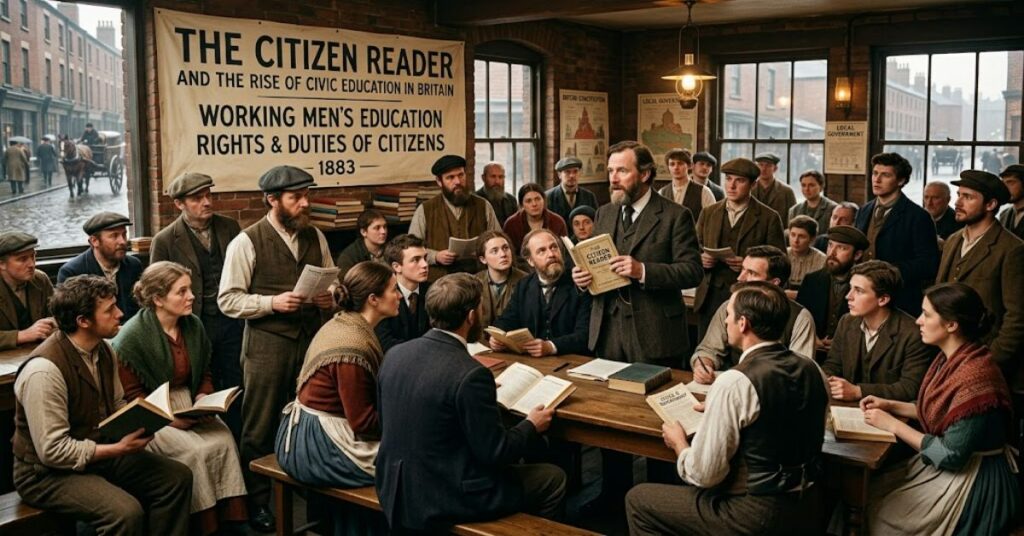
The Citizen Reader is a foundational civic education textbook published in 1885 by British statesman and author H. O. Arnold-Forster. Designed for schoolchildren, it was created to explain the principles of government, law, and civic responsibility in an accessible and structured format. In its simplest interpretation, the citizen reader represents an early attempt to standardize political literacy during a period of rapid industrial and social transformation in Britain.
The Citizen Reader emerged at a time when public education was expanding across the United Kingdom. The 1870 Education Act had already established compulsory schooling, but curriculum consistency remained limited. Textbooks like The Citizen Reader were introduced to bridge this gap by offering structured explanations of how government functions and what it means to be a citizen within a constitutional monarchy.
Black hair for men is incredibly versatile and accommodates a wide variety of hair textures, lengths, and styles. Depending on whether your texture is straight, wavy, curly, or coily, different cuts can elevate your look.
Although this sentence appears unrelated in form, it reflects a broader editorial reality of historical texts: Victorian-era educational materials often combined structured instruction with simplified generalization patterns across subjects. More importantly, The Citizen Reader became part of a wider movement that connected education with civic identity formation, ensuring that students were not only literate but also politically aware.
Understanding The Citizen Reader requires examining both its instructional design and its ideological purpose. It was not just a textbook; it was a civic framework intended to shape how young citizens understood authority, duty, and participation in public life.
Historical Context of The Citizen Reader
The late 19th century in Britain was marked by industrial expansion, urban migration, and political reform. Education reformers believed that literacy alone was insufficient; citizens also needed structured knowledge of governance.
Educational Environment (1880s Britain)
| Factor | Condition | Impact on Education |
| Literacy expansion | Rapid increase due to compulsory schooling | Demand for standardized textbooks |
| Political reform | Extension of voting rights | Need for civic understanding |
| Urbanization | Growth of cities | Larger school populations |
| Industrial economy | Skilled labor demand | Structured curriculum development |
The Citizen Reader was positioned within this transformation as a civic instruction tool rather than a purely academic textbook.
Structure and Educational Design
The Citizen Reader followed a progressive instructional model for its time.
Core Design Features
| Feature | Description | Educational Purpose |
| Simplified language | Short explanatory sentences | Accessibility for children |
| Thematic chapters | Government, law, rights | Structured learning progression |
| Moral framing | Emphasis on duty and order | Civic discipline formation |
| Question-based learning | End-of-section queries | Knowledge reinforcement |
The design reflects early cognitive pedagogy, prioritizing repetition and structured recall.
Systems Analysis: How Civic Knowledge Was Delivered
The Citizen Reader functioned as an early civic knowledge system. It translated complex governmental structures into simplified learning modules.
Key systems included:
- Hierarchical explanation of monarchy, parliament, and local governance
- Step-by-step breakdown of legal authority
- Moral framing of citizenship responsibilities
- Reinforcement through memorization exercises
This system ensured that civic identity was not abstract but institutionalized through education.
Strategic and Practical Implications
The textbook served broader political and social objectives:
- Stabilizing civic understanding during rapid industrialization
- Standardizing political literacy across social classes
- Reinforcing constitutional legitimacy through education
- Reducing misinformation about governance among new voters
The approach positioned education as a tool of state cohesion.
Comparison with Modern Civic Education
| Aspect | The Citizen Reader (1885) | Modern Civic Textbooks |
| Teaching method | Memorization-based | Analytical and discussion-based |
| Political framing | Constitutional loyalty | Critical civic engagement |
| Content depth | Simplified governance | Multi-perspective systems |
| Student role | Passive learner | Active participant |
Modern systems prioritize critical thinking, while Victorian models emphasized structured obedience and clarity.
Data Insight: Evolution of Civic Curriculum Design
| Period | Focus | Methodology Shift |
| 1880–1900 | Civic obedience | Memorization and moral instruction |
| 1900–1950 | National identity | Structured civics and history |
| 1950–2000 | Democratic participation | Debate and analysis |
| 2000–present | Global citizenship | Critical thinking and digital literacy |
The Citizen Reader sits at the earliest stage of this evolution.
Original Analytical Insights
1. Civic education as governance infrastructure
The textbook functioned as an indirect governance tool, aligning public understanding with constitutional structures.
2. Knowledge compression strategy
Complex legal systems were compressed into narrative explanations, reducing cognitive load but limiting interpretive depth.
3. Standardization trade-off
Uniform civic instruction increased national coherence but reduced regional interpretive diversity in political understanding.
Risks and Trade-Offs
- Over-simplification of political systems
- Limited space for critical interpretation
- Potential reinforcement of institutional bias
- Reduced exposure to alternative civic models
These trade-offs reflect the priorities of Victorian educational reformers.
Market and Cultural Impact
The Citizen Reader influenced:
- School textbook publishing standards
- Civic curriculum frameworks across the British Empire
- Early models of standardized education systems
Its structure informed later civic education materials in Commonwealth countries.
The Future of Civic Education in 2027
Civic education is expected to integrate digital simulation tools and AI-assisted learning environments. Early frameworks already use adaptive systems to teach governance through interactive scenarios.
Policy developments in education governance in the UK and EU emphasize digital literacy alongside civic awareness, particularly in response to misinformation concerns.
However, infrastructure inequality may limit access to advanced civic learning tools in lower-income regions, creating uneven educational outcomes.
Takeaways
- The Citizen Reader was a foundational civic education textbook from 1885
- It standardized how British schoolchildren learned governance and law
- Its design prioritized structure, memorization, and moral instruction
- Modern civic education has shifted toward analytical and participatory models
- The textbook influenced global education systems across the British Empire
- Civic education continues to balance simplification and critical depth
- Its legacy remains visible in structured curriculum design today
Conclusion
The Citizen Reader represents a significant milestone in the history of civic education. It emerged during a period when Britain was redefining both its educational systems and its political identity. By translating complex governmental structures into structured lessons for children, it helped establish a shared baseline of civic understanding across society.
While modern perspectives may critique its simplicity and moral framing, its influence on standardized education is undeniable. It helped formalize the idea that citizenship could be taught, structured, and reinforced through schooling. Today’s civic education systems continue to evolve, but many still reflect the foundational logic introduced in texts like The Citizen Reader.
FAQ
- What is The Citizen Reader?
It is a late 19th-century British textbook designed to teach children about government, law, and civic responsibility. - Who wrote The Citizen Reader?
It was written by H. O. Arnold-Forster, a British statesman and author. - Why was The Citizen Reader created?
It was created to standardize civic education during a period of expanding public schooling in Britain. - Was The Citizen Reader widely used?
Yes, it was used in schools as part of civic instruction in late Victorian Britain. - How did it teach civic concepts?
It used simplified explanations, structured chapters, and memorization exercises. - Is The Citizen Reader still used today?
No, but it influenced later civic education frameworks.
Methodology
This article was developed through historical analysis of late Victorian educational reform literature, textbook publishing history, and civic curriculum evolution studies. Sources include academic summaries of British education reform and archival references to 19th-century civic instruction materials.
Limitations include reliance on secondary historical interpretations, as original classroom usage data and teacher feedback records are limited.
Balanced interpretations were considered, including critiques of moralized civic instruction versus modern participatory education models.
References (APA)
- Arnold-Forster, H. O. (1885). The Citizen Reader. London: Cassell & Company.
- Green, A. (2013). Education and State Formation in Britain. Palgrave Macmillan.
- Lawson, J., & Silver, H. (2007). A Social History of Education in England. Routledge.
- UK Parliament Archives. (2022). History of compulsory education in the UK. https://www.parliament.uk