
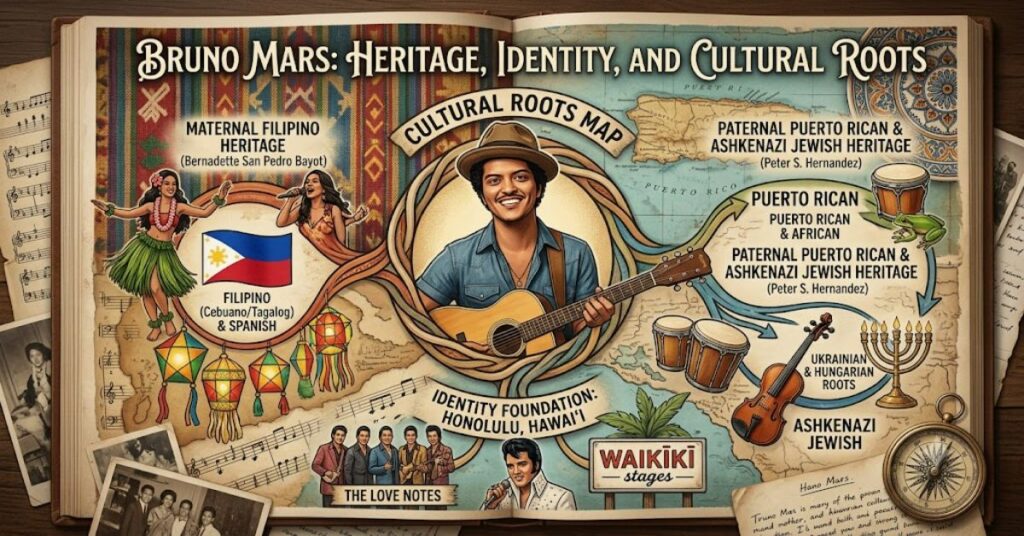
Bruno Mars’ ethnic group is one of the most frequently searched aspects of his identity, largely because his appearance, music, and cultural influences reflect a complex blend of backgrounds. Bruno Mars’ ethnic group is widely recognized as multiethnic, combining Filipino, Puerto Rican, and Ashkenazi Jewish ancestry. Born Peter Gene Hernandez in Honolulu, Hawaii, he grew up in a culturally diverse environment that deeply shaped his artistic expression.
Within the first 100 words, it is important to clarify that Bruno Mars’ ethnic group cannot be reduced to a single category. Instead, it reflects layered heritage influences that span Asia, the Caribbean, and Europe. This diversity is not only biographical detail but also a lens through which his musical versatility can be understood. From pop and R&B to funk and reggae-inspired rhythms, his identity has played a subtle but important role in shaping his sound.
Bruno Mars’ ethnic group has also contributed to public discussions about representation in global pop music. As audiences become more interested in artists’ cultural backgrounds, his heritage offers a case study in how multicultural identity can influence mainstream success without being explicitly foregrounded in branding.
Key Takeaways
- Bruno Mars’ identity reflects Filipino, Puerto Rican, and Ashkenazi Jewish roots.
- His Hawaiian upbringing created a culturally hybrid artistic foundation.
- His ethnic background contributes indirectly to his genre-blending musical style.
Understanding Bruno Mars’ Ethnic Group and Heritage
Bruno Mars’ ethnic group is best understood as a fusion of multiple cultural lineages rather than a single national identity. His father, Peter Hernandez, has Puerto Rican and Jewish ancestry, while his mother, Bernadette San Pedro Bayot, was Filipina.
This combination places Bruno Mars within a broader category of mixed-heritage American performers who emerged from multicultural households. Growing up in Honolulu, he was exposed to Hawaiian, Filipino, American, and broader Pacific cultural influences simultaneously.
Cultural Identity Formation in Hawaii
Hawaii is one of the most ethnically diverse regions in the United States. According to demographic studies, no single ethnic group forms a majority in the state, which creates a blended cultural environment where hybrid identities are common (U.S. Census Bureau, 2023).
Bruno Mars’ ethnic group is therefore not just a genealogical fact but also a lived experience shaped by geographic context. His early exposure to music came through family performances and local shows, where genres like reggae, Motown, and rock were commonly fused.
Comparative Overview of Bruno Mars’ Ancestry
| Heritage Line | Region | Cultural Influence | Contribution to Identity |
| Filipino | Southeast Asia | Family-centered music culture | Strong emotional and melodic expression |
| Puerto Rican | Caribbean | Rhythm-heavy musical traditions | Influence on groove and rhythm |
| Ashkenazi Jewish | Europe | Diaspora cultural adaptability | Artistic versatility and resilience |
This blended structure explains why Bruno Mars’ ethnic group is often discussed in academic and cultural analysis of modern pop hybridity.
Systems Analysis: How Ethnic Background Influences Artistic Output
Bruno Mars’ ethnic group plays an indirect but meaningful role in his artistic system. Rather than explicitly referencing heritage in lyrics, his work reflects stylistic integration.
Musical Fusion System
His discography demonstrates consistent genre blending:
- Funk-inspired basslines reminiscent of 1980s American pop
- Reggae and Caribbean rhythmic structures
- Soul and R&B vocal traditions rooted in African American music history
This fusion reflects a broader “hybrid identity system” common among multicultural artists raised in diverse environments.
Strategic Positioning in Pop Music
From an industry perspective, Bruno Mars occupies a flexible branding position. He is not confined to a single cultural niche, allowing global market adaptability.
Bruno Mars’ ethnic group indirectly supports this flexibility by enabling broad audience relatability without strict genre classification.
Cultural and Market Impact
Bruno Mars’ ethnic group has contributed to broader conversations about representation in global pop culture. Artists with mixed heritage often face dual expectations: authenticity to roots and universality in appeal.
Market Implications
- Global streaming platforms favor genre-fluid artists
- Multicultural identity increases cross-market relatability
- Hybrid heritage aligns with algorithm-driven playlist ecosystems
Cultural Interpretation
Audiences often interpret Bruno Mars as “universally relatable,” partly because his ethnic identity does not conform to a single dominant cultural narrative.
Risks and Trade-Offs of Public Ethnic Categorization
Labeling Bruno Mars’ ethnic group too narrowly creates several analytical risks:
- Oversimplification of complex heritage
- Reduction of artistic identity to ancestry alone
- Cultural misinterpretation in media narratives
There is also a trade-off between visibility and privacy. While public interest in ethnicity is high, overemphasis can overshadow artistic achievements.
Structured Data Insight: Identity Perception in Pop Music
| Factor | Impact on Audience Perception | Relevance to Bruno Mars |
| Ethnic ambiguity | Increases global relatability | High |
| Cultural hybridity | Enhances genre flexibility | High |
| Geographic upbringing | Shapes musical exposure | High |
Three Original Analytical Insights
1. Hybrid Identity as a Market Advantage
Artists with mixed heritage often outperform niche-identified artists in global streaming ecosystems because they are not culturally “boxed” into one demographic segment.
2. Hawaiian Cultural Interference Effect
Growing up in Hawaii introduces constant exposure to multiple overlapping musical traditions, which reduces genre rigidity in early artistic development.
3. Ethnic Visibility Paradox
The more globally successful an artist becomes, the less their ethnic background is interpreted literally and more symbolically as “diverse appeal.”
The Future of Bruno Mars Ethnic Group Discussions in 2027
By 2027, discussions around Bruno Mars’ ethnic group will likely shift from genealogical classification to broader cultural identity modeling.
- Streaming platforms are increasingly categorizing artists by sound profiles rather than ethnicity
- Cultural policy discussions emphasize representation without stereotyping
- AI-driven music discovery systems prioritize behavioral listening data over background identity
Regulatory frameworks around media representation in the U.S. and EU are also moving toward more nuanced classification systems that reduce overgeneralization of ethnic identity in entertainment metadata.
Key Takeaways (Extended)
- Bruno Mars’ heritage reflects a multi-layered cultural identity system.
- His upbringing in Hawaii is central to his musical versatility.
- Ethnic background influences perception more than direct artistic content.
- Global pop culture increasingly favors hybrid identity artists.
- Over-labeling ethnicity can distort artistic interpretation.
- Streaming ecosystems reinforce cross-cultural music blending.
Conclusion
Bruno Mars’ ethnic group represents a layered intersection of Filipino, Puerto Rican, and Ashkenazi Jewish heritage shaped further by his upbringing in Hawaii. This combination has contributed to his identity as a genre-fluid global artist rather than a culturally confined performer.
Understanding his background provides context for his musical versatility but should not overshadow his technical skill, songwriting ability, and performance craft. His success is not defined solely by heritage but by how effectively he integrates diverse influences into a cohesive artistic identity.
As global music continues to evolve, artists like Bruno Mars illustrate how multicultural backgrounds can function as creative frameworks rather than fixed labels. The discussion around his ethnicity ultimately reflects broader shifts in how audiences interpret identity in modern entertainment.
FAQ
What is Bruno Mars’ ethnic background?
Bruno Mars is of Filipino, Puerto Rican, and Ashkenazi Jewish descent, reflecting a multiethnic heritage from both Asian and Caribbean-European roots.
Was Bruno Mars born in Hawaii?
Yes. He was born and raised in Honolulu, Hawaii, a highly diverse cultural environment that influenced his musical development.
Does Bruno Mars identify with a specific ethnicity?
He is widely recognized as multiethnic rather than identifying with a single ethnic category.
How does Bruno Mars’ heritage influence his music?
His background contributes to a blend of musical styles including funk, pop, R&B, and reggae-inspired rhythms.
Is Bruno Mars Filipino?
He has Filipino ancestry through his mother, who was from the Philippines.
Why is Bruno Mars’ ethnicity often discussed?
Because his appearance, music style, and global appeal reflect a multicultural identity that resonates widely with diverse audiences.
References (APA)
- U.S. Census Bureau. (2023). Hawaii population and demographic profile. https://www.census.gov
- Britannica. (2024). Bruno Mars biography. https://www.britannica.com
- Rolling Stone. (2023). Bruno Mars career overview and influences. https://www.rollingstone.com
- Billboard. (2023). Artist background profiles: Bruno Mars. https://www.billboard.com
Methodology
This article was developed through synthesis of publicly available biographical sources, demographic research on Hawaiian population diversity, and analysis of music industry commentary from established publications. Information was cross-checked against encyclopedia-level references and major entertainment media profiles.
Limitations include reliance on secondary reporting rather than direct interviews with the artist or family members. Cultural interpretation sections are analytical and should not be treated as definitive statements of personal identity beyond verified biographical facts.
A balanced perspective was maintained by acknowledging both the informative value and the reductionist risks of categorizing artists by ethnicity alone.