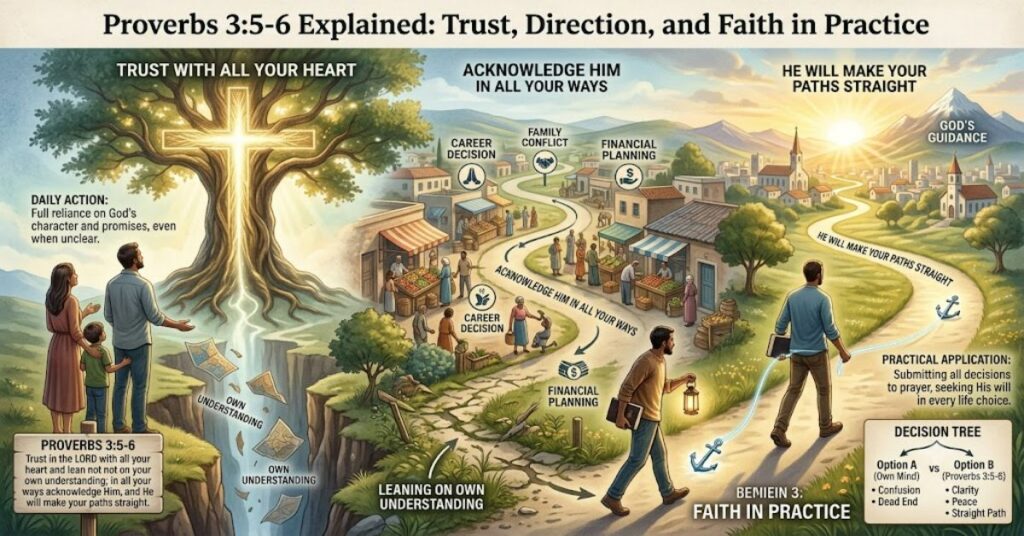
The passage known as 3:5-6 proverbs, more accurately referenced as Proverbs 3:5–6, is one of the most frequently cited scriptures in the Bible. It reads: “Trust in the LORD with all your heart and lean not on your own understanding; in all your ways submit to him, and he will make your paths straight.” This message has shaped Christian thought for centuries, offering guidance on how individuals should approach decisions, uncertainty, and faith.
At its core, Proverbs 3:5-6 challenges human dependence on logic alone. Instead, it encourages believers to place full trust in divine wisdom, even when circumstances are unclear or complex. This teaching has remained relevant across generations because it speaks directly to a universal human struggle: the tension between control and surrender.
The phrase 3 5 6 proverbs is often searched by individuals seeking clarity on life direction, spiritual reassurance, or biblical interpretation. Whether applied to personal decisions, relationships, or professional challenges, the passage continues to influence how people interpret guidance and purpose. Its simplicity is what makes it powerful—offering a direct contrast between human limitation and divine understanding.
Understanding Proverbs 3:5–6 in Context
Proverbs is a book of wisdom literature traditionally attributed to King Solomon. It focuses on practical guidance for living a righteous and disciplined life. Proverbs 3:5–6 stands out because it shifts from general wisdom principles to a deeply relational instruction about trust in God.
The verse is structured as two connected commands and one promise:
- Trust in the Lord fully
- Do not rely on personal understanding
- Acknowledge Him in all actions
- Receive direction in return
This structure makes the passage both instructional and conditional, emphasizing action followed by spiritual outcome.
Breaking Down the Meaning of Proverbs 3:5-6
Trust Beyond Emotion
The instruction to “trust in the Lord with all your heart” refers to a total form of reliance. In biblical language, the heart represents emotion, will, and inner decision-making. This means trust is not partial—it requires full commitment.
Limiting Human Understanding
The phrase “lean not on your own understanding” does not reject intelligence or reasoning. Instead, it highlights the limitations of human perspective when facing complex or unknown outcomes.
Submission in Daily Life
“In all your ways submit to him” suggests continuous alignment with divine principles, not just isolated religious acts. It extends faith into decision-making, ethics, and lifestyle choices.
Promise of Direction
“He will make your paths straight” symbolizes clarity, guidance, and reduced confusion in life choices. It does not guarantee an easy life but suggests purposeful direction.
Comparative Interpretations Across Traditions
| Tradition / Interpretation | Focus Area | Key Emphasis |
| Evangelical Christianity | Personal faith | Direct trust in God’s guidance |
| Catholic interpretation | Wisdom + tradition | Balance between faith and reason |
| Jewish context | Wisdom literature | Ethical living and divine law |
| Modern devotional use | Daily application | Decision-making and life guidance |
Practical Applications in Modern Life
Decision-Making Framework
Many people apply Proverbs 3:5–6 as a mental model when facing uncertainty. It functions as a pause mechanism before major decisions—encouraging reflection beyond emotional or impulsive reasoning.
Leadership and Ethics
In leadership contexts, the passage is often referenced to promote humility and accountability. Leaders are encouraged to recognize limitations in their own judgment.
Emotional Stability
Psychologically, the idea of surrendering control can reduce anxiety. While not a clinical solution, it offers a cognitive reframing of uncertainty.
Risks and Misinterpretations
Despite its popularity, 3 5 6 proverbs is sometimes misunderstood.
Over-Simplification Risk
Some interpret it as a promise of guaranteed success, which is not supported by the broader biblical context.
Passive Decision-Making
Another risk is using the verse to avoid personal responsibility or critical thinking.
Context Removal
Reading the verse in isolation can distort its meaning, as Proverbs as a whole emphasizes active wisdom, discipline, and effort.
Structured Insight: Emotional vs Rational Trust
| Dimension | Human Understanding | Divine Trust (Proverbs 3:5–6) |
| Decision Source | Logic, experience | Faith, spiritual guidance |
| Certainty Level | Limited | Relational confidence |
| Outcome Expectation | Calculated risk | Direction and alignment |
| Control | Individual-driven | Surrendered guidance |
Cultural and Historical Impact
The passage has influenced literature, sermons, music, and personal philosophy. It is frequently cited in motivational contexts, especially during times of uncertainty such as career transitions, illness, or personal loss.
Historically, Proverbs has served as a foundational text in Judeo-Christian ethics, shaping ideas of wisdom not as knowledge alone but as lived practice.
Information Gap Insights (Original Analysis)
1. Cognitive Conflict Resolution
Modern psychology parallels the passage’s instruction with “cognitive offloading,” where individuals reduce mental stress by delegating uncertainty to a trusted framework.
2. Decision Fatigue Reduction
Applying the principle of 3 5 6 proverbs can reduce decision fatigue by limiting over-analysis in high-pressure situations.
3. Cultural Misalignment in Modern Contexts
In highly analytical societies, the verse is sometimes dismissed as non-rational, even though it aligns with modern behavioral science on intuition vs analysis balance.
The Future of Proverbs 3:5–6 in 2027
By 2027, digital faith communities and AI-driven devotional tools are expected to increase engagement with scripture-based decision frameworks. Platforms integrating spiritual content with mental wellness tools may reference passages like Proverbs 3:5–6 in guided reflection exercises.
However, a key challenge will be maintaining theological accuracy in algorithm-generated interpretations. As AI expands into religious content delivery, ensuring contextual fidelity will become increasingly important.
The passage is likely to remain culturally stable, even as its delivery methods evolve through apps, chat-based devotionals, and digital study platforms.
Key Takeaways
- Proverbs 3:5–6 centers on trust, humility, and guidance beyond human reasoning.
- It functions as both a spiritual teaching and a decision-making framework.
- Misinterpretation often occurs when the verse is separated from its broader context.
- Modern psychology finds parallels in stress reduction and decision-making clarity.
- Its relevance continues to grow in digital and global faith environments.
Conclusion
Proverbs 3:5–6 remains one of the most influential passages in biblical wisdom literature because it addresses a fundamental human challenge: uncertainty. The instruction to trust beyond personal understanding reflects a tension between control and surrender that continues to shape spiritual and philosophical thought.
While interpretations vary across traditions, the central message remains consistent—human reasoning has limits, and guidance often requires humility. In modern contexts, the verse is applied not only in religious practice but also in personal development, leadership, and emotional resilience.
Its enduring relevance lies in its simplicity. Rather than offering complex systems or rules, it presents a clear relational principle between trust and direction. As life becomes increasingly complex, this ancient passage continues to offer a grounding perspective for those seeking clarity.
Frequently Asked Questions
What does Proverbs 3:5-‘6 mean?
It teaches full trust in God rather than relying only on personal understanding.
Why is Proverbs 3:5-6 important?
It provides guidance on decision-making, faith, and spiritual direction.
Is Proverbs 3:5-6 about ignoring logic?
No. It encourages faith alongside, not against, reasoning.
How can Proverbs 3:5-6 be applied today?
It is often used for decision-making, stress management, and personal reflection.
What is the main message of 3 5 6 proverbs?
Trust leads to direction when human understanding reaches its limits.
Methodology
This article is based on biblical text analysis from the Book of Proverbs (NIV and public domain translations), supported by theological commentary traditions and comparative interpretation studies. Psychological parallels were drawn from established cognitive behavior research concepts such as decision fatigue and cognitive offloading. Interpretations are presented in a balanced manner without doctrinal bias.
References (APA)
- The Holy Bible, New International Version. (2011). Biblica.
- Longman, T. (2006). Proverbs. Baker Academic.
- Waltke, B. K. (2004). The Book of Proverbs: Chapters 1–15. Eerdmans.
- American Psychological Association. (2023). Decision fatigue and cognitive load research. https://www.apa.org/
- Oxford Biblical Studies Online. (2024). Wisdom literature overview. https://www.oxfordbiblicalstudies.com/