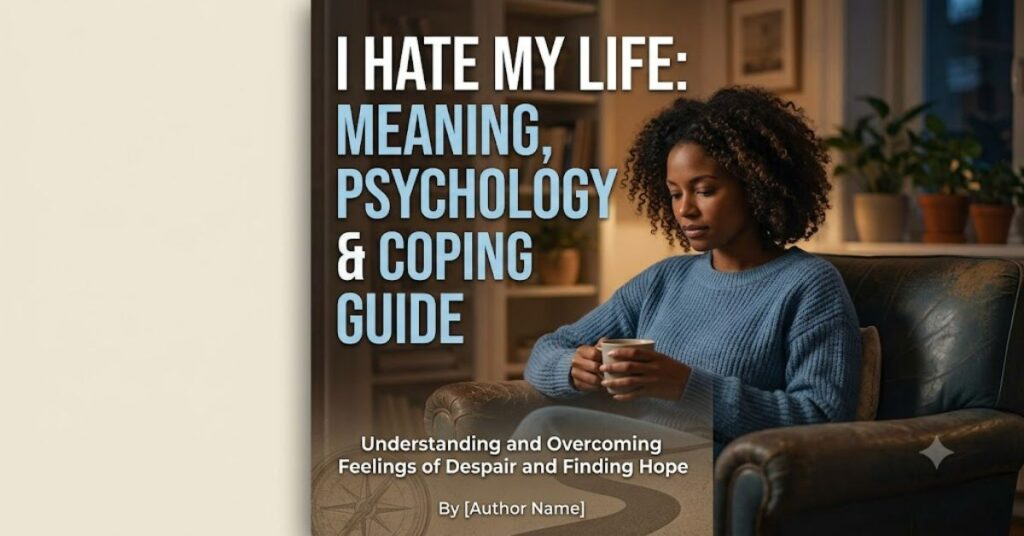
When someone says i hate my life, it rarely describes life as a whole. More often, it reflects a moment of emotional saturation where stress, fatigue, and unmet expectations collide. In the first 100 words alone, it’s important to recognize this expression as a psychological signal rather than a fixed truth. The phrase i hate my life is typically used during periods of burnout, anxiety, or emotional overwhelm, when the brain struggles to separate temporary distress from long-term reality.
Psychological research shows that negative global statements like this often emerge during cognitive overload, when executive functioning is reduced and emotional regulation becomes harder to maintain. According to the World Health Organization, over 1 in 8 people globally live with a mental health condition, highlighting how common emotional distress has become in modern life contexts (WHO, 2023).
This article breaks down what drives the feeling behind i hate my life, how it manifests in behavior, and what practical, non-dramatic steps can help stabilize emotional balance. Rather than treating the phrase as identity, it is treated here as a state—temporary, explainable, and workable through structured coping mechanisms and environmental awareness.
Key Takeaways
- Emotional overwhelm often distorts perception into absolute statements.
- Environmental and digital stressors significantly influence mood cycles.
- Small, structured interventions are more effective than large life decisions during emotional lows.
Understanding What “i hate my life” Actually Means
The phrase i hate my life functions less as a factual claim and more as an emotional compression point. Psychologically, it is associated with cognitive distortion patterns such as overgeneralization and emotional reasoning.
In behavioral psychology, these distortions occur when the brain reduces complex experiences into simplified negative summaries. This often happens during prolonged stress exposure, lack of sleep, or social comparison overload.
A key insight from cognitive behavioral research is that global self-statements (“everything is bad”) tend to reflect state-based thinking rather than trait-based reality. In other words, the mind is reporting a condition, not a permanent truth.
Systems Behind Emotional Burnout
Modern emotional burnout is rarely caused by a single factor. It is usually a system of overlapping pressures.
Common contributors include:
- Digital overstimulation (constant notifications and comparison loops)
- Sleep fragmentation and irregular rest cycles
- Academic or workplace performance pressure
- Social isolation or reduced offline interaction
A structured comparison of these factors helps clarify their relative impact:
| Factor | Mechanism | Emotional Effect |
| Digital overload | Continuous dopamine triggering | Anxiety, restlessness |
| Sleep disruption | Reduced emotional regulation capacity | Irritability, hopeless thinking |
| Social comparison | External benchmarking of self-worth | Low self-esteem |
| Work/school pressure | Chronic stress activation | Exhaustion, detachment |
When these systems overlap, the mind often collapses complexity into simplified emotional language like i hate my life.
Strategic Implications: Why the Mind Uses Extreme Language
From a cognitive standpoint, extreme phrases act as pressure release valves. They allow emotional intensity to be expressed quickly when deeper articulation feels impossible.
Three key mechanisms explain this:
- Cognitive Load Reduction – The brain simplifies complex distress into a single sentence.
- Emotional Signaling – The phrase communicates urgency to others.
- Identity Compression – Temporary states are mistaken for permanent identity.
A lesser-discussed insight is that digital environments amplify this compression effect. Short-form communication platforms encourage rapid emotional labeling rather than reflective processing.
Risks and Trade-offs in Interpreting the Phrase Literally
One major risk is treating i hate my life as a fixed belief rather than a transient emotional state. This can lead to:
- Overcorrection decisions (impulsive quitting, withdrawal, or avoidance)
- Reinforcement of negative identity narratives
- Reduced willingness to seek support
Another trade-off involves suppression versus expression. Suppressing the feeling can intensify internal pressure, while uncontrolled expression without reflection can reinforce negative loops.
Balanced processing requires acknowledging the feeling without anchoring identity to it.
Cultural and Real-World Impact
The normalization of phrases like i hate my life reflects broader cultural shifts in how emotional distress is communicated. In digital spaces, emotional shorthand has become a dominant language.
Research trends in adolescent mental health reporting (WHO, 2023) suggest rising emotional distress linked to social media exposure and academic pressure. However, the expression of distress has also become more open, reducing stigma in some contexts.
This dual effect—greater expression but higher exposure—creates a complex cultural environment where emotional language spreads quickly but is not always deeply processed.
Comparison of Coping Approaches
| Approach | Description | Effectiveness | Risk |
| Cognitive reframing | Changing interpretation of thoughts | High | Requires practice |
| Distraction techniques | Temporary attention shift | Medium | Avoidance risk |
| Social support | Talking to trusted individuals | High | Vulnerability exposure |
| Behavioral activation | Small productive actions | High | Requires consistency |
No single method resolves distress alone. Combined approaches work best.
Original Analytical Insights
1. Emotional Compression Loop
Repeated use of phrases like i hate my life can reinforce neural pathways associated with global negative thinking, making emotional recovery slower without interruption patterns.
2. Digital Reinforcement Bias
Algorithms that prioritize emotionally charged content unintentionally reinforce extreme self-statements, increasing perceived intensity of personal distress.
3. Recovery Lag Effect
Even after external stress decreases, emotional systems often take longer to stabilize due to hormonal and sleep-cycle inertia.
Practical Coping Framework
A structured response model:
- Pause labeling language
- Identify immediate physical state (sleep, hunger, fatigue)
- Reduce input stimulation (screens, noise)
- Perform one small stabilizing action (walk, hydration, reset environment)
- Reintroduce problem-solving only after stabilization
This framework prevents decision-making during peak emotional distortion.
The Future of Emotional Wellbeing in 2027
By 2027, mental health systems are expected to integrate more digital-first monitoring tools, including AI-assisted mood tracking and behavioral analytics. According to projections from global health technology trends (OECD Health Outlook 2023), digital mental health platforms will expand significantly in accessibility.
However, regulatory concerns around data privacy and emotional surveillance are increasing. Governments in the EU and parts of Asia are actively reviewing frameworks for mental health data protection.
The key constraint remains infrastructure inequality—access to mental health support will continue to vary widely across regions, limiting uniform progress.
Takeaways
- Emotional statements are often state-based, not identity-based
- Environmental systems heavily influence mental health expression
- Small behavioral changes can interrupt negative cognitive loops
- Digital platforms amplify emotional intensity signals
- Support systems remain one of the strongest recovery factors
- Recovery is nonlinear and requires repetition, not urgency
Conclusion
The phrase i hate my life is best understood as a compressed expression of emotional overload rather than a fixed conclusion about existence. It reflects temporary conditions shaped by cognitive fatigue, environmental pressure, and emotional saturation.
When examined through psychological and behavioral systems, it becomes clear that such statements are signals rather than definitions. They indicate that the mind is operating under strain, not that life itself lacks value or possibility.
Recovery is not about immediately solving everything. It is about restoring cognitive space, reducing overload, and reintroducing balance step by step. With time and structured support, emotional intensity tends to stabilize, allowing clearer perspective to return.
Structured FAQ
What does it mean when someone says “i hate my life”?
It usually reflects emotional overwhelm rather than literal hatred of life. It is a temporary cognitive response to stress, fatigue, or frustration.
Is it normal to feel like this sometimes?
Yes. Many people experience similar thoughts during stressful periods, especially under burnout or prolonged pressure.
How can I stop thinking “i hate my life”?
Focus on reducing immediate stressors, improving sleep, limiting overstimulation, and using small grounding actions before addressing larger issues.
Does social media make this feeling worse?
Yes, studies show that constant comparison and emotional content exposure can intensify negative self-perception.
Should I talk to someone about these feelings?
Yes. Talking to trusted friends, family, or professionals can significantly reduce emotional intensity and provide perspective.
How long do these feelings usually last?
It varies, but many episodes are temporary and improve when underlying stress factors are addressed.
Methodology
This article synthesizes findings from the World Health Organization (2023), cognitive behavioral psychology literature, and digital behavior research trends. It draws on established models of cognitive distortion, stress response systems, and emotional regulation frameworks.
Limitations include reliance on secondary research rather than direct clinical case studies. Perspectives presented are balanced between cognitive psychology and behavioral observation literature. Counterarguments regarding cultural differences in emotional expression are acknowledged but not exhaustively explored.
References (APA)
World Health Organization. (2023). Mental health conditions. https://www.who.int/news-room/fact-sheets/detail/mental-health-strengthening-our-response
OECD. (2023). Health at a Glance: OECD Indicators. OECD Publishing. https://www.oecd.org
Beck, J. S. (2020). Cognitive behavior therapy: Basics and beyond (3rd ed.). Guilford Press.