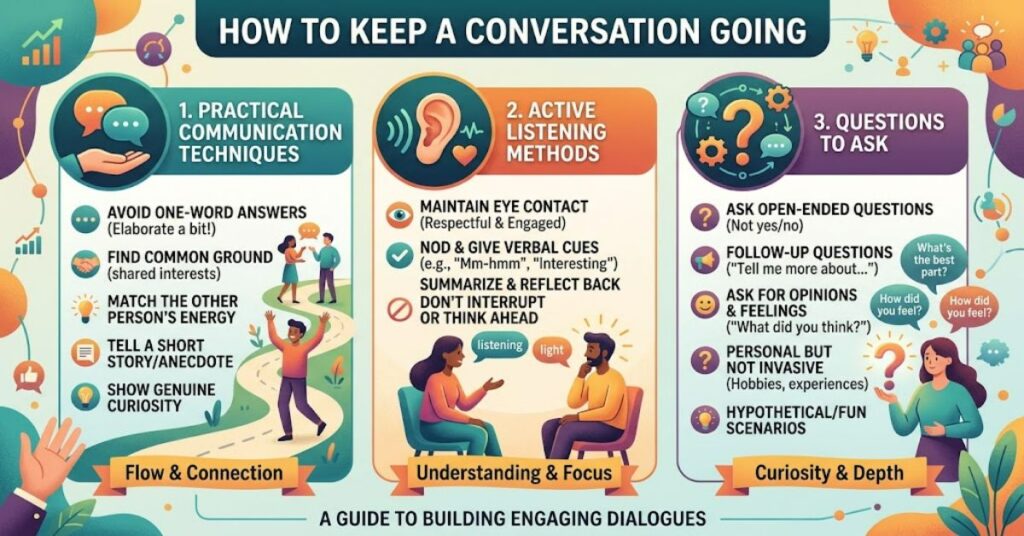
Knowing how to keep a conversation going is an important social skill that helps people build friendships, professional relationships, and stronger personal connections. Many people struggle with conversations because they focus too much on finding the “perfect” thing to say instead of paying attention to the person in front of them.
A good conversation is not a performance. It is a shared exchange where both people feel heard and valued. The easiest way to create this flow is to shift your focus from trying to be interesting to becoming genuinely interested. Asking thoughtful follow-up questions, responding to what someone has shared, and adding small pieces of your own experience can transform a short interaction into a meaningful discussion.
Research in social psychology shows that people often feel closer to those who demonstrate curiosity and active listening. A 2017 study published in the Journal of Personality and Social Psychology found that asking questions, particularly follow-up questions, improves social connection because it signals interest and engagement.
Whether you are meeting someone new, attending an event, networking, or simply trying to improve everyday communication, conversational ability is a learnable skill. It does not depend on having endless stories or being naturally outgoing. It depends on understanding conversational patterns and practicing better responses.
This guide explains practical methods for maintaining conversations, common mistakes that stop discussions, and evidence-based techniques that help people communicate with more confidence.
Why Conversations Often Stop Too Quickly
Many conversations end because one or both people unintentionally create barriers. These problems are usually not caused by a lack of topics but by weak conversational habits.
The Pressure to Be Interesting
A common mistake is believing every response must be clever, funny, or impressive. This creates unnecessary pressure and can make conversations feel unnatural.
People who focus only on their next answer often miss important details in what the other person is saying. Instead of listening, they mentally prepare their next statement.
A better approach is to treat conversation as exploration. Each answer contains possible directions for the discussion.
For example:
Person A: “I recently started learning photography.”
A weak response:
“That’s cool. I like cameras too.”
A stronger response:
“What made you interested in photography? Do you prefer taking pictures of people or places?”
The second response creates an opening for a longer exchange.
The Difference Between Talking and Connecting
Talking involves exchanging words. Connecting involves understanding another person’s thoughts, experiences, and emotions.
A conversation becomes memorable when people feel recognized. Simple signals such as remembering details, asking follow-up questions, and responding with genuine reactions create stronger social bonds.
The Core Principles of How to Keep a Conversation Going
1. Ask Open-Ended Questions
Questions are the engine of conversation, but not all questions create the same result.
Closed questions usually produce short answers:
“Did you enjoy the event?”
“Yes.”
Open-ended questions encourage explanation:
“What was the most interesting part of the event?”
The second question gives the person more room to share thoughts and experiences.
Useful open-ended question patterns include:
- “What inspired you to…?”
- “How did you get interested in…?”
- “What was that experience like?”
- “What happened next?”
- “What do you enjoy most about it?”
These questions work because they invite stories rather than simple facts.
2. Follow the Conversation Thread
Many conversations fail because people change topics too quickly.
If someone mentions an interesting detail, explore it before moving somewhere else.
Example:
“I spent my summer volunteering at an animal shelter.”
Possible follow-up:
“What kind of animals did you work with?”
Less effective response:
“That reminds me, I watched a movie about animals yesterday.”
The first response shows attention. The second shifts the focus away.
3. Share Small Personal Details
A conversation cannot survive if only one person answers questions. Mutual sharing creates balance.
However, sharing does not mean telling your entire life story immediately.
Small personal details work better:
- A recent experience
- A personal opinion
- A funny observation
- A related memory
This creates what communication researchers call reciprocal self-disclosure, where people gradually reveal information and build trust.
Conversation Techniques Compared
| Technique | How It Works | Best Used When | Common Mistake |
| Open-ended questions | Encourages detailed answers | Meeting someone new | Asking too many questions without sharing |
| Active listening | Shows attention and understanding | Personal conversations | Waiting for your turn to speak |
| Personal sharing | Creates connection and trust | Building relationships | Oversharing too quickly |
| Topic expansion | Extends interesting discussions | Social events | Changing subjects too often |
Active Listening: The Hidden Skill Behind Great Conversations
Many people think conversation ability comes from speaking well. In reality, listening quality often determines conversation success.
Active listening involves:
- Paying attention without interrupting
- Responding to key points
- Asking relevant follow-up questions
- Showing emotional understanding
A useful technique is the “echo and expand” method.
First, repeat or acknowledge an important part of what the person said.
Example:
“That sounds like a challenging project.”
Then expand:
“What part required the most problem-solving?”
This approach confirms that you heard them while encouraging deeper discussion.
Common Mistakes That End Conversations
Understanding what damages conversations is as important as knowing what improves them.
Turning Conversations Into Interviews
Asking question after question can make someone feel examined rather than connected with.
Balance questions with personal responses.
Instead of:
“What do you do?”
“What hobbies do you have?”
“What movies do you like?”
Try:
“What do you do?”
“I work in marketing.”
“That sounds interesting. I have always wondered how creative campaigns are developed. What part of your work do you enjoy most?”
The conversation becomes a shared exchange.
Giving One-Word Answers
Short responses often unintentionally signal disinterest.
Instead of:
“Fine.”
Try:
“Fine, actually. I finally finished a project I had been working on for weeks.”
A small addition gives the other person something to continue.
Trying Too Hard to Avoid Silence
Short pauses are normal. Many people panic when silence appears and rush to fill it.
Comfortable conversations include moments of thinking. A pause does not automatically mean failure.
Data Insights: What Makes Conversations Stronger?
| Communication Factor | Effect on Conversation |
| Follow-up questions | Increases engagement and perceived interest |
| Personal stories | Creates emotional connection |
| Active listening | Builds trust and understanding |
| Shared experiences | Creates stronger memories |
| Balanced speaking time | Prevents one-sided interaction |
The Psychology Behind Meaningful Conversations
Human conversations are influenced by several psychological principles.
Curiosity Builds Connection
People naturally respond positively when others show interest in their experiences. Curiosity communicates respect and encourages openness.
Similarity Creates Comfort
People often connect faster when they discover shared interests, experiences, or values.
Finding common ground does not mean pretending to agree with everything. It means recognizing genuine points of connection.
Emotional Responses Matter
Facts keep conversations moving, but emotions make them memorable.
Compare:
“I moved to another city.”
with:
“I moved to another city, and the first few months were exciting but also lonely.”
The second statement creates more opportunities for meaningful discussion.
Practical Strategies for Different Situations
Keeping a Conversation Going With Someone New
Use simple discovery questions:
- “What brought you here?”
- “How do you know the host?”
- “What has been keeping you busy lately?”
Avoid overly personal questions too early.
Professional Conversations
Work conversations benefit from curiosity about experiences and ideas.
Examples:
- “What trends are affecting your industry?”
- “What skills have helped you most in your career?”
Digital Conversations
Online chats require extra clarity because tone is harder to understand.
Helpful habits:
- Avoid extremely short replies
- Ask follow-up questions
- Reference previous messages
- Use appropriate humor
The Future of Conversation Skills in 2027
Communication skills are becoming increasingly valuable as digital interaction grows. Advances in artificial intelligence, remote work, and online communities are changing how people communicate, but human connection remains dependent on trust and understanding.
By 2027, conversational skills are likely to become more important in workplaces where hybrid teams rely heavily on written and virtual communication. Organizations are already investing in emotional intelligence and collaboration training because technical skills alone do not create effective teams.
At the same time, AI-powered communication tools may influence how people write messages and interact online. The challenge will be maintaining authentic human conversation while using technology as support rather than replacement.
The future of communication will likely favor people who can combine digital awareness with traditional interpersonal skills: listening, empathy, curiosity, and adaptability.
Key Takeaways
- Conversations improve when curiosity replaces the pressure to impress.
- Follow-up questions create natural opportunities for deeper discussion.
- Active listening is often more valuable than having perfect responses.
- Personal sharing helps create trust when balanced appropriately.
- Silence is a normal part of communication, not always a problem.
- Strong conversations are built through mutual participation.
Conclusion
Keeping a conversation alive is not about memorizing endless topics or becoming the most entertaining person in the room. It is about creating an environment where both people feel comfortable sharing ideas, experiences, and opinions.
The strongest conversations usually come from simple habits: listening carefully, asking meaningful questions, and responding with genuine interest. These skills work across friendships, professional relationships, and everyday interactions.
Communication improves through practice. Every conversation provides an opportunity to understand people better and develop stronger social awareness. By focusing less on performing and more on connecting, anyone can become a better conversational partner.
Frequently Asked Questions
How do you keep a conversation going naturally?
Keep conversations flowing by asking open-ended questions, responding to details the other person shares, and adding your own related experiences. Focus on curiosity rather than trying to create perfect answers.
What should I talk about when a conversation becomes boring?
Look for topics connected to the other person’s interests, experiences, or opinions. Asking “What has been exciting for you recently?” can open new directions.
How do follow-up questions improve conversations?
Follow-up questions show that you are paying attention. They encourage people to share more information and create a stronger feeling of connection.
Why do some conversations feel awkward?
Awkward conversations often happen when people feel pressure to perform, avoid sharing, or fail to respond to what the other person says.
How can shy people become better conversationalists?
Shy people can improve by practicing small interactions, preparing a few open-ended questions, and focusing attention on learning about others rather than monitoring themselves.
Is silence bad during a conversation?
No. Short pauses are natural. Comfortable conversations include moments of thinking and do not require constant talking.
Methodology
This article was developed using established communication research, social psychology findings, and practical communication frameworks. Sources were reviewed from academic publications and recognized communication resources.
The analysis focuses on general conversation techniques rather than clinical communication training. Individual personality differences, cultural backgrounds, and social environments may affect how people communicate.
This article was drafted with AI assistance and reviewed for structure, clarity, and accuracy before publication.
References (APA Style)
Huang, K., Yeomans, M., Brooks, A. W., Minson, J. A., & Gino, F. (2017). It doesn’t hurt to ask: Question-asking increases liking. Journal of Personality and Social Psychology, 113(3), 430–452.
Rogers, C. R. (1957). The necessary and sufficient conditions of therapeutic personality change. Journal of Consulting Psychology, 21(2), 95–103.
Kraut, R. E., Fish, R. S., Root, R. W., & Chalfonte, B. L. (1990). Informal communication in organizations: Form, function, and technology. In S. Oskamp & S. Spacapan (Eds.), People’s reactions to technology in factories, offices, and homes. Sage Publications.
Editorial Note: Internal links from Postcard.fm were not inserted because no verified live related URLs were provided. They should be added after checking the site’s published content inventory.