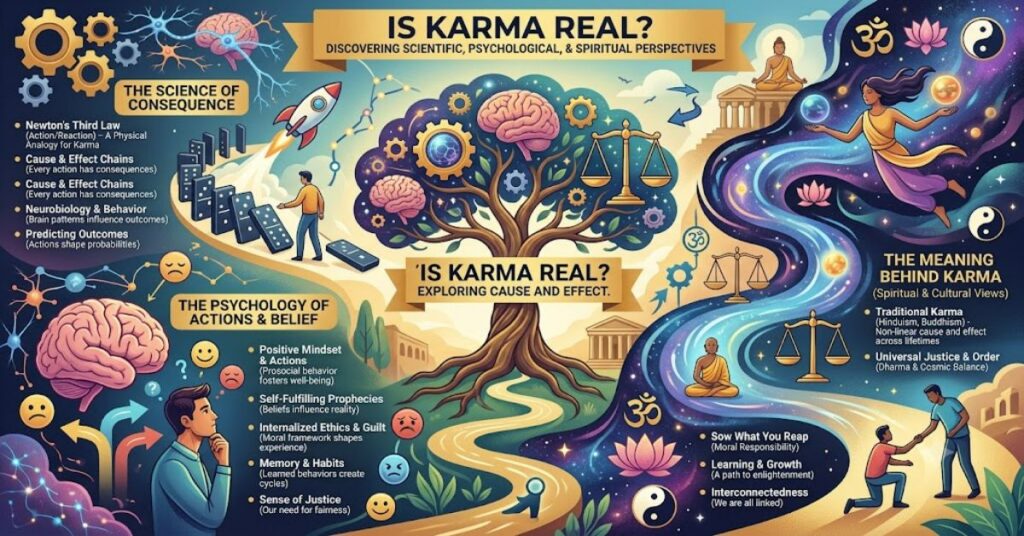
The question “is karma real” has been debated for centuries across religions, philosophy, psychology, and everyday life. Some people believe karma is a universal force that ensures good actions eventually receive rewards and harmful actions eventually bring consequences. Others view karma as a cultural idea rather than a measurable law of nature.
From a scientific perspective, there is no verified evidence of a cosmic system that records human actions and delivers rewards or punishments. However, karma can be understood through psychology and social behavior. The way people treat others often influences their relationships, reputation, mental health, and opportunities.
A person who consistently acts with honesty may build stronger relationships and receive more support over time. Someone who repeatedly harms others may lose trust, damage their reputation, and experience social consequences. These outcomes are not caused by a mystical force but by predictable patterns in human interaction.
The concept of karma has roots in ancient Indian traditions, particularly Hinduism, Buddhism, and Jainism. Over thousands of years, it has developed into a broader cultural idea about responsibility, morality, and the connection between actions and outcomes.
This article explores karma from multiple perspectives: religious history, scientific understanding, psychological research, and modern social behavior. The goal is not to prove or disprove spiritual beliefs but to examine why the idea remains powerful and meaningful in human societies.
Understanding the Origins of Karma
The word karma comes from the Sanskrit term “karman,” meaning action, deed, or work. Early discussions of karma appeared in ancient Indian texts such as the Upanishads, where actions were connected with moral consequences and cycles of existence.
Different traditions interpret karma in different ways.
| Tradition | View of Karma | Main Focus |
| Hinduism | Actions influence future experiences and spiritual development | Moral responsibility and rebirth |
| Buddhism | Intentions and actions shape experiences and suffering | Mindfulness and ethical living |
| Jainism | Actions create spiritual consequences affecting the soul | Purification and non-violence |
| Modern culture | Actions often create predictable outcomes | Social consequences and personal growth |
Although interpretations differ, many traditions share one idea: human choices matter.
Is Karma Real From a Scientific Perspective?
Science studies measurable events through observation, testing, and evidence. Because karma is often described as a spiritual mechanism, it cannot be tested in the same way as physical laws like gravity or chemical reactions.
There is currently no scientific proof that a universal force rewards good people or punishes bad people.
However, science does explain why karma can appear real in everyday life.
Social Consequences of Human Behavior
Human beings depend on cooperation. Trust, reputation, and relationships influence survival and success.
A person who behaves fairly may develop:
- Stronger friendships
- Better professional relationships
- Greater social support
- More opportunities through trust networks
A person who behaves dishonestly may experience:
- Loss of reputation
- Reduced cooperation from others
- Social isolation
- Professional consequences
These effects create a natural cause-and-effect system.
The Psychology of Reciprocity
Psychologists have studied reciprocity, the tendency for people to respond to actions from others.
When someone receives kindness, they are often more likely to return positive behavior. This principle helps explain why generosity and cooperation can spread through groups.
Research by social psychologist Robert Cialdini identified reciprocity as one of the major principles influencing human behavior and persuasion.
How Psychology Explains Karma-Like Effects
Modern psychology provides several explanations for why people often believe karma works.
Reputation and Social Memory
Communities remember patterns of behavior.
A person who consistently helps others develops a reputation for reliability. Over time, this reputation can create opportunities because people prefer working with individuals they trust.
This is especially visible in professional environments where relationships influence hiring, partnerships, and career growth.
Self-Fulfilling Behavior
People’s beliefs about themselves and others can influence their actions.
Someone who believes kindness creates connection may behave more openly and build stronger relationships. Someone who expects conflict may act defensively and create negative interactions.
The result can look like karma because behavior influences future experiences.
Emotional Consequences
Actions also affect internal psychological states.
Positive actions may create feelings of:
- Satisfaction
- Purpose
- Social connection
Harmful actions may contribute to:
- Stress
- Guilt
- Anxiety
- Relationship problems
These emotional outcomes are measurable psychological effects rather than supernatural punishment.
Karma Compared With Other Cause-and-Effect Ideas
| Concept | Source | How It Works |
| Karma | Religious and philosophical traditions | Actions influence future outcomes |
| Reciprocity | Psychology | People respond to treatment from others |
| Consequence Theory | Behavioral science | Actions create predictable results |
| Social Reputation | Sociology | Communities reward trust and discourage harmful behavior |
Real-World Examples of Karma-Like Outcomes
Business and Professional Life
Companies and leaders often experience consequences based on how they treat employees, customers, and partners.
Organizations that build trust may attract stronger talent and customer loyalty. Companies that damage their reputation may struggle even when they have strong products.
Personal Relationships
Relationships are shaped by repeated behavior.
A person who listens, supports others, and communicates honestly usually creates healthier connections. Someone who repeatedly breaks trust may eventually find fewer people willing to offer support.
Online Communities
Digital platforms have created new forms of reputation systems.
Reviews, ratings, and public discussions influence how people are perceived. Online behavior can create long-lasting consequences because digital actions are often recorded permanently.
Risks of Misunderstanding Karma
While karma can encourage ethical behavior, it can also be misunderstood.
Blaming People for Their Misfortune
One harmful interpretation is assuming that every negative event happens because someone “deserved” it.
Real life is more complicated. People experience illness, accidents, economic hardship, and unfair circumstances that are not caused by personal wrongdoing.
Expecting Immediate Justice
Another misunderstanding is believing every harmful action will quickly receive punishment.
Sometimes unfair situations remain unresolved. Karma, when interpreted practically, is better understood as long-term patterns rather than guaranteed immediate justice.
Ignoring Structural Factors
Individual choices matter, but social conditions also influence outcomes.
Education, economic opportunities, discrimination, and access to resources can affect people’s experiences. A complete understanding of consequences requires considering both personal actions and external circumstances.
Cultural Impact of Karma
The idea of karma has influenced literature, films, personal development movements, and everyday language around the world.
Expressions such as “what goes around comes around” reflect a simplified version of karmic thinking.
The concept remains popular because it addresses a universal human desire: the belief that actions have meaning and that fairness exists beyond immediate circumstances.
In modern society, karma often functions as a moral framework rather than a scientific explanation.
The Future of Karma in 2027
By 2027, discussions about karma are likely to continue evolving alongside interest in psychology, mindfulness, and ethical living.
Modern wellness movements increasingly focus on concepts connected to karma, including compassion, emotional awareness, and personal responsibility. These ideas are often separated from religious beliefs and presented as tools for improving mental health and relationships.
Research into social networks and behavioral science will likely continue showing how cooperation, trust, and reputation influence outcomes. Digital environments may make these effects even more visible because online actions can create lasting records.
However, there is no evidence suggesting science will validate karma as a supernatural system. Future discussions will likely focus more on karma as a philosophical idea explaining human connection and consequences.
Key Takeaways
- There is no scientific evidence of karma as a supernatural reward system.
- Human behavior creates real consequences through relationships and reputation.
- Ancient traditions view karma as a moral principle connected with actions.
- Psychology explains many karma-like experiences through reciprocity and social behavior.
- Karma can encourage ethical choices without requiring a spiritual explanation.
- Misusing karma to blame people for suffering creates harmful interpretations.
Conclusion
The question of whether karma is real depends largely on what someone means by karma. If karma refers to a cosmic system that automatically rewards and punishes people, science has not found evidence supporting that claim. If karma refers to the way actions influence relationships, emotions, and social outcomes, there is strong evidence that human behavior creates consequences.
The lasting appeal of karma comes from its message of responsibility. People’s choices matter, and the way they treat others often shapes the world they experience.
A practical understanding of karma does not require certainty about supernatural forces. It can simply represent an awareness that kindness, honesty, and respect often create conditions for better relationships, while harmful actions frequently carry predictable costs.
Frequently Asked Questions
Is karma real according to science?
Science has not found evidence that karma exists as a supernatural force controlling rewards and punishments. However, psychology and sociology show that actions often create predictable social and emotional consequences.
Does karma mean bad people will always be punished?
No. Karm’a does not guarantee immediate justice. Real-life outcomes are influenced by many factors, including circumstances, choices, and social conditions.
Why do people believe in karma?
Many people believe in karm’a because it provides a framework for understanding morality, fairness, and personal responsibility.
Is karm’a connected to religion?
Yes. Karma is strongly connected with Hinduism, Buddhism, and Jainism, where it has different spiritual meanings. Modern culture also uses karm’a as a general idea about consequences.
Can karm’a improve behavior?
The belief in karm’a may encourage people to act ethically because it emphasizes responsibility and awareness of consequences.
Is karm’a the same as “what goes around comes around”?
The phrases are related, but “what goes around comes around” is a simplified modern expression. Traditional karm’a concepts often involve deeper spiritual and philosophical ideas.
Methodology
This article was developed using research from psychology, sociology, religious studies, and philosophical sources. Information was gathered from academic publications, established books, and recognized research organizations.
The analysis separates spiritual beliefs from scientifically measurable effects. Since karm’a has religious interpretations that cannot be tested scientifically, the article presents multiple perspectives rather than making a definitive claim about belief systems.
Limitations include differences between cultural interpretations of karm’a and variations in individual experiences.
This article was drafted with AI assistance and reviewed for accuracy, structure, and readability before publication.
References (APA Style)
Cialdini, R. B. (2021). Influence: The psychology of persuasion. Harper Business.
Fehr, E., & Gächter, S. (2000). Fairness and retaliation: The economics of reciprocity. Journal of Economic Perspectives, 14(3), 159–181.
Karma, in Encyclopedia Britannica. (2024). Encyclopaedia Britannica.
Nowak, M. A. (2006). Five rules for the evolution of cooperation. Science, 314(5805), 1560–1563.
Tomasello, M. (2016). A natural history of human morality. Harvard University Press.
Editorial Note: Internal links were not added because no verified live Postcard.fm URLs related to this topic were provided. They should be inserted after checking the website’s current published articles.