
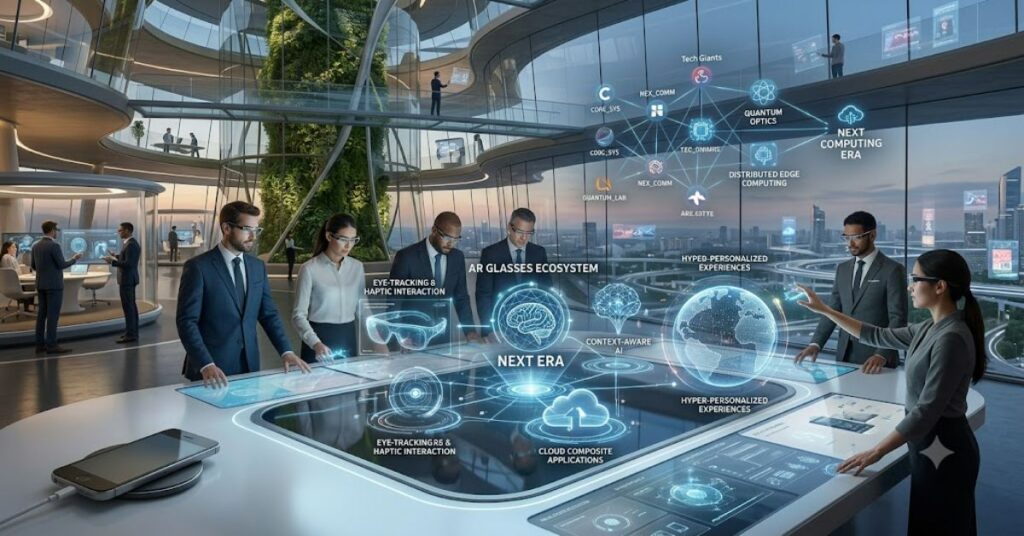
The idea that tech giants envision future beyond smartphones is no longer science fiction. Over the past several years, companies including Apple, Meta, Google, Samsung, and Qualcomm have significantly increased investments in augmented reality (AR), mixed reality (MR), spatial computing, and artificial intelligence. Their long-term objective is not simply to create another gadget but to redefine how people interact with digital information.
Instead of looking down at a handheld screen hundreds of times each day, future users may receive notifications, navigation, translations, and AI assistance directly through lightweight smart glasses. Advances in miniature processors, computer vision, voice recognition, and cloud computing are making this transition increasingly realistic.
The smartphone transformed communication, commerce, entertainment, and productivity over the past two decades. However, many technology leaders believe handheld devices have reached a maturity point where future innovation depends on more immersive, context-aware interfaces. Wearable devices powered by AI assistants could provide information exactly when needed while reducing constant screen interaction.
Although significant technical and social challenges remain, the industry’s investment patterns clearly indicate that wearable computing represents one of the next major frontiers of consumer technology.
Why the Smartphone May No Longer Be the Final Platform
Smartphones remain incredibly capable devices, but they also introduce limitations.
Users must constantly unlock screens, launch applications, and manually navigate digital interfaces. These repeated interactions interrupt conversations, driving, walking, and everyday activities.
Wearable computing aims to reduce this friction by allowing information to appear naturally within a user’s field of view through voice commands, gesture recognition, and contextual AI assistance.
Rather than replacing every smartphone function immediately, smart glasses may gradually absorb many everyday tasks.
Technologies Driving the Transition
Several technological advances are converging to support this shift.
| Technology | Role in Future Wearables |
| Augmented Reality | Displays digital information in real environments |
| Artificial Intelligence | Provides contextual assistance and automation |
| Spatial Computing | Understands physical surroundings |
| Computer Vision | Recognizes objects and environments |
| Edge Computing | Reduces latency for real-time responses |
| 5G & Future Networks | Enables fast cloud communication |
These technologies work together to create seamless digital experiences beyond traditional mobile screens.
How Major Tech Companies Are Preparing
Several global technology companies are pursuing different strategies.
| Company | Current Focus |
| Apple | Spatial computing ecosystem and mixed reality |
| Meta | Consumer smart glasses and AI integration |
| Android XR and AI-powered wearable experiences | |
| Samsung | XR hardware partnerships and ecosystem expansion |
| Qualcomm | Chips powering next-generation wearable devices |
Although each company follows a unique roadmap, their long-term vision increasingly centers on wearable computing rather than solely improving smartphones.
The Role of Artificial Intelligence
Artificial intelligence may become the defining feature of next-generation wearable devices.
Instead of opening multiple apps, users could simply ask an AI assistant to:
- Schedule meetings
- Translate conversations
- Navigate unfamiliar cities
- Summarize emails
- Identify landmarks
- Answer contextual questions
AI transforms wearable devices from display tools into proactive digital assistants that understand user intent and surroundings.
Opportunities for Businesses
The transition toward wearable computing creates significant opportunities.
Industries expected to benefit include:
- Healthcare
- Manufacturing
- Education
- Logistics
- Retail
- Field services
For example, technicians wearing AR glasses can receive maintenance instructions without stopping work, while medical professionals may access patient information during procedures without leaving the examination room.
These enterprise applications may drive adoption before consumer replacement of smartphones becomes widespread.
Challenges Slowing Adoption
Despite impressive progress, several barriers remain.
| Challenge | Impact |
| Battery limitations | Short operating time |
| Hardware cost | Higher prices reduce accessibility |
| Privacy concerns | Cameras raise ethical questions |
| Social acceptance | Wearables change public interactions |
| Display technology | Miniaturization remains difficult |
| Application ecosystem | Software must evolve |
Solving these challenges will determine how quickly wearable devices become mainstream.
Three Important Industry Insights
Beyond the commonly discussed advantages, three trends deserve closer attention:
Enterprise adoption may arrive first. Businesses often accept expensive hardware when productivity gains justify the investment, making industrial applications a likely early success.
Developers will shape the ecosystem. Just as smartphones flourished through mobile applications, wearable computing depends on compelling software rather than hardware alone.
Privacy regulations could influence adoption. Governments may introduce stricter rules surrounding always-on cameras, biometric tracking, and AI-powered environmental scanning, affecting product design and user acceptance.
The Future of Tech Giants Envision Future Beyond Smartphones in 2027
By 2027, smartphones are unlikely to disappear, but their role may begin shifting toward that of a companion device rather than the primary computing interface.
AI-powered smart glasses are expected to become lighter, more energy efficient, and increasingly integrated with cloud services. Improvements in battery technology, display optics, and semiconductor manufacturing should expand their practical use.
However, widespread replacement depends on affordability, application availability, consumer trust, and regulatory clarity regarding privacy. The transition will likely occur gradually rather than through a sudden technological revolution.
Key Takeaways
- Technology companies are investing heavily in wearable computing.
- AI assistants will become central to future user experiences.
- Spatial computing enables more natural digital interaction.
- Enterprise adoption may outpace consumer adoption initially.
- Hardware, privacy, and software ecosystems remain significant challenges.
- Smartphones will likely coexist with smart glasses for several years.
Conclusion
The fact that tech giants envision future beyond smartphones reflects a broader transformation in computing rather than the decline of mobile devices. Companies are pursuing interfaces that reduce dependence on handheld screens while making digital information more accessible through AI, augmented reality, and contextual computing.
Although today’s smartphones remain indispensable, the industry’s research and investment clearly point toward wearable ecosystems capable of delivering richer, hands-free experiences. Enterprise deployments are already demonstrating practical value, while consumer adoption continues to grow as hardware becomes smaller and more capable.
Whether smart glasses eventually replace smartphones entirely remains uncertain. What appears increasingly likely is that the next generation of personal computing will revolve around intelligent, connected wearables working alongside existing devices rather than replacing them overnight.
Frequently Asked Questions
Why do tech giants envision a future beyond smartphones?
Many companies believe wearable computing and AI can provide more natural, hands-free interactions than traditional touchscreen devices.
Will AR glasses completely replace smartphones?
Probably not immediately. Most experts expect smartphones and smart glasses to coexist for several years while wearable technology matures.
What technologies power smart glasses?
Modern smart glasses combine augmented reality, artificial intelligence, computer vision, spatial computing, sensors, and cloud connectivity.
Which industries may adopt wearable computing first?
Healthcare, manufacturing, logistics, education, and field services are expected to benefit early from productivity improvements.
What are the biggest challenges facing smart glasses?
Battery life, affordability, privacy concerns, software ecosystems, and lightweight hardware design remain the largest obstacles.
Methodology
This article synthesizes information from official announcements, product launches, developer conferences, technical documentation, and industry analysis related to augmented reality, spatial computing, wearable devices, and artificial intelligence. Claims were cross-checked against publicly available documentation from major technology companies and reputable industry research. Forward-looking observations are based on announced product roadmaps and current technological capabilities, while acknowledging uncertainty around adoption timelines and regulatory developments.
References
- Apple. (2024). Apple Vision Pro Newsroom and Developer Documentation.
- Google. (2024). Android XR and AI Platform Announcements.
- Meta. (2024). Meta Connect Keynotes and Reality Labs Updates.
- Qualcomm Technologies. (2024). Snapdragon XR Platform Documentation.
- International Data Corporation (IDC). (2024). Worldwide Augmented and Virtual Reality Market Forecast.
AI Disclosure
This article was drafted with AI assistance and reviewed and verified by [Author Name]. All data, citations, and claims should be independently confirmed by the editorial team at Postcard.fm before publication.