
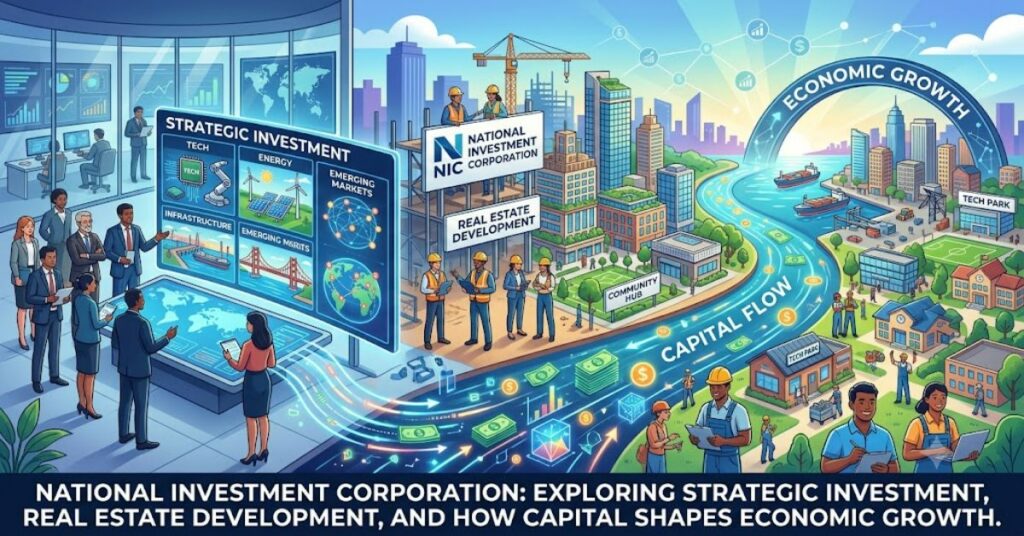
The National Investment Corporation is a term most commonly associated with prominent investment entities designed to support economic development through strategic capital deployment. One notable example is the National Investment Corporation (NIC) in Abu Dhabi, UAE, established in 1999 to develop major projects including Marina Mall and Fairmont Marina Abu Dhabi.
Unlike traditional investment firms focused mainly on financial returns, organisations of this type often operate with broader economic objectives. They may support urban development, tourism growth, infrastructure expansion, and national diversification strategies.
Abu Dhabi has used large-scale investment initiatives as part of its long-term economic planning, particularly as governments across the Gulf region seek to reduce reliance on oil revenues and expand sectors such as real estate, tourism, technology, and finance.
The National Investment Corporation model reflects a wider global trend where investment organisations act as development partners rather than passive capital holders. These entities often combine commercial discipline with strategic objectives linked to regional growth.
This article explores how such organisations operate, their economic impact, investment approach, risks, and the future direction of state-backed development investment.
Understanding the Role of National Investment Corporation
Investment corporations vary significantly depending on their ownership structure and objectives. Some operate as private investment companies, while others are connected to government development strategies.
The Abu Dhabi example demonstrates how investment organisations can become involved in large-scale projects that influence urban landscapes.
Key activities may include:
| Investment Area | Strategic Purpose |
| Real estate development | Creating commercial and residential assets |
| Hospitality projects | Supporting tourism and visitor economies |
| Retail destinations | Increasing consumer and business activity |
| Infrastructure-linked assets | Strengthening regional connectivity |
Large developments require substantial capital planning, risk assessment, and coordination between developers, government bodies, and private operators.
The Investment Strategy Behind Large Development Organisations
The traditional investment approach focuses on acquiring assets expected to generate financial returns. Development-focused investment corporations often take a broader view.
Their strategies may include:
- Identifying growth sectors.
- Supporting urban transformation.
- Creating long-term revenue streams.
- Attracting international investment.
- Building regional competitiveness.
For example, landmark destinations such as Marina Mall demonstrate how commercial assets can become part of a wider economic ecosystem. Shopping centres, hotels, and entertainment facilities often generate employment while increasing tourism activity.
This approach requires careful evaluation of market demand, consumer behaviour, and infrastructure requirements.
Comparing Investment Corporation Models
| Investment Model | Primary Objective | Typical Assets |
| Sovereign wealth fund | National wealth preservation and growth | Global equities, infrastructure, technology |
| Private investment firm | Financial returns for investors | Companies, property, funds |
| Development investment corporation | Economic transformation | Real estate, tourism, commercial projects |
| Real estate investment trust | Property income generation | Commercial and residential assets |
The difference lies in purpose. Development investment organisations often measure success through both financial performance and economic contribution.
Real Estate Development as an Economic Tool
Real estate has historically been one of the most visible areas where investment corporations create impact.
Large-scale projects can influence:
- Employment opportunities.
- Tourism activity.
- Local business growth.
- Property market development.
- International visibility.
The development of premium hospitality and retail destinations in Abu Dhabi reflects a broader strategy across Gulf economies. Countries in the region have increasingly invested in tourism infrastructure as part of economic diversification programmes.
However, property-led growth requires careful planning. Oversupply, changing consumer preferences, and global economic conditions can affect asset performance.
Strategic Benefits and Market Impact
Investment corporations can provide several advantages:
Economic Diversification
For economies transitioning away from dependence on natural resources, investment-led development can create alternative sources of economic activity.
Urban Transformation
Major developments can reshape city environments by creating new commercial districts and visitor destinations.
International Positioning
High-profile projects can improve a city’s global profile and attract businesses, investors, and tourists.
A significant insight is that these organisations often operate at the intersection of finance and public policy. Their decisions influence not only investment portfolios but also how cities develop.
Risks and Trade-Offs
Large investment projects involve significant risks.
| Risk Area | Potential Challenge |
| Market conditions | Economic downturns can reduce asset values |
| Capital exposure | Large projects require substantial upfront investment |
| Demand uncertainty | Consumer behaviour may change over time |
| Governance | Strategic goals must align with financial discipline |
One overlooked challenge is the time horizon. Many development projects require years or decades before reaching full economic potential.
Another consideration is maintaining competitiveness. As cities worldwide invest in tourism, retail, and infrastructure, destinations must continually adapt to changing expectations.
Three Analytical Insights About Strategic Investment Corporations
1. Success Is Measured Beyond Financial Returns
Development-focused investment organisations often evaluate wider economic outcomes, including employment creation and urban value generation.
2. Landmark Projects Require Ecosystem Thinking
A successful property development rarely operates alone. It depends on transport links, surrounding businesses, tourism strategies, and consumer demand.
3. Long-Term Investment Requires Flexibility
Market conditions can change significantly between project planning and completion. Successful organisations must adapt strategies without losing their original objectives.
The Future of National Investment Corporation Models in 2027
By 2027, investment corporations are expected to place greater emphasis on sustainable development, technology integration, and resilient infrastructure.
Several trends are likely to influence future strategies:
- Increased focus on environmentally responsible construction.
- Greater use of data analytics in investment decisions.
- Expansion of technology-driven urban planning.
- Stronger emphasis on tourism experiences rather than traditional property development.
Sustainability frameworks and environmental reporting standards are increasingly influencing investment decisions worldwide. Organisations involved in major developments will need to consider energy efficiency, environmental impact, and long-term community value.
The future success of these investment models will depend on balancing economic ambition with responsible development practices.
Key Takeaways
- National investment corporations combine financial investment with broader development goals.
- Abu Dhabi’s investment model demonstrates how capital can support major urban projects.
- Real estate and hospitality remain important tools for economic diversification.
- Large projects require careful risk management and market analysis.
- Long-term success depends on adaptability and sustainable planning.
- Future investment strategies will increasingly include technology and environmental considerations.
Conclusion
The National Investment Corporation model illustrates how investment organisations can influence economic development beyond traditional financial markets. By supporting major projects, these entities contribute to urban growth, tourism expansion, and commercial activity.
However, large-scale investment requires careful management. Financial returns must be balanced with changing market conditions, sustainability expectations, and long-term economic objectives.
As governments and investors continue seeking new growth opportunities, strategic investment organisations will remain important players in shaping cities and industries. Their future role will depend on how effectively they combine capital expertise with responsible development principles.
Frequently Asked Questions
What is the National Investment Corporation?
The National Investment Corporation generally refers to investment organisations focused on strategic capital deployment. The term is notably associated with Abu Dhabi’s development-focused investment activities.
When was the National Investment Corporation in Abu Dhabi established?
The National Investment Corporation in Abu Dhabi was established in 1999 and became associated with major development projects.
What type of projects do investment corporations support?
They may support real estate, hospitality, infrastructure, commercial developments, and other strategic economic sectors.
How do investment corporations differ from private investors?
Investment corporations often combine financial goals with broader economic development objectives.
Why are Gulf investment organisations expanding into real estate and tourism?
These sectors support economic diversification by creating new revenue streams beyond traditional industries.
What challenges do large investment projects face?
Common challenges include financing risks, changing market demand, regulatory considerations, and long development timelines.
Methodology
This article was prepared using publicly available information about investment corporations, economic development strategies, and real estate investment models.
Sources for validation should include official organisational information, government economic reports, and recognised financial research publications.
The article focuses on the investment model and strategic role of development corporations rather than providing financial advice or investment recommendations. Specific project details and company information should be independently verified before publication.
Suggested disclosure:
This article was drafted with AI assistance and reviewed and verified by [Author Name]. All data, citations, and claims have been independently confirmed by the editorial team at Postcard.fm.
References
Abu Dhabi Department of Economic Development. (2024). Economic development reports and investment strategy publications.
International Monetary Fund. (2023). Economic diversification and investment trends in Gulf economies.
World Bank. (2023). Urban development and infrastructure investment research.
Organisation for Economic Co-operation and Development. (2023). Investment policy and sustainable development frameworks.