
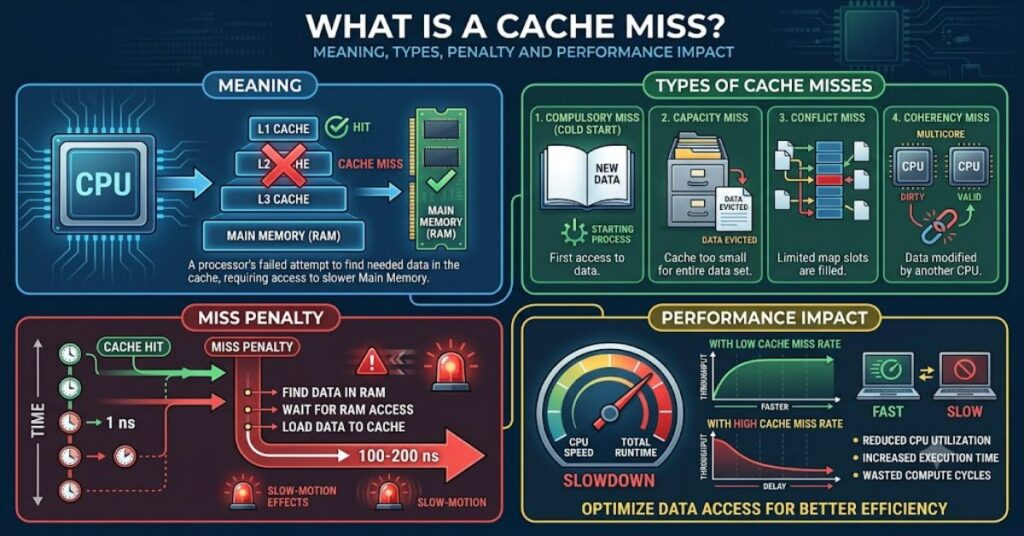
If you are asking what is a cache miss, the simple answer is this: it occurs when a system looks for requested data in its cache but cannot find a usable copy. The system then follows a slower fallback path, such as checking another cache level, main memory, a database or an origin server. The additional time required is commonly described as the cache miss penalty.
Caching exists because repeatedly retrieving the same information from a slower location wastes time and resources. A cache keeps frequently or recently needed information closer to the component requesting it. When the requested information is already there, the system gets a cache hit. When it is absent, the request becomes a miss.
The concept appears across modern computing. A CPU can miss its L1 cache and continue through L2 or L3. A browser can miss its HTTP cache and request a resource from a network server. A content delivery network (CDN) can miss an object and retrieve it from the origin. These situations share the same basic principle, although their costs and solutions differ.
Understanding misses is therefore important for developers, system architects and anyone investigating unexplained latency. A high miss rate can increase memory traffic, network requests, database load and response times. But a miss rate should never be judged in isolation: the location of the miss and its penalty matter just as much.
How a Cache Miss Works
A cache normally sits between a requester and a slower data source.
The basic process is:
- An application or processor requests data.
- The cache checks whether a usable copy exists.
- If the data exists, the request produces a cache hit.
- If it does not, the request produces a cache miss.
- The system retrieves the data from a lower or slower layer.
- Depending on the cache design, the retrieved data may be stored for future requests.
For example, a CPU might request a memory address and first check L1 cache. If the required cache line is absent, the processor can check another level before going to main memory. The farther the request travels through the memory hierarchy, the greater the potential latency.
A similar principle applies to web delivery. Cloudflare explains that when a CDN does not contain requested content, the request can be passed to the origin server, after which the content can be cached for subsequent requests.
This reveals an important point: a cache miss does not automatically mean a system is performing badly. A miss is simply a failure to satisfy a request at the current cache layer. The real performance question is how expensive that failure becomes.
Cache Hit vs Cache Miss
The difference is straightforward, but the consequences can be significant.
| Feature | Cache Hit | Cache Miss |
| Requested data | Available in cache | Not available |
| Retrieval path | Short | Longer |
| Typical latency | Lower | Higher |
| Extra resource use | Usually low | Potentially higher |
| Fallback required | No | Yes |
| Performance impact | Positive | Depends on miss penalty |
A CDN, for example, may serve a cached image immediately during a hit. During a miss, the CDN has to contact the origin or another upstream layer before returning the resource.
The same principle appears inside a processor. A miss in L1 is not necessarily catastrophic because the requested data may still be available in L2. A miss that continues all the way to main memory carries a much larger cost.
What Is a Cache Miss Penalty?
The cache miss penalty is the additional time or performance cost associated with retrieving data after a cache miss.
Consider a simplified example. Suppose a cache access takes 1 nanosecond and the fallback operation takes 50 nanoseconds. If 5% of requests miss, a simplified average access calculation is:
Average access time = hit time + miss rate × miss penalty
So:
1 ns + 0.05 × 50 ns = 3.5 ns
This is a simplified model, but it demonstrates why even a relatively small miss rate can influence average performance when the fallback operation is expensive. Cornell’s computer architecture material uses the same basic relationship when explaining average memory access time and multi-level cache hierarchies.
The key insight is that miss rate and miss penalty must be considered together.
A 10% miss rate with a tiny penalty may be less damaging than a 2% miss rate that repeatedly sends requests to a very slow database or distant origin.
Types of Cache Misses
CPU cache misses are commonly discussed in several categories.
Compulsory Miss
A compulsory miss occurs when data is accessed for the first time and has not yet been loaded into the cache.
This type of miss is difficult to eliminate completely. If a processor has never requested a particular cache line, there is no existing copy for the cache to return.
Capacity Miss
A capacity miss occurs when the working data set is larger than the cache can effectively hold. Data that was previously stored is removed to make room for newer information. When the old data is needed again, another miss occurs.
Increasing cache capacity can help, but only if capacity is actually the problem.
Conflict or Associativity Miss
A conflict miss occurs when multiple pieces of data compete for the same cache location or set, causing useful data to be displaced even when the cache has unused space elsewhere.
Cache architecture uses associativity and replacement policies to manage this problem.
Coherence-Related Miss
In multi-core systems, one processor may modify data that another processor has cached. Maintaining a consistent view of memory can therefore trigger coherence traffic and invalidate or update cache lines. The Linux kernel’s performance glossary identifies communication and related cache effects among reasons data may no longer be available in a CPU’s local cache.
Cache Misses Across Different Systems
The term is used across several layers of technology, but the consequences differ.
| Cache Type | Miss Fallback | Main Risk |
| L1 CPU cache | L2/L3 or memory | Processor stalls |
| L2/L3 cache | Lower cache or RAM | Higher memory latency |
| Browser cache | Network server | Slower page resources |
| CDN cache | Origin server | Network and origin load |
| Database cache | Storage/database engine | Query and I/O latency |
| Application cache | Database or service | Increased response time |
Browser caching illustrates the same pattern at the application level. HTTP caching allows a stored response to be reused rather than sending every request back to the origin. When the cached response is unavailable or no longer fresh, the browser may need to communicate with the remote server.
Why Cache Misses Happen
Several factors can produce misses.
Data has never been cached: This is common during application startup or when a new resource is requested.
The cache is too small: A working set can exceed available cache capacity.
Data has expired: Web and application caches often use freshness rules. Microsoft documentation, for example, describes a miss occurring when content is not cached or when its cached copy has expired and no longer represents the origin version.
Poor locality: Software that accesses memory in scattered patterns can make less effective use of CPU caches.
Rapidly changing data: Highly dynamic content may be difficult or undesirable to cache.
Eviction: Cache replacement policies remove entries when space is required.
These causes require different solutions. Simply adding more memory will not fix every cache problem.
Why Miss Rate Alone Can Mislead
One of the most useful performance insights is that a lower miss rate is not always the only objective.
A cache may deliberately tolerate some misses if reducing them would require excessive memory, complexity or energy. CPU caches operate as a hierarchy because different levels balance speed, capacity and cost.
The same principle applies to CDNs. Cloudflare notes that static websites can achieve very high cache hit ratios, while sites serving substantial dynamic content may naturally have lower ratios. It also warns that hit ratio alone does not determine CDN effectiveness; where content is served from and how quickly it reaches the user matter too.
This creates a practical rule: optimise for overall latency and resource efficiency, not simply for the highest possible hit percentage.
How Developers Can Reduce Cache Misses
Several strategies can improve cache behaviour.
Improve Locality
For CPU-bound software, arranging data so related values are accessed close together can improve spatial and temporal locality.
Choose Appropriate Cache Sizes
Application caches need enough capacity for useful working sets, but excessively large caches can increase memory consumption and management overhead.
Review Expiration Policies
Web and distributed caches need sensible freshness rules. Very short lifetimes can create unnecessary misses, while very long lifetimes can deliver stale information.
Monitor the Right Metrics
Useful measurements include:
| Metric | What It Reveals |
| Hit rate | How often the cache satisfies requests |
| Miss rate | How often fallback is required |
| Miss penalty | Cost of a fallback |
| Eviction rate | How frequently entries are removed |
| Latency | User or application impact |
| Origin load | Pressure created by misses |
A 2023 study on software optimisation demonstrated that reducing L1 data-cache misses can produce measurable performance improvements in real open-source workloads, showing why memory access behaviour can matter alongside algorithmic optimisation.
Risks and Trade-Offs
Caching is not free.
More cache capacity consumes resources. More aggressive caching can create stale-data problems. Complex invalidation rules increase operational difficulty. Distributed caches also introduce consistency questions.
The classic challenge is deciding how long data should remain usable. A cache that expires everything quickly may provide excellent freshness but poor hit rates. A cache that keeps data for too long may perform efficiently while serving information that is no longer correct.
For database-backed applications, this trade-off becomes particularly important. Postcard.fm’s recent discussion of database optimisation highlights cache hit ratios alongside query profiling, CPU, memory and I/O monitoring as part of broader performance analysis.
The Future of Cache Misses in 2027
By 2027, caching will remain fundamental because modern systems continue to separate fast local resources from slower remote or persistent storage.
The important change is likely to be greater observability. Developers increasingly need to understand not just whether a request missed, but why it missed, where the fallback occurred and how much latency that miss introduced.
Multi-level architectures will also remain important. CPUs already use hierarchical caches, while web applications increasingly combine browser caches, CDNs, application caches and database caches.
The infrastructure constraint is unchanged: faster storage and larger caches do not remove the fundamental trade-off between capacity, latency, cost and freshness.
For that reason, future optimisation will probably focus less on eliminating every miss and more on controlling expensive misses.
Key Takeaways
- A cache miss means requested data is unavailable at the cache layer being checked.
- The system then follows a slower retrieval path.
- Miss penalty is often more important than miss count alone.
- CPU misses can involve L1, L2, L3 and main memory.
- Web caches can fall back to origin servers.
- Cache size, locality, expiration and eviction policies all affect miss rates.
- Effective optimisation considers latency, resource use and freshness together.
Conclusion
A cache miss is a basic computing event with consequences that can range from almost negligible to highly expensive. The defining feature is simple: the requested data is not available where the system expected to find it.
What happens next determines the real impact. A CPU may move from L1 to L2, while a CDN may contact an origin server. A browser may request a resource over the network, and an application cache may fall back to a database.
That is why cache performance should not be judged by miss rate alone. The size of the penalty, the workload, data freshness and fallback path all matter.
The strongest caching strategies therefore balance speed with accuracy and resource use. The objective is not necessarily a perfect hit rate. It is a system in which unavoidable misses remain inexpensive while costly misses are identified, measured and reduced.
Frequently Asked Questions
What is a cache miss in simple terms?
A cache miss happens when a system looks for requested data in a cache but does not find it. The system then retrieves the information from another, usually slower, location.
What is the difference between a cache hit and a cache miss?
A cache hit means the requested data is available in the cache. A cache miss means it is unavailable and must be retrieved from another layer.
What causes a cache miss?
Common causes include first-time access, limited cache capacity, eviction, expiration, poor memory locality, conflicting accesses and rapidly changing data.
What is cache miss penalty?
Cache miss penalty is the additional time or performance cost required to obtain data after a cache lookup fails.
Is a high cache miss rate always bad?
Not necessarily. The impact depends on the miss penalty. A relatively high L1 miss rate may be acceptable if most requests are quickly satisfied by L2 or L3.
How can cache misses be reduced?
Developers can improve data locality, adjust cache capacity, tune expiration policies, reduce unnecessary invalidation and profile workloads to identify expensive misses.
Do browser caches also have cache misses?
Yes. If a browser cannot satisfy a request from its HTTP cache, it may need to contact a remote server or validate a stored response.
Methodology
This article was prepared by comparing technical explanations from Cloudflare, MDN, Microsoft documentation, Cornell University’s computer architecture material and Linux kernel documentation. These sources were used to distinguish CPU cache behaviour from browser, CDN and application caching.
The analysis also uses a published 2023 research paper on reducing data-cache misses in software workloads. No fabricated benchmark or firsthand testing is presented as original testing.
A limitation is that cache behaviour varies significantly by processor architecture, operating system, application, cache policy and workload. Examples of latency and miss penalties are therefore illustrative rather than universal measurements.
Editorial disclosure: This article was drafted with AI assistance and should be reviewed and verified by a human editor before publication. Technical claims, dates and references should be checked against their original sources.
References
Cloudflare. (2026). What is a cache hit ratio? Cloudflare Learning Center.
Cornell University. (2026). Caches. CS 3410 course materials.
Langdon, W. B., Petke, J., Blot, A., & Clark, D. (2023). GI software with fewer data cache misses. arXiv.
MDN Web Docs. (2026). HTTP caching. Mozilla Developer Network.
Microsoft. (2009). Cache miss. Microsoft Learn.
McKenney, P. E. (2026). Cache miss. Linux kernel performance book glossary.