Peptide Sciences was once a recognisable name in the U.S. research-peptide market, associated with laboratory-oriented peptides, amino-acid derivatives and other research materials. For years, the company’s products were presented as being intended for scientific research rather than human or veterinary use. That distinction became increasingly important as peptides moved from specialist laboratories into mainstream conversations about weight management, longevity, recovery and performance.
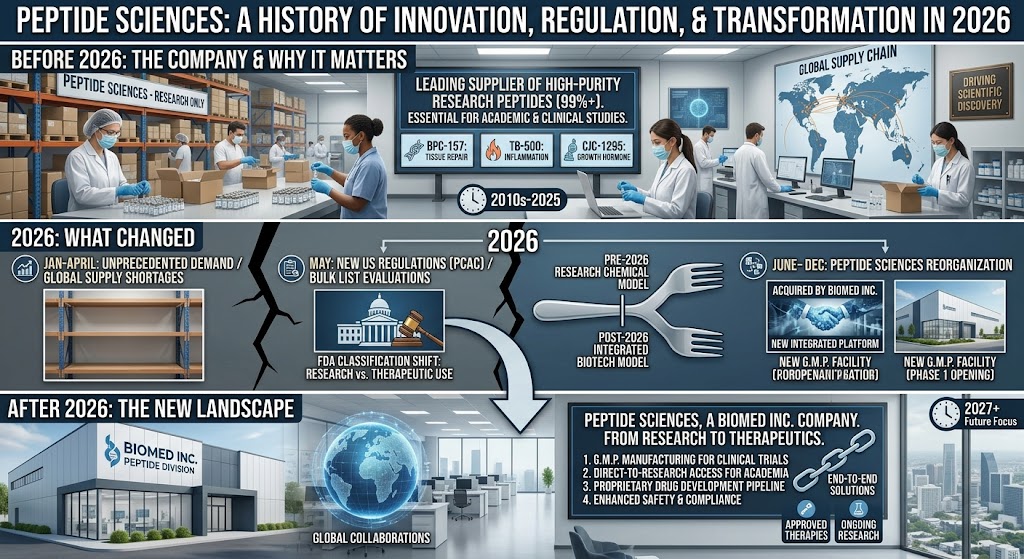
The situation changed sharply on March 6, 2026, when Peptide Sciences announced that it was voluntarily shutting down operations and discontinuing sales of its research products. Multiple contemporary reports documented the closure, while the company’s statement did not provide a detailed explanation for the decision.
That makes the Peptide Sciences story larger than one company’s closure. It illustrates a structural problem facing the research-peptide market: a product can be labelled “research use only”, but regulators examine the broader context in which a substance is advertised and sold. The FDA has explicitly taken action against peptide sellers where website claims indicated intended human use despite research-only disclaimers.
For researchers, businesses and readers trying to understand Peptide Sciences today, the important questions are therefore not simply what the company sold. They are why its operating model became difficult to sustain, what the shutdown says about regulatory expectations, and how peptide research may develop from here.
What Was Peptide Sciences?
Peptide Sciences was associated with the commercial supply of research peptides and related laboratory materials. Its products were marketed for scientific research, with disclaimers stating that they were not intended for human consumption or therapeutic use.
That business model occupied an unusual position. Peptides are legitimate scientific tools, and many peptide molecules are actively studied in molecular biology, pharmacology and drug development. However, the same molecules can sometimes be discussed online in connection with human health claims.
This created a crucial distinction between research material and medicine.
| Issue | Research-use context | Human-use context |
| Intended purpose | Laboratory investigation | Diagnosis or treatment |
| Regulatory pathway | Research material rules may apply | Drug regulation applies |
| Evidence expected | Analytical and experimental data | Safety and efficacy evidence |
| Manufacturing requirements | Depends on research application | Pharmaceutical standards and applicable law |
| Consumer risk | Laboratory handling concerns | Direct patient safety concerns |
The table explains why a disclaimer alone cannot settle the regulatory question. The FDA has stated that products marketed as “research use only” can still be treated as drugs when the evidence demonstrates an intended human use.
Why Research-Use-Only Labels Became a Central Issue
The phrase “research use only” sounds straightforward, but its legal significance depends on how a product is actually marketed.
In a February 2025 warning letter to USApeptide.com, the FDA specifically addressed products carrying research-only disclaimers while pointing to website evidence that indicated intended human use. The agency stated that unapproved drugs lack the safety, effectiveness and quality assurances associated with FDA-approved medicines.
A similar principle appeared in a March 2026 FDA warning letter to Gram Peptides. The agency concluded that products advertised by the company were unapproved new drugs and specifically rejected research-use wording as sufficient where the surrounding evidence established intended human use.
These are important documented cases because they demonstrate the regulatory issue in practice rather than merely describing it theoretically.
What Happened to Peptide Sciences?
On March 6, 2026, Peptide Sciences announced that it had decided to voluntarily shut down operations and discontinue sales of its research products. Contemporary reporting reproduced the brief closure statement and documented the disappearance of its former commercial operation.
The company did not publicly provide a detailed reason for the closure in the statement itself.
That limitation matters. It would be inaccurate to state definitively that a particular FDA action, lawsuit or quality incident directly caused the shutdown unless primary evidence establishes that connection.
However, the timing occurred against a wider regulatory background. The FDA had been intensifying enforcement against companies marketing unapproved peptide and GLP-1 products, including warning letters concerning misleading claims and unapproved drug products.
The shutdown therefore represents a documented business event within a clearly changing regulatory environment, even if the company’s precise internal reasoning remains undisclosed.
The Quality-Control Problem
Regulatory compliance is only one part of the story. Peptide research also depends heavily on analytical quality.
A research laboratory needs to know what material it is actually studying. Purity, identity, concentration, degradation products, contaminants and batch consistency can all affect experimental results.
For that reason, a credible research workflow may involve analytical techniques such as high-performance liquid chromatography (HPLC) and mass spectrometry (MS). These techniques answer different questions: HPLC can help assess purity and separate components, while mass spectrometry can provide information about molecular mass and identity.
A certificate of analysis can therefore be useful, but a document labelled “COA” is not automatically proof of quality. Researchers need to consider who performed the analysis, whether the documentation is batch-specific, which analytical methods were used and whether the reported results make scientific sense.
Structured Quality Insight
| Quality question | Why it matters |
| Is the lot identified? | Connects test results to a specific material |
| Is identity tested? | Helps establish what compound is present |
| Is purity reported? | Indicates the proportion of the target material |
| Is the analytical method stated? | Allows researchers to assess the evidence |
| Is the testing independent? | Can reduce conflicts of interest |
| Are storage conditions documented? | Peptides may be affected by handling and degradation |
This is one of the most important practical lessons from the sector: a high stated purity percentage is not the same thing as a complete quality-control system.
Regulatory Pressure Is Changing the Market
The FDA’s current compounding framework shows why the peptide market is becoming more complicated.
Under FDA’s framework for bulk drug substances, compounders operating under sections 503A and 503B face specific requirements governing which substances can be used. The agency maintains different categories while substances are evaluated and updates its lists as evidence develops.
The regulatory process remained active in 2026. In April, the FDA proposed excluding semaglutide, tirzepatide and liraglutide from the 503B bulk list after finding insufficient clinical need for outsourcing facilities to compound those substances from bulk materials.
Then, in July 2026, the Pharmacy Compounding Advisory Committee considered several peptide-related substances, including BPC-157, KPV, TB-500 and MOTS-c. The FDA briefing materials explicitly stated that final determinations would follow consideration of the advisory committee process and completion of the agency’s reviews.
That sequence shows that peptide regulation is not static. It is being evaluated substance by substance.
Three Practical Insights From the Peptide Sciences Case
First: a disclaimer is not a complete compliance strategy. The FDA’s warning letters demonstrate that regulators can assess the total context surrounding a product rather than accepting “research use only” language at face value.
Second: analytical documentation is becoming commercially important. As regulatory and scientific scrutiny increases, laboratories have stronger reasons to demand traceable, batch-specific evidence rather than relying on marketing claims.
Third: the market is separating research from medical access. A laboratory compound and an approved medicine may contain the same or related molecule while remaining very different products from a regulatory and quality perspective. Confusing those categories creates both scientific and consumer risk.
Real-World Impact of the Shutdown
For researchers, a supplier closure can create more than an inconvenience. Existing experiments may depend on continuity of materials, batch records and validated protocols.
A sudden change in supplier can introduce a new variable into an experiment. Even if two products carry the same compound name, differences in purity, formulation, salt form, storage or analytical verification can affect reproducibility.
For the wider market, the shutdown also sends a commercial signal. Suppliers operating in legally ambiguous territory face greater uncertainty when regulatory agencies focus on intended use, advertising claims and product characteristics.
The likely result is a stronger emphasis on traceability, analytical verification and clearly defined institutional research use.
The Future of Peptide Sciences in 2027
The future of the Peptide Sciences brand itself is uncertain. The March 6, 2026 announcement provided no indication of a planned reopening, and there is insufficient evidence to predict a return.
The broader peptide industry is easier to assess.
By 2027, regulatory evaluation is likely to remain substance-specific rather than treating “peptides” as one legal category. The FDA’s ongoing review of bulk substances demonstrates this approach, while its 2026 advisory committee meetings show that scientific evidence continues to influence decisions.
For laboratories, that could mean greater attention to documentation, analytical validation and supplier traceability. For human health applications, the distinction between FDA-approved medicines, appropriately compounded products and research-only materials is likely to remain critical.
One uncertainty is how quickly regulatory decisions will evolve. The July 2026 FDA briefing documents explicitly caution that advisory committee discussion does not itself constitute a final determination.
The safest forecast is therefore not that peptides will disappear or become universally accessible. It is that the market will become more differentiated, with stronger scrutiny around products intended for human use.
Key Takeaways
- Peptide Sciences announced a voluntary shutdown on March 6, 2026.
- The company did not publicly state a detailed reason for its closure.
- FDA enforcement demonstrates that research-only disclaimers do not override evidence of intended human use.
- Analytical quality requires more than a headline purity percentage.
- Batch identity, testing methodology and traceability are increasingly important research considerations.
- FDA peptide-related evaluations continued throughout 2026.
- The future of peptide research will depend heavily on scientific evidence, regulatory classification and quality controls.
Conclusion
The story of Peptide Sciences is ultimately a story about the changing boundaries between scientific research, commercial distribution and medical use. The company became a recognisable supplier in the research-peptide market, but on March 6, 2026, it announced that it would voluntarily end operations and discontinue sales.
Its closure should not be interpreted as evidence that peptide science itself is disappearing. Peptides remain important tools in biomedical research and drug development. What is changing is the commercial environment surrounding them.
FDA enforcement has demonstrated that research-use-only language cannot by itself determine how a product is legally treated. At the same time, the agency’s continuing evaluation of peptide-related substances shows that regulatory decisions are still developing.
For researchers, the enduring lesson is practical: identity, analytical evidence, traceability and appropriate regulatory classification matter as much as the name printed on a vial. That principle is likely to remain important well beyond the Peptide Sciences shutdown.
Frequently Asked Questions
What was Peptide Sciences?
Peptide Sciences was a prominent supplier associated with research peptides and laboratory materials. Its products were marketed for research use rather than human or veterinary consumption.
What happened to Peptide Sciences in 2026?
On March 6, 2026, the company announced that it was voluntarily shutting down operations and discontinuing sales of its research products. No detailed explanation was provided in the closure statement.
Why did Peptide Sciences shut down?
The company did not publicly provide a detailed reason. Its closure occurred during a period of heightened regulatory scrutiny of research-peptide and unapproved drug sellers, but a direct causal explanation has not been publicly established.
Are research peptides the same as approved medicines?
No. A research compound and an FDA-approved medicine can involve the same or related molecule but have different regulatory status, manufacturing controls, approved uses and evidence requirements.
What does “research use only” mean?
It indicates that a product is intended for laboratory research rather than human or veterinary use. However, the FDA can consider other evidence of intended use when determining whether a product is actually being marketed as a drug.
How is peptide quality evaluated?
Researchers may consider identity and purity testing, batch-specific documentation, analytical methods, storage conditions and traceability. Techniques such as HPLC and mass spectrometry can contribute to analytical characterisation.
Methodology
This article was researched using the supplied keyword brief and current public sources, with particular emphasis on primary FDA materials for regulatory claims. FDA pages covering bulk drug substances, compounding policies, warning letters and the July 2026 Pharmacy Compounding Advisory Committee meeting were used to validate the regulatory discussion.
Contemporary independent reporting was used to establish the March 6, 2026 Peptide Sciences shutdown and the wording of the company’s public announcement.
No product was purchased or experimentally tested for this article, so no fabricated hands-on testing claims are included. The two principal documented authority signals are the independently reported shutdown event and FDA enforcement actions against peptide sellers.
A key limitation is that Peptide Sciences did not publicly disclose a detailed explanation for its closure. Consequently, the article distinguishes the documented shutdown from broader regulatory developments rather than claiming that a particular enforcement action directly caused the company’s decision.
This article was drafted with AI assistance and should be reviewed and verified by a human editor before publication. All data, citations and named claims should be independently confirmed against the original sources.
References
U.S. Food and Drug Administration. (2025, February 26). USApeptide.com warning letter 696885. U.S. Department of Health and Human Services.
U.S. Food and Drug Administration. (2026, March 31). Gram Peptides warning letter 721806. U.S. Department of Health and Human Services.
U.S. Food and Drug Administration. (2026, April 30). FDA proposes to exclude semaglutide, tirzepatide, and liraglutide on 503B bulks list. U.S. Department of Health and Human Services.
U.S. Food and Drug Administration. (2026, July 23–24). Meeting of the Pharmacy Compounding Advisory Committee. U.S. Department of Health and Human Services.
The Peptide List Research Team. (2026, March 6). Peptide Sciences is dead: Inside the rise and fall of the gray market’s biggest name.
Peptide Protocol Wiki. (2026, March 9). Peptide Sciences shuts down: What happened and what it means for the research peptide industry.
Internal linking note: No relevant Postcard.fm article was surfaced during the site-specific search, so no unrelated internal links have been inserted. This follows the prompt’s requirement to avoid forced or irrelevant internal linking.