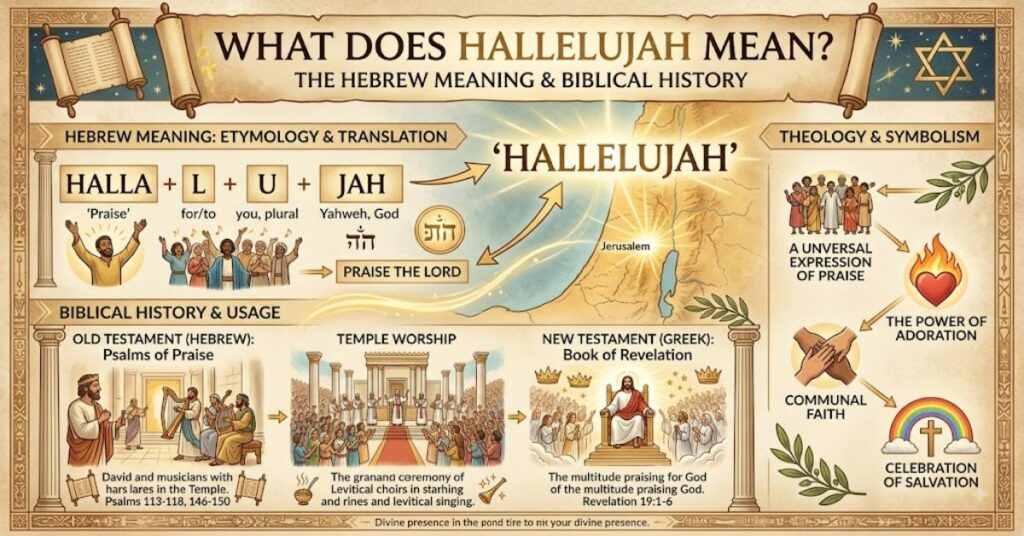
If you have ever wondered what does hallelujah mean, the simplest answer is “praise the Lord”. The word comes from Hebrew and is traditionally understood as a combination of hallelu, a command to praise, and Yah, a shortened form of Yahweh, the biblical name of God. In this sense, hallelujah is not merely a word describing happiness. It is an expression that directs praise towards God.
Its importance comes from its use in biblical worship. The term appears repeatedly in the Psalms, particularly in passages devoted to thanksgiving, celebration and recognition of God’s power. It later appears in the New Testament’s Book of Revelation, where it forms part of a heavenly chorus of praise.
The word has also travelled far beyond its original Hebrew setting. It became alleluia in Greek and has been preserved in many languages, often with only small changes in spelling or pronunciation. Christian worship adopted it as a familiar acclamation, while musicians and writers have used it in very different contexts.
Understanding its history helps explain why the word remains powerful. Hallelujah is fundamentally a call to praise rather than simply an emotional reaction. Its meaning rests on language, scripture and centuries of religious practice.
The Hebrew Meaning Behind Hallelujah
The Hebrew form is commonly represented as hallelu-yah. The first element comes from the Hebrew root halal, associated with praising, celebrating or expressing admiration. The second element, Yah, is a shortened form of Yahweh.
Together, the expression conveys the idea of praising Yahweh. That explains why English Bibles traditionally translate it as “Praise the Lord” rather than treating it as an ordinary noun.
There is also an important grammatical point. Hallelujah functions as an imperative expression. It calls people to praise rather than merely announcing that praise has taken place. In a worship setting, therefore, saying “hallelujah” can be understood as an invitation for others to join in praise.
This distinction gives the word much of its force. It is not simply equivalent to saying “wonderful” or “excellent”. Its original direction is religious and specific: praise belongs to God.
Hallelujah in the Psalms
The strongest biblical association is with the Book of Psalms. Several Psalms begin or end with hallelujah, and a number of them are commonly associated with the description “Hallelujah Psalms”.
Examples include Psalms 111–113 and 146–150. Psalm 150 is particularly significant because it closes the Psalter with an extended call to praise.
The placement of the expression matters. It can act as an opening summons, encouraging worshippers to praise God, or as a concluding declaration that reinforces the theme of the Psalm.
This creates an important insight into the word’s original function: hallelujah was not primarily designed as a private statement of excitement. It worked as part of communal worship, giving people a shared verbal expression through which they could acknowledge God’s greatness.
| Biblical setting | Function of hallelujah | Main emphasis |
| Psalms | Call or expression of praise | Worship and thanksgiving |
| Psalm collections | Opening or closing acclamation | Communal praise |
| Revelation 19 | Heavenly declaration | God’s victory and glory |
| Modern worship | Congregational expression | Praise and devotion |
Bible reference resources identify several groups of Psalms where the expression appears, including Psalms 104–106, 111–113 and 146–150.
Hallelujah in the New Testament
The word’s journey did not end with the Hebrew Bible. Its Greek form, alleluia, appears in the Book of Revelation.
Revelation 19 is especially important because the expression appears four times in that chapter. The word occurs within scenes of heavenly praise, connecting the New Testament usage with the worship tradition already established in the Psalms.
This provides a useful historical connection. The Hebrew expression was not replaced with a completely different Greek concept. Instead, it was largely carried across through transliteration. The sound and religious identity of the word were preserved.
That continuity helps explain why Christians across many languages still use a form of “hallelujah” rather than translating it every time. The word itself became part of the shared vocabulary of worship.
What Does Hallelujah Mean in Everyday Speech?
Today, what does hallelujah mean can have a slightly different answer depending on context.
In a church service, it generally retains its traditional religious meaning: praise to God. In ordinary conversation, however, people sometimes use “hallelujah” as an exclamation of relief or celebration.
For example, someone might say “Hallelujah” after a difficult problem has finally been resolved. In that setting, the expression may function more broadly as a statement of joy.
This wider use demonstrates how religious vocabulary can move into everyday language. However, the secular use does not erase the word’s original meaning. Its historical foundation remains a call to praise God.
| Aspect | Original meaning | Modern extension |
| Language | Hebrew | Used across many languages |
| Basic sense | Praise Yahweh | Praise, joy or relief |
| Main biblical setting | Psalms | Psalms and Revelation |
| Function | Religious acclamation | Religious or conversational expression |
| Cultural reach | Jewish worship | Jewish, Christian and wider popular culture |
Why the Word Remains Important
One reason hallelujah has survived for so long is its simplicity. It communicates an entire religious response in a single expression.
It also connects different parts of biblical tradition. The Psalms provide its major Old Testament setting, while Revelation uses the same expression in its vision of heavenly praise.
A second important point is that hallelujah is fundamentally outward-facing. The phrase directs attention towards God rather than simply describing the speaker’s emotions. That makes it different from generic expressions such as “hooray” or “wonderful”.
Its continued use in worship also demonstrates the durability of liturgical language. A Hebrew expression can pass into Greek, Latin, English and countless other languages without losing its central identity.
The Future of What Does Hallelujah Mean in 2027
There is little reason to expect the core meaning of hallelujah to change by 2027. Its biblical definition is firmly established, while its wider cultural use will probably continue alongside its religious function.
Digital worship, streaming services and online religious communities may expose younger audiences to the word in new settings. At the same time, music and popular culture will continue using it in both religious and secular contexts.
The key distinction will remain context. In scripture and formal worship, hallelujah retains its specific meaning of praising God. In casual speech, it can function as an expression of relief or celebration.
Key Takeaways
- Hebrew origin: Hallelujah comes from a Hebrew expression involving a command to praise and “Yah”.
- Biblical foundation: Its strongest Old Testament association is with the Psalms.
- New Testament use: Revelation 19 preserves the expression in its Greek form.
- Religious purpose: It is fundamentally a call or declaration of praise directed towards God.
- Modern meaning: Everyday speech sometimes uses it as an exclamation of joy or relief.
- Linguistic survival: Its preservation across languages reflects its importance in Jewish and Christian worship.
Conclusion
So, what does hallelujah mean? At its heart, it means “praise the Lord” or “praise Yah”. The expression comes from Hebrew and combines a command associated with praise with Yah, a shortened form of Yahweh. Its biblical history gives the word much more depth than its modern conversational use might suggest.
The Psalms established hallelujah as a powerful expression of worship, thanksgiving and communal praise. Revelation later carried the word into its vision of heavenly celebration. Across centuries, the expression remained recognisable even as it moved between languages and cultures.
Today, hallelujah can be heard in churches, songs and everyday conversation. Its context may change, but its original foundation remains remarkably stable: an invitation to recognise and praise God.
FAQ
What does hallelujah mean literally?
Hallelujah literally conveys the idea “praise Yah” or “praise the Lord”. It comes from Hebrew and combines an imperative related to praising with “Yah”, a shortened form of Yahweh.
Is hallelujah a Hebrew word?
Yes. Hallelujah originates from Hebrew and was later transliterated into other languages, including Greek as alleluia.
What is the difference between hallelujah and alleluia?
They are essentially different forms of the same expression. Hallelujah reflects the Hebrew form, while alleluia represents the Greek form used in the New Testament.
Where does hallelujah appear in the Bible?
It appears prominently in the Psalms and occurs four times in Revelation 19. The Psalms use it as an expression or call to praise, while Revelation places it within heavenly worship.
Does hallelujah always refer to God?
In its original biblical and religious meaning, yes. It is specifically a call to praise God. Modern casual speech sometimes uses the word more broadly.
Why do Christians say hallelujah?
Christians use hallelujah as an expression of praise and worship. Its use continues the biblical tradition found especially in the Psalms and Revelation.
Methodology
This article was prepared by comparing established biblical reference material and lexical information concerning the Hebrew expression hallelu-yah, its use in the Psalms and its appearance in Revelation 19. The analysis distinguishes the original religious meaning from later conversational usage.
The principal limitation is that English translations can represent Hebrew terminology in slightly different ways. “Praise the Lord” is the established English rendering, while “praise Yah” more closely reflects the components of the Hebrew expression.
No firsthand testing or personal religious experience has been presented as evidence. Historical and linguistic claims should be checked against the original biblical texts and authoritative scholarly reference works before publication.
Editorial disclosure: This article was drafted with AI assistance and should be reviewed and fact-checked by a human editor before publication.
References
Bible Gateway. (n.d.). Hallelujah. In Encyclopedia of the Bible.
Bible Gateway. (n.d.). Hallelujah. In Easton’s Bible Dictionary.
Bible Gateway. (n.d.). The rejoicing of heaven and earth (Revelation 19:1–8). In IVP New Testament Commentary Series.
Bible Hub. (n.d.). Strong’s Greek: 239. ἀλληλουϊα (hallélouia) — Hallelujah.
Bible Hub. (n.d.). Strong’s Hebrew: 3050. יָהּ (Yah) — LORD.