
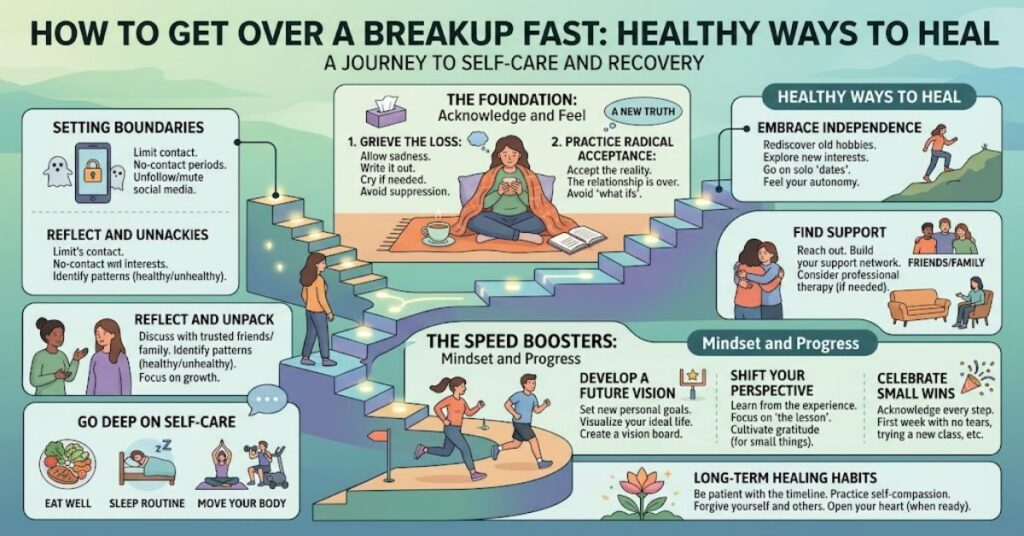
Learning how to get over a breakup fast does not mean forcing yourself to stop caring overnight. There is no reliable shortcut that instantly removes attachment, grief or disappointment. What you can do is reduce the habits that keep reopening the emotional wound and begin building a routine that supports recovery.
A helpful starting point is to create space. For many people, this means limiting unnecessary contact, avoiding repeated checks of social media and removing reminders that trigger constant emotional reactions. This is not about pretending the relationship never existed. It is about giving your mind fewer opportunities to restart the same cycle of hope, regret and rumination.
The next step is less comfortable: allowing yourself to feel what happened. A breakup can involve sadness, anger, loneliness, relief or several conflicting emotions at once. Trying to suppress them completely may only delay the process.
Recovery also requires practical change. When a relationship ends, everyday life often contains empty spaces. Messages stop. Plans disappear. Even small routines can suddenly feel unfamiliar. Building new habits helps fill those gaps with experiences that belong to your present rather than your past.
Why Breakups Can Feel So Difficult
Relationships become connected to routines, expectations and a sense of identity. When they end, people may grieve more than the person alone. They may also grieve imagined plans, shared friendships or a version of the future they expected.
This explains why a breakup can feel confusing even when ending the relationship was the right decision. Logical understanding and emotional adjustment do not always happen at the same speed.
The goal is not to judge yourself for still feeling affected. Instead, focus on behaviours that either support healing or keep you emotionally stuck.
Consider a Period of No Contact
For many people, reducing unnecessary contact can be one of the most practical steps after a breakup. Constant messaging, checking stories or searching for signs that an ex still cares can maintain emotional attachment.
“No contact” does not always mean the same thing for everyone. Shared children, work responsibilities or other practical commitments may make complete separation impossible. In those situations, communication may need to remain focused on necessary matters.
| Approach | Possible Benefit | Potential Challenge |
| No unnecessary contact | Fewer emotional triggers | Can initially feel lonely |
| Limited practical contact | Useful when responsibilities are shared | Requires clear boundaries |
| Constant checking | May provide short-term reassurance | Can prolong rumination |
| Repeated attempts to reconnect | May keep hope alive | Can delay acceptance |
The key principle is simple: reduce behaviours that repeatedly pull your attention back into the relationship.
Remove Constant Reminders
You do not need to destroy every photograph or throw away everything connected to the relationship. A more balanced option is to place highly emotional reminders somewhere you will not encounter them every day.
This can include photographs, gifts, old messages or digital folders. The purpose is not denial. It is reducing unnecessary triggers while you are emotionally vulnerable.
Social media can require particular attention. Repeatedly checking an ex’s activity may create stories that are impossible to verify. A photograph, new friendship or short post can become the subject of hours of overthinking.
Creating distance from these triggers gives your attention room to move elsewhere.
Face Your Emotions Instead of Fighting Them
One of the most difficult parts of how to get over a breakup fast is accepting that healing usually involves feeling uncomfortable emotions.
You may feel sad in the morning and relieved in the afternoon. You may miss the relationship while knowing it was unhealthy or unsuitable. These contradictions are common during major emotional changes.
Writing down your thoughts can help identify repeated patterns. Talking with a trusted friend may also provide perspective. If emotions become overwhelming or begin seriously affecting daily functioning, speaking with a qualified mental health professional can offer additional support.
The aim is not to analyse every memory endlessly. It is to acknowledge what you feel without allowing every thought to control your next action.
Create a New Daily Routine
Breakups often leave behind unstructured time. The hours previously spent messaging, meeting or planning together can become periods of loneliness.
A new routine does not need to be dramatic. Start with small, repeatable activities:
- Take a daily walk.
- Return to an old hobby.
- Exercise regularly if it suits your ability.
- Spend time with supportive people.
- Try a class, project or skill that creates a sense of progress.
The value of routine is that it gives the day structure when motivation is low. Small commitments can gradually create new associations and reduce the feeling that every part of life belongs to the past relationship.
Avoid Using Someone New as a Distraction
Starting another relationship immediately may sometimes be a genuine new connection, but it can also become a way to avoid grief. If the main purpose is to prove that you are desirable or to make an ex jealous, the emotional problems from the previous relationship may remain unresolved.
A useful question is: Am I interested in this person, or am I trying to escape how I currently feel?
There is no universal timetable for dating again. What matters is whether you are making choices based on genuine interest rather than panic, loneliness or the need for validation.
A Practical Recovery Framework
| Stage | Helpful Focus |
| First days | Create distance and manage immediate emotions |
| First weeks | Establish routine and seek social support |
| Adjustment period | Identify lessons and personal priorities |
| Moving forward | Build goals unrelated to the former relationship |
Recovery rarely follows a perfect sequence. You may feel better for several days and then experience a difficult moment after hearing a song or visiting a familiar place. A setback does not mean you are back at the beginning.
Three Important Insights About Healing
First, speed and avoidance are not the same thing. Trying to “move on” by filling every quiet moment with distractions may delay emotional processing.
Second, contact can create a powerful cycle. A message may bring temporary relief while increasing the desire for more contact later. Recognising that pattern can make boundaries easier to maintain.
Third, recovery becomes easier when your future contains something concrete. New goals do not need to erase the past. They simply give your attention somewhere else to go.
The Future of Breakup Recovery in 2027
By 2027, digital communication will continue to shape how people experience breakups. Social media, messaging platforms and algorithmic reminders can make emotional distance harder to maintain than it was in earlier generations.
At the same time, greater awareness of mental health may encourage more people to use counselling, structured self-help resources and peer support when dealing with relationship loss.
Technology can provide useful tools, but it can also maintain unwanted connection. Muting accounts, managing digital memories and setting communication boundaries may become an increasingly important part of modern breakup recovery.
Key Takeaways
- Create healthy distance from unnecessary contact and emotional triggers.
- Avoid repeatedly checking an ex’s online activity.
- Allow yourself to experience emotions rather than suppressing them.
- Build a new routine around your own interests and goals.
- Expect recovery to be uneven rather than perfectly linear.
- Seek professional support if distress becomes overwhelming or persistent.
Conclusion
Understanding how to get over a breakup fast begins with changing what “fast” means. You cannot always control how quickly painful emotions disappear, but you can stop feeding the habits that keep those emotions constantly active.
Creating distance, reducing reminders and facing your feelings honestly can provide a healthier foundation for recovery. At the same time, practical changes matter. New routines, supportive friendships and personal goals help rebuild the parts of daily life that may have been organised around the relationship.
Healing does not require forgetting someone or pretending the relationship had no meaning. It means gradually reaching a point where the past no longer controls your attention, choices or sense of self. That process may take time, but every healthy boundary and new routine can move you forward.
Frequently Asked Questions
How long does it take to get over a breakup?
There is no fixed timeline. Recovery depends on the length and intensity of the relationship, the circumstances of the breakup and the support available to you.
Is no contact the fastest way to move on?
Reducing unnecessary contact can help many people by limiting emotional triggers and repeated cycles of hope or rumination. However, complete no contact may not be possible when practical responsibilities are shared.
Why do I still miss my ex?
Missing someone does not necessarily mean the relationship should continue. You may miss the person, routine, familiarity or future you imagined together.
Should I delete all photos of my ex?
Not necessarily. If deleting them feels too extreme, consider moving them to a private folder so they do not appear in your everyday digital environment.
Can I get over a breakup in a week?
Some people feel significantly better quickly, while others need much longer. Aiming for healthy progress is usually more realistic than demanding a specific recovery deadline.
When should I seek professional help after a breakup?
Consider professional support if emotional distress becomes overwhelming, continues to seriously affect daily life or leaves you unable to manage normal responsibilities.
Methodology
This article follows the supplied Postcard.fm framework, which requires the keyword to shape the title, introduction and metadata while avoiding unnatural repetition. The article also follows the supplied keyword framing around creating distance, reducing reminders, processing emotions and establishing new routines.