A research dossier for target company assessment is an organised collection of evidence used to understand a business before entering a significant commercial relationship. It can support an investment decision, acquisition, partnership, supplier relationship or other form of strategic engagement.
The purpose is not simply to create a longer company profile. A useful dossier should help answer a harder question: What do we actually know about this business, and what remains uncertain?
That distinction matters. A company’s website may explain its services and achievements, while public filings can reveal its legal status, accounts, directors and filing history. These sources may tell different parts of the story. Companies House, for example, provides access to company information including accounts, officers, filing transactions, charges and insolvency information, but it also makes clear that it does not check the accuracy of information filed by companies.
A serious dossier therefore treats evidence according to its reliability, relevance and limitations.
What Should a Company Research Dossier Include?
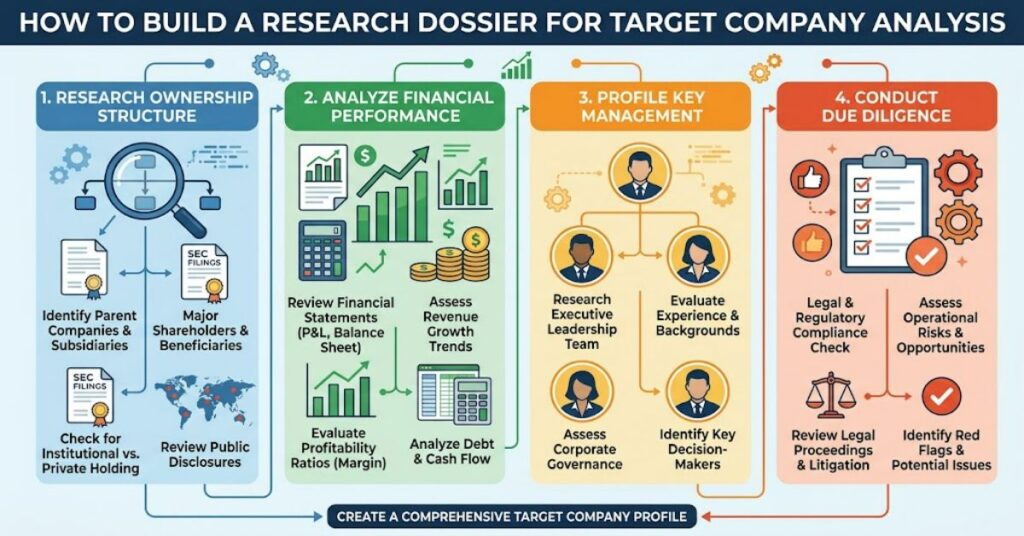
A practical dossier should be structured around several evidence categories rather than a simple company biography.
| Research area | Key questions |
| Corporate identity | Is the legal entity correctly identified and active? |
| Ownership | Who controls the business and how is ownership structured? |
| Management | Who runs the company and what relevant experience do they have? |
| Financial position | What do accounts indicate about revenue, liabilities and financial resilience? |
| Business model | How does the company generate revenue and what does it depend on? |
| Market position | Who are its customers, competitors and strategic rivals? |
| Legal and regulatory risk | Are there litigation, licensing or compliance concerns? |
| Commercial dependencies | Does the business depend heavily on particular customers, suppliers, licences or intellectual property? |
This structure also reflects the type of information recognised in formal UK financial-services due-diligence requirements. The FCA’s current rules for certain qualifying public offers include information about an issuer’s identity, ownership, management, business model, risks, litigation, material contracts and financial structure.
Start With Corporate Identity and Ownership
The first stage is surprisingly important because research can become unreliable if the wrong legal entity is being investigated.
Record the company’s registered name, registration number, incorporation date, registered office, trading names and current status. Then examine directors, former officers, significant control information and group relationships.
Companies House allows researchers to examine current and resigned officers, previous names, disqualified directors, charges and insolvency information.
One useful insight is that identity verification should come before reputation analysis. A strong online presence does not prove that the company being promoted online is the same legal entity appearing in a transaction. Matching registration details across documents can prevent basic but costly research errors.
Ownership deserves separate attention. Complex structures, parent companies or multiple subsidiaries may change the interpretation of financial and operational information. A company that appears independent may actually depend heavily on another entity for funding, intellectual property or customers.
Examine Financial Strength Beyond Revenue
Financial research should not stop at turnover.
Review available accounts, profit or loss, balance-sheet position, liabilities, cash generation and financing arrangements. Look for changes over time rather than treating one year’s figure as definitive.
A company with rising revenue may still face financial pressure if working-capital requirements, debt or operating costs are increasing faster than sales. Conversely, modest revenue growth can be less concerning when cash generation and margins are stable.
The FCA’s due-diligence framework highlights the importance of understanding financial reports, liabilities and sources of capital when assessing an issuer.
The practical lesson is simple: financial performance and financial resilience are different questions.
Investigate Management and Key People
A company is partly a collection of contracts, systems and assets, but management quality can materially affect execution.
Record directors and senior executives, then compare their stated backgrounds with corporate filings, professional profiles and other credible records. Look for relevant experience, changes in leadership and previous business involvement.
This does not mean treating a person’s career history as proof of future performance. Instead, it helps establish whether the people responsible for the business have experience that is consistent with its stated strategy.
The FCA’s due-diligence rules specifically recognise the importance of information about key individuals, including professional experience and factors relevant to their fitness and propriety.
Test the Business Model and Market Position
A company profile should explain what the organisation actually sells, who pays for it and why customers choose it.
Research products and services, pricing structure, customer concentration, geographic exposure, competitors and major dependencies. If the business relies on a small number of clients, a single platform, a particular licence or a key supplier, that dependency should be visible in the dossier.
This is where public information and management-provided information should be compared rather than merged uncritically.
For example, management may describe a market as expanding rapidly, while independent industry data may suggest slower growth. The discrepancy itself is useful evidence because it creates a question for further investigation.
Assess Legal, Regulatory and Reputational Risk
Legal and regulatory research should cover litigation, enforcement actions, licences, sanctions exposure, insolvency history and other material concerns relevant to the sector.
For regulated businesses, the FCA’s guidance shows why due diligence needs to be documented rather than based solely on familiarity or personal relationships. Its recent findings on customer due diligence also emphasise the importance of recording relevant information, applying enhanced checks where risk warrants them and maintaining ongoing monitoring.
A further insight is that absence of negative search results is not evidence of absence. Public research has limits. Some disputes, contracts, liabilities or operational problems may not be visible in publicly available records.
From Information Collection to Decision Support
The final dossier should distinguish between verified facts, reported claims, analytical conclusions and unresolved questions.
| Evidence type | Treatment |
| Official filing | Record as primary documentary evidence |
| Company statement | Attribute clearly to the company |
| Independent report | Assess source quality and date |
| Analyst interpretation | Label as analysis rather than fact |
| Missing information | Record as an unresolved issue |
| Contradictory evidence | Highlight and investigate |
This approach prevents a common research failure: producing a polished document that hides uncertainty.
A dossier becomes more valuable when it ends with a risk register and a list of questions for management, advisers or counterparties. Those questions should focus on issues that could change the decision, valuation or transaction terms.
The Future of Research Dossiers in 2027
By 2027, company research is likely to become more automated as public registries, regulatory databases, financial datasets and document-analysis systems become easier to integrate. The basic research principles, however, should remain unchanged.
Automation can identify filings, compare dates and flag inconsistencies, but it does not remove the need for source evaluation. Companies House itself notes that information supplied to its register is not independently checked for accuracy.
The strongest workflow will therefore combine automated discovery with human verification. AI can help organise evidence and identify patterns, while professional judgement determines whether a discrepancy is material.
Key Insights
- Legal identity comes first: Research should establish the exact entity before assessing its reputation or financial performance.
- Public data has limits: Official records can be authoritative without being independently verified in every respect.
- Trends matter more than snapshots: Multi-year financial and management changes often reveal more than a single reporting period.
- Contradictions are valuable: Differences between company claims and independent evidence should generate questions rather than being ignored.
- Dependencies deserve attention: Customers, suppliers, licences, intellectual property and group companies can create hidden concentration risk.
- A dossier should support decisions: The end product should identify material risks and unanswered questions, not simply accumulate facts.
Conclusion
A research dossier for target company analysis is most useful when it turns scattered information into a structured decision framework. Corporate records establish identity and ownership; financial documents provide evidence about economic condition; management research adds context; market analysis tests the business model; and legal and regulatory checks expose risks that promotional material may not reveal.
The strongest dossiers also acknowledge uncertainty. Public records are valuable, but they are not automatically complete or independently verified. Company statements can provide essential information, but they should be distinguished from external evidence.
For an investor, buyer or prospective partner, the objective is therefore not to prove that a company is attractive. It is to establish what the evidence supports, what it challenges and what still needs to be verified before a consequential decision is made.
FAQ
What is a research dossier for target company?
It is a structured collection of corporate, financial, management, market, legal and operational information used to evaluate a business before an investment, partnership or acquisition.
What should be included in a research dossier for target company?
Core sections normally include legal identity, ownership, directors, financial performance, business model, market position, competitors, regulatory exposure, litigation and key commercial dependencies.
Is Companies House information enough for due diligence?
No. Companies House is an important source of corporate information, but Companies House states that it does not check the accuracy of information filed with it. Additional evidence may therefore be necessary.
How can financial risk be identified?
Compare multiple reporting periods and examine profitability, cash generation, liabilities, financing arrangements and changes in the balance sheet rather than relying only on revenue.
Why investigate company directors?
Management research can reveal relevant experience, leadership changes and potential risk indicators. It also helps establish whether the people running the business have backgrounds consistent with its stated activities.
What is the biggest mistake in company research?
Treating information collection as the final objective. A dossier should interpret evidence, identify contradictions and highlight unresolved questions that could materially affect a decision.
Methodology
This article research dossier for target company uses the supplied RubbleMagazine.co.uk editorial framework and supplements it with UK primary-source guidance. Companies House material was used to establish the scope and limitations of public corporate records. FCA material was used to inform discussion of due diligence, management information, financial assessment and documented risk controls.
The analysis is intended as a general research framework rather than legal, accounting or investment advice. Public-source research cannot guarantee that all liabilities, disputes or commercial dependencies will be discovered.
References
Financial Conduct Authority. (2026). COBS 23.3 Due diligence. FCA Handbook.
Financial Conduct Authority. (2026). Firms’ customer due diligence processes and controls: Our findings. FCA.
Financial Conduct Authority. (2025). Financial crime controls in corporate finance firms: Survey findings. FCA.
Companies House. (2026). Searching the Companies House register. GOV.UK.
HM Revenue & Customs. (2025). Testing customer due diligence: What is due diligence? GOV.UK.
Editorial disclosure: This article was drafted with AI assistance and should be independently reviewed before publication. Statistics, named claims and references should be checked against their original sources by the editorial team.