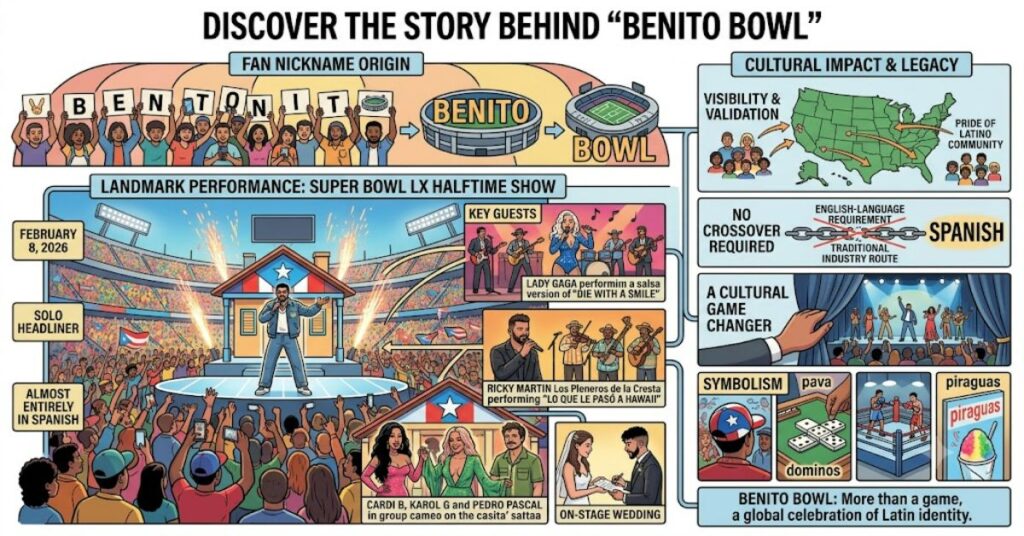
The term benito bowl has become a popular nickname among fans describing the Super Bowl that featured Puerto Rican superstar Bad Bunny, whose real name is Benito Antonio Martínez Ocasio, as the halftime headliner. Whether used on social media or in entertainment discussions, the phrase captures far more than a football game. It represents a moment when Latin culture, Spanish-language music, and global pop culture shared one of the world’s biggest stages.
For decades, the Super Bowl halftime show has been reserved for artists with massive international appeal. Bad Bunny’s appearance marked a celebration of Puerto Rican identity, Latin music, and the worldwide popularity of reggaeton and Latin trap. Millions of viewers watched as Spanish-language songs reached an audience that extended well beyond traditional Latin music fans.
The significance of the event extends beyond entertainment. It reflects changing audience preferences, the globalization of music streaming, and the growing commercial value of Hispanic audiences. While football remained the central attraction, many viewers tuned in specifically to experience Bad Bunny’s performance, leading fans online to affectionately call the event the “Benito Bowl.”
What Does Benito Bowl Mean?
Benito Bowl is an informal nickname created by fans rather than an official NFL title. “Benito” comes from Bad Bunny’s first name, Benito Antonio Martínez Ocasio.
The nickname highlights how strongly his performance resonated with audiences. Instead of focusing solely on the championship game, many conversations centered on the halftime show, making the artist the defining feature for millions of viewers.
This type of fan-created branding has become increasingly common in the social media era, where memorable performances quickly develop their own cultural identity.
Why Bad Bunny’s Halftime Performance Was Historic
Bad Bunny has spent years breaking barriers in the global music industry. His success includes chart-topping albums, sold-out stadium tours, and collaborations with artists across multiple genres.
A Spanish-language halftime performance represented an important shift in mainstream entertainment. Rather than asking international audiences to adapt to English-language performances, the event celebrated Spanish as the primary language of one of the world’s biggest live broadcasts.
The production combined energetic choreography, vibrant visuals, Latin rhythms, and Puerto Rican cultural influences. It appealed both to long-time fans and viewers experiencing his music for the first time.
Cultural Significance of Benito Bowl
The cultural impact of benito bowl extends far beyond music.
For many Hispanic and Latino viewers, seeing their language and culture represented on one of television’s largest stages created a powerful sense of inclusion.
Several broader trends contributed to this moment:
- Growth of Latin music on global streaming platforms.
- Increasing diversity among mainstream audiences.
- Greater investment by entertainment companies in multicultural programming.
- International success of Spanish-language artists.
Rather than being treated as a niche genre, Latin music demonstrated that it belongs alongside the world’s biggest entertainment events.
Comparison: Traditional Halftime Shows vs. Benito Bowl
| Feature | Traditional Halftime Shows | Benito Bowl |
| Primary language | Mostly English | Mostly Spanish |
| Musical style | Pop, rock, hip-hop | Latin trap and reggaeton |
| Cultural emphasis | Broad American pop culture | Puerto Rican and Latin culture |
| Audience reaction | Entertainment-focused | Entertainment and cultural celebration |
| Social media discussion | Artist performance | Music, language, and representation |
Entertainment Industry Impact
The success associated with benito bowl illustrates changing priorities within the entertainment business.
Streaming services have made language less of a barrier. Fans now regularly listen to music from artists across the world, regardless of whether they understand every lyric.
Music companies increasingly recognize that global audiences value authenticity. Instead of adapting to English-speaking markets, many international artists succeed by remaining true to their cultural identity.
Bad Bunny’s popularity demonstrates this shift perfectly.
Business Perspective
Major sporting events attract advertisers because they deliver enormous audiences.
A halftime show featuring one of the world’s biggest Latin artists also attracts:
| Industry Insight | Impact |
| Global streaming growth | Larger international audience |
| Hispanic consumer spending | Greater advertiser interest |
| Social media engagement | Increased event visibility |
| Music streaming after performance | Higher song discovery rates |
| Brand partnerships | Expanded sponsorship opportunities |
These trends make multicultural entertainment increasingly valuable from both creative and commercial perspectives.
Challenges and Trade-Offs
Although widely celebrated, such performances can also generate debate.
Some viewers prefer traditional halftime entertainment, while others welcome greater cultural diversity. Major sporting events must balance appealing to long-time audiences with attracting younger and more international viewers.
There are also production challenges. Live broadcasts require flawless coordination between performers, stage crews, broadcasters, and event organizers.
Despite these complexities, successful performances often become defining moments in television history.
The Future of Benito Bowl in 2027
Looking ahead, the influence associated with benito bowl could encourage even greater diversity in major entertainment events.
Streaming platforms continue expanding global audiences, while international artists increasingly dominate worldwide music charts. These trends suggest future halftime shows may feature performers from a wider variety of musical traditions and languages.
Rather than being viewed as unusual, multilingual performances may become a normal part of major international broadcasts.
The pace of change will ultimately depend on audience preferences, broadcaster strategies, and commercial partnerships, but the direction points toward broader cultural representation.
Key Takeaways
- Latin music has become a permanent force in global entertainment.
- Fan-created nicknames such as benito bowl demonstrate the influence of online communities.
- Spanish-language performances can achieve mainstream worldwide success.
- Cultural representation continues to shape major entertainment events.
- Global streaming has reduced language barriers for music audiences.
- The commercial value of diverse audiences continues to grow.
Conclusion
Benito bowl represents much more than an informal nickname. It reflects a cultural moment in which music, language, and identity became central to one of the world’s most-watched sporting events. Bad Bunny’s influence extends beyond record sales and streaming numbers; he has helped reshape expectations for what mainstream entertainment can look like.
The event also demonstrated that audiences increasingly appreciate authenticity. Rather than changing his artistic identity to fit traditional expectations, Bad Bunny showcased his Puerto Rican roots and Spanish-language music on an international stage.
Whether remembered primarily for its entertainment value or its cultural significance, benito bowl stands as an example of how global audiences continue embracing diverse voices. As music becomes increasingly international, moments like this are likely to become more common, reflecting a broader and more inclusive vision of popular culture.
FAQ
What is Benito Bowl?
Benito Bowl is a fan-created nickname referring to the Super Bowl associated with Bad Bunny’s highly anticipated halftime performance.
Why is it called Benito Bowl?
The nickname comes from Bad Bunny’s real first name, Benito Antonio Martínez Ocasio, and reflects his enormous influence on the event.
Why was the performance considered important?
Many fans viewed it as a celebration of Latin music, Puerto Rican culture, and Spanish-language entertainment on one of television’s biggest stages.
Is Benito Bowl an official NFL term?
No. It is an unofficial nickname created and popularized by fans and social media users.
What made Bad Bunny’s appearance unique?
His performance highlighted Latin musical styles and Spanish-language songs while reaching a massive international audience.
Methodology
This article was prepared using publicly available information about Bad Bunny’s career, the evolution of Super Bowl halftime entertainment, and broader trends in the global music industry. The analysis focuses on cultural and entertainment perspectives while acknowledging that “Benito Bowl” is a fan-driven nickname rather than an official event title. Readers should verify specific event details through official NFL and artist announcements where applicable.
References
- National Football League. (n.d.). Super Bowl Halftime Show. https://www.nfl.com/
- Billboard. (2024). Bad Bunny News and Features. https://www.billboard.com/
- Rolling Stone. (2024). Bad Bunny Coverage. https://www.rollingstone.com/