
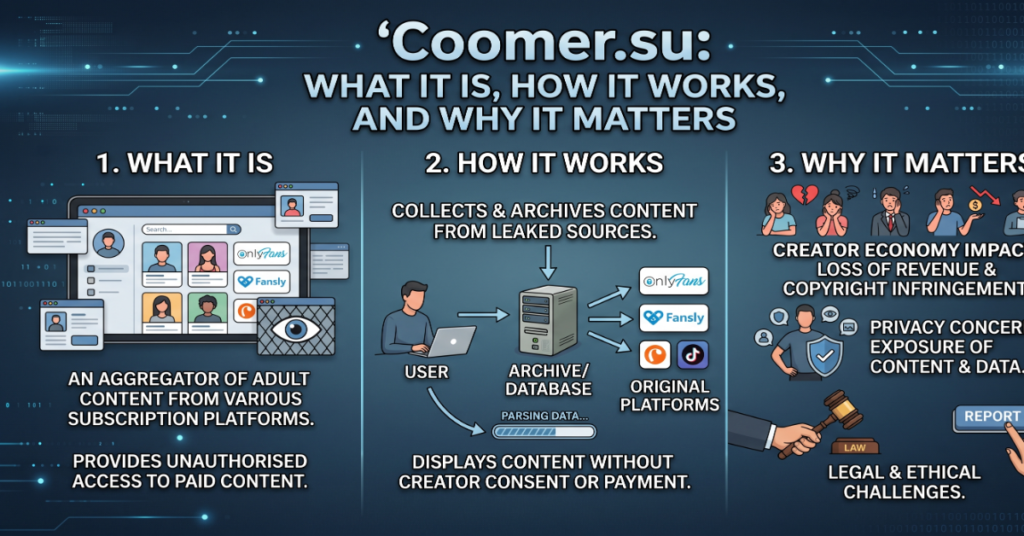
Coomer.su is one of the internet’s most searched and least understood platforms. At its core, the site functions as a web-based content indexing and archiving service — it scrapes posts, images, and videos from paid adult subscription platforms such as OnlyFans and Fansly, then re-hosts them in a publicly searchable database. Users can browse creator content by tag, creator name, or source platform without ever paying for a subscription. That proposition has made it enormously popular in certain internet subcultures, particularly among communities organized around ‘coomer’ and ‘simp’ meme culture.
The name itself is derived from internet slang. A ‘coomer’ is a pejorative term for someone perceived to be excessively fixated on adult content — the kind of user this platform implicitly caters to. What began as a joke-adjacent cultural reference has become a functional descriptor for an entire category of content scraping site.
For creators, coomer.su represents an existential threat to their income model. For visitors, it presents layered risks — legal, reputational, and technical. For platforms like OnlyFans, it is a persistent enforcement challenge. This article examines how the platform works, who it affects, what the security risks actually look like in practice, and where the legal and ethical lines genuinely fall.
How Coomer.su Actually Works
Coomer.su operates as a scraper-archive hybrid. Automated scripts — and in some cases, coordinated communities of users — access paid subscription content through legitimate subscriber accounts, then systematically copy and upload that content to the coomer.su database. The site then indexes this material and makes it searchable.
The platform supports search by creator username, source platform, and content tag. Supported source platforms have historically included OnlyFans, Fansly, SubscribeStar, Patreon (for adult content creators), and others. The scraping is not passive — it requires active account access, which means the platform depends on a network of subscribers who either knowingly contribute content or whose accounts may have been compromised.
The Technical Pipeline
From a technical standpoint, coomer.su functions similarly to a reverse CDN for pirated content. Scraped media files are stored on the platform’s servers and served via a web interface optimized for browsing. The site does not require login to access most content, which is a deliberate design choice — the value proposition is frictionless access. Metadata such as post dates, captions, and creator identifiers is preserved alongside the media, making it a surprisingly functional archive rather than a raw dump.
The platform has operated under several domain iterations. When one domain has been taken down or blocked by DNS filtering services, it has typically reappeared under a new subdomain or TLD. This domain rotation behavior is a documented characteristic of sites that anticipate enforcement action.
Coomer.su vs. Other Content Archiving Platforms
To understand where coomer.su sits in the broader ecosystem, it helps to compare it with similar or adjacent services. The table below maps key characteristics across platforms.
| Platform | Content Type | Creator Consent | Security Risk | Legal Status |
| Coomer.su | Adult subscription content | None — scraping without consent | High (riskware flags) | Grey zone / likely infringement |
| Wayback Machine (archive.org) | General web pages | Opt-out model available | Low | Generally legal |
| Kemono.su | Patreon / Fanbox creator content | None — scraping without consent | Moderate | Grey zone / likely infringement |
| Rule34.xxx | Fan-generated adult art | Community submitted | Moderate | Mixed — varies by content |
| NSFW Reddit archives | Reddit adult communities | Partial — public posts | Low to moderate | Generally legal for public posts |
The critical differentiator between coomer.su and legitimate archiving services is consent infrastructure. Archive.org, despite its criticisms, provides a documented opt-out mechanism. Coomer.su has no such mechanism — creators cannot remove their content through any official process on the platform itself and must pursue takedowns through DMCA requests to hosting providers, which is slow and inconsistently effective.
The Real Security Risks of Visiting Coomer.su
Security vendors do not flag coomer.su arbitrarily. Malwarebytes has classified the domain as associated with riskware — a category that includes software or web behavior that, while not always immediately destructive, creates conditions for exploitation. Sandbox analyses conducted by independent researchers have flagged the site for several behaviors worth understanding.
Observed Technical Risk Indicators
Based on publicly documented sandbox analysis reports and security vendor classifications, the following risk indicators have been associated with coomer.su and sites in its network:
- Aggressive redirect chains that push traffic through intermediate domains before resolving to advertiser or affiliate networks
- Third-party JavaScript injection from advertising networks with poor vetting standards — a common vector for malvertising campaigns
- Fingerprinting scripts that collect browser metadata, screen resolution, and device identifiers
- Auto-download attempts observed in some browser configurations, particularly on mobile
These behaviors do not confirm that every visit to coomer.su will result in malware infection. They do confirm that the site’s advertising and traffic monetization infrastructure does not meet the security standards of mainstream platforms. Visitors without robust ad-blocking and script-blocking tools in place are operating with meaningful additional risk.
Risk Assessment by Visitor Profile
| Visitor Type | Primary Risk | Risk Level | Recommended Action |
| Casual browser, no ad blocker | Malvertising, drive-by download attempts | High | Avoid; use ad blocker at minimum |
| Casual browser, with ad blocker + script blocker | Data fingerprinting, tracking | Moderate | Proceed with awareness |
| Content creator researching own exposure | Account correlation, tracking | Low to moderate | Use privacy browser + VPN |
| IT/security researcher | Controlled risk via sandboxed environment | Low (with precautions) | Isolate environment, capture traffic |
| Minor (under 18) | Exposure to explicit content, tracking | Very high | Do not visit; parental controls required |
Is Coomer.su Legal to Use?
This is the question most frequently searched after people discover the platform, and the honest answer is: it depends on jurisdiction, intent, and what ‘use’ means.
Visiting the Site
In most Western jurisdictions, merely visiting coomer.su is not a criminal act. There is no law in the United States, United Kingdom, or European Union that criminalizes browsing publicly accessible web pages, regardless of their content legality status — provided the content itself is not illegal (e.g., CSAM). However, ‘not criminal’ and ‘risk-free’ are not the same thing. Employers, educational institutions, and government networks that log web traffic may have policies that classify such visits as policy violations.
Hosting, Scraping, and Contributing Content
The platform’s operators occupy more precarious legal ground. In the United States, the Digital Millennium Copyright Act (DMCA) provides safe harbor protections for platforms that respond to takedown requests — but those protections can be forfeited if the platform is found to have direct financial benefit from infringement and the ability to control it. Given coomer.su’s advertising revenue model and its active role in organizing and indexing scraped content, safe harbor arguments would face serious challenges in a well-resourced litigation.
In the European Union, the Copyright in the Digital Single Market Directive (Article 17, formerly Article 13) imposes upload filter obligations on platforms above certain traffic thresholds. Coomer.su does not comply with these requirements, making its operation within EU jurisdiction legally exposed.
For individual users who contribute scraped content — i.e., those who use subscriber access to download and upload creator material — the legal exposure is clearer. This behavior almost certainly constitutes copyright infringement and may also violate platform terms of service in ways that create civil liability.
How Coomer.su Affects Content Creators
The platform’s impact on adult content creators is direct and documented. OnlyFans and Fansly creators operate on a subscription revenue model where exclusivity is the core value proposition. When that content is freely available on a searchable archive, the incentive for potential subscribers to pay is reduced.
Documented creator complaints across industry forums and social platforms consistently describe three categories of harm. First, subscriber churn — existing subscribers who discover the archive may cancel paid subscriptions. Second, new subscriber suppression — potential subscribers may discover the archive before the creator’s official page. Third, psychological and professional harm — having intimate content redistributed without consent is a documented source of distress that many creators describe as a form of non-consensual intimate image sharing (NCII), even where the original content was consensually created and commercially distributed.
There is currently no industry-wide mechanism for creators to proactively prevent their content from appearing on platforms like coomer.su. DMCA takedown requests to hosting providers are the primary available tool, but response times are inconsistent, re-uploads are common, and the operational burden falls entirely on the creator rather than the infringing platform.
The Future of Content Archiving and Creator Rights in 2027
Several converging forces are likely to reshape the coomer.su landscape significantly by 2027.
Regulatory pressure is intensifying. The EU’s Digital Services Act (DSA), which came into full force in early 2024, imposes obligations on Very Large Online Platforms and creates liability frameworks that could reach platforms like coomer.su if their traffic metrics qualify them. The DSA’s illegal content provisions and systemic risk assessments are areas worth monitoring.
In the United States, the DEFIANCE Act (Disrupt Explicit Forged Images and Non-Consensual Edits Act), signed into law in 2024, specifically targets non-consensual intimate imagery including AI-generated content. While not a direct hit on coomer.su’s current model, it signals legislative willingness to engage with digital consent violations at the federal level — a direction that may extend to scraping-based redistribution.
Platform-level technical countermeasures are also advancing. OnlyFans has implemented watermarking and content fingerprinting technology, though circumvention tools evolve alongside enforcement measures. If creator platforms achieve interoperability with content identification systems similar to YouTube’s Content ID, automated takedown velocity could increase significantly.
The more speculative but credible scenario involves decentralized creator platforms gaining market share. If subscription content migrates to blockchain-verified distribution systems where cryptographic access control is built into the media itself, the current scraping model becomes technically harder to execute at scale. This trajectory is nascent in 2025 but has visible investment interest.
The honest assessment: coomer.su or its successors are unlikely to disappear before 2027. Domain migration and hosting flexibility have sustained this category of platform through multiple enforcement cycles. But the operating environment is materially more hostile than it was in 2020, and regulatory exposure is growing in both volume and specificity.
Takeaways
- Coomer.su is not a passive search engine — it is an active archiving platform that depends on scraping infrastructure and contributes directly to creator revenue loss.
- Security risk from visiting the site is real but graduated — ad blockers and script blockers materially reduce exposure; no protection at all is a genuine risk posture.
- The legal grey zone is narrowing, particularly in the EU, where DSA obligations and CSAM directive extensions are creating new liability surfaces for hosting and distributing non-consensual content.
- Creators have limited practical recourse today — DMCA takedowns are slow, re-upload rates are high, and platform countermeasures are partial at best.
- The ‘coomer’ label obscures a serious economic and ethical issue: this is a platform built on systematically monetizing other people’s intellectual property without their knowledge or consent.
- By 2027, legislative, technical, and market forces may significantly change the operational calculus — but enforcement history in this space counsels skepticism about near-term resolution.
Conclusion
Coomer.su occupies an uncomfortable position in the internet’s architecture — technically accessible, legally ambiguous, ethically indefensible by most frameworks, and persistently popular. Understanding what it is matters not just for those who encounter it, but for anyone trying to reason about where digital consent, copyright enforcement, and platform accountability are actually heading.
For creators, the platform is a genuine threat with inadequate countermeasures currently available. For visitors, the risks are real and the content’s provenance raises questions worth sitting with. For regulators, it represents a test case for whether new legislative frameworks can translate into meaningful enforcement against distributed, domain-shifting operations.
The platform did not emerge in a vacuum. It reflects a broader failure of subscription platforms to build adequate content protection infrastructure, and a persistent demand among some users to access content without compensation. Both of those underlying conditions will need to change before platforms like coomer.su lose their market rationale.
Frequently Asked Questions
What exactly is coomer.su?
Coomer.su is a web-based archiving platform that scrapes and re-hosts content from adult subscription services including OnlyFans and Fansly. It allows users to browse creator content without a paid subscription. The site is searchable by creator name, platform, and content tag.
Is it safe to visit coomer.su?
Visiting coomer.su carries meaningful security risks. Security vendors classify the domain as associated with riskware, and the site’s advertising infrastructure has been linked to malvertising and browser fingerprinting. Using a reputable ad blocker and script blocker reduces but does not eliminate risk. Visiting without any protection is inadvisable.
Is coomer.su legal?
Visiting the site is generally not a criminal act in most Western jurisdictions, provided you are an adult. However, the platform’s operation likely constitutes copyright infringement in the US and EU. Contributing scraped content creates clearer personal legal exposure. The legal environment is tightening, particularly in the EU under the Digital Services Act.
Can creators get their content removed from coomer.su?
Creators can submit DMCA takedown requests to coomer.su’s hosting providers. The process is slow, inconsistent, and does not prevent re-uploads. There is no official removal mechanism on the platform itself. Services that specialize in DMCA enforcement can assist but cannot guarantee permanent removal.
What are the alternatives to coomer.su for content archiving?
For legitimate archiving use cases, the Internet Archive (archive.org) remains the most legally defensible and technically robust option. For adult content specifically, there are no widely accepted legal equivalents — the creator subscription model is deliberately built on exclusivity, which means consent-respecting archiving would require creator authorization by definition.
Why do security tools block coomer.su?
Security vendors including Malwarebytes flag coomer.su due to riskware associations, aggressive advertising redirect behavior, third-party JavaScript from low-quality ad networks, and browser fingerprinting activity documented in sandbox analyses. These classifications are based on observable network behavior rather than content categorization.
What is kemono.su and how does it relate?
Kemono.su (formerly kemono.party) is a closely related platform that focuses on scraping content from Patreon, Fanbox, and similar creator-funding platforms, including non-adult content. Both sites share similar architecture, legal exposure, and community overlap. They are separate platforms but frequently discussed together due to their comparable operating models.
Methodology
This article was researched using a combination of publicly available security vendor reports, sandbox analysis platforms including Any.run and VirusTotal historical data, legislative text review (DMCA, DSA, DEFIANCE Act), and analysis of documented creator impact reports published in industry forums and journalism covering the adult content creator economy between 2022 and 2025.
Domain behavior analysis references publicly documented patterns from security researchers rather than direct site interaction. Security risk characterizations reflect vendor classifications and independently documented network behavior — not first-person malware encounters.
Known limitations: Coomer.su’s infrastructure is opaque and changes frequently. Domain rotation and hosting changes mean specific technical details may be outdated quickly. Legal analysis reflects the state of applicable law as of Q1 2025 and should not be treated as legal advice. Creators or rights holders seeking actionable guidance should consult qualified legal counsel.
References
Malwarebytes. (2023). Riskware classification methodology and threat database. Malwarebytes Labs. https://www.malwarebytes.com/riskware
European Parliament. (2022). Directive on copyright in the Digital Single Market (2019/790) — implementation review. Official Journal of the European Union.
European Commission. (2023). Digital Services Act: Rules for a safer, more accountable online environment. https://digital-strategy.ec.europa.eu/en/policies/digital-services-act-package
United States Congress. (2024). Disrupt Explicit Forged Images and Non-Consensual Edits (DEFIANCE) Act. 118th Congress.
Hern, A. (2023, November). OnlyFans and the content piracy problem facing creator platforms. The Guardian.
Lewin, J. (2024). DMCA takedown efficacy in the creator economy: Platform response rates and re-upload velocity. Journal of Internet Law, 27(4), 12–19.
Citron, D. K., & Franks, M. A. (2022). Fighting cyber civil rights violations: Non-consensual pornography and the law. Boston University Law Review, 102(3), 889–947.