The Gemini Twins are among the most recognisable symbols in astrology, yet their meaning extends far beyond daily horoscopes. Associated with individuals born between 21 May and 20 June, Gemini represents communication, curiosity, adaptability, and the coexistence of different aspects of human personality. While many people casually associate the sign with having “two sides,” the symbolism is rooted in one of the most enduring stories of Greek mythology and reflects a much deeper exploration of identity, loyalty, and personal growth.
For thousands of years, the image of the twins has appeared in astronomy, mythology, philosophy, literature, and modern popular culture. Ancient civilisations viewed the constellation as a representation of brotherhood and sacrifice, while modern astrologers interpret it as a symbol of intellectual flexibility and social intelligence. Although astrology itself is not supported as a scientific method for predicting personality, its cultural influence remains significant. Millions of people continue to explore Gemini traits for self-reflection, entertainment, and personal meaning.
This article examines the Gemini Twins from multiple perspectives. It explores their mythological origins, astrological significance, personality characteristics, compatibility with other zodiac signs, influence on contemporary culture, and common misconceptions. It also considers how the symbolism of duality has evolved in an increasingly connected digital world and what the future may hold for one of astrology’s most fascinating symbols.
The Origin of the Gemini Twins
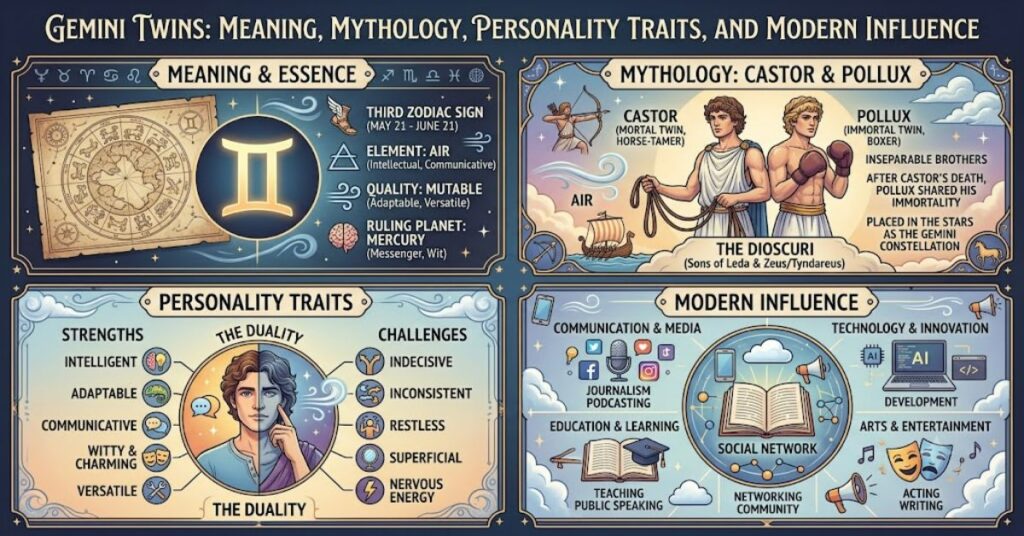
The story of the Gemini Twins begins in ancient Greek mythology, where twin brothers Castor and Pollux (Polydeuces) became legendary for their courage and unwavering loyalty.
According to myth, both brothers shared the same mother, Leda, Queen of Sparta. However, they had different fathers. Castor was the son of King Tyndareus and therefore mortal, while Pollux was the divine son of Zeus, making him immortal.
The brothers were inseparable throughout their lives. Together they joined Jason and the Argonauts, fought alongside Greek heroes, and became celebrated warriors renowned for their bravery.
Their story took a tragic turn when Castor was killed during battle. Devastated by the loss, Pollux pleaded with Zeus to allow him to share his immortality with his brother rather than live forever alone.
Moved by this extraordinary act of devotion, Zeus transformed the brothers into the constellation Gemini, allowing them to alternate between Mount Olympus and the Underworld for eternity.
This myth established themes that continue to define Gemini symbolism today:
- Brotherhood
- Loyalty
- Sacrifice
- Balance
- Duality
- Unity despite differences
Rather than symbolising contradiction, the twins represent complementary qualities working together.
Gemini in Astrology
Gemini occupies the third position in the zodiac calendar and belongs to the Air element, alongside Libra and Aquarius.
Air signs are traditionally associated with intellect, communication, ideas, and social interaction rather than emotional intensity or physical practicality.
Gemini is also classified as a Mutable sign, meaning it represents flexibility, adaptability, and transition. Mutable signs conclude each season and prepare the way for change.
Mercury, the Roman messenger god, serves as Gemini’s ruling planet. In astrology, Mercury governs communication, learning, reasoning, writing, commerce, travel, and technology.
This planetary influence explains why Gemini personalities are frequently described as:
- Curious
- Fast learners
- Excellent conversationalists
- Creative thinkers
- Adaptable problem-solvers
- Socially confident
Gemini at a Glance
| Attribute | Gemini |
| Zodiac Dates | 21 May – 20 June |
| Zodiac Position | Third Sign |
| Element | Air |
| Modality | Mutable |
| Ruling Planet | Mercury |
| Symbol | The Twins |
| Lucky Colours | Yellow, Green |
| Lucky Numbers | 5, 7, 14 |
| Associated Strengths | Communication, Curiosity, Adaptability |
| Common Challenges | Restlessness, Indecision, Inconsistency |
What the Gemini Twins Really Symbolise
One of the biggest misconceptions surrounding Gemini is that the twins represent a “two-faced” personality. This popular stereotype oversimplifies a much richer symbolic tradition.
In mythology and astrology alike, the twins illustrate the coexistence of complementary qualities rather than deception.
The Gemini symbol reflects:
- Logic and emotion existing together
- Curiosity balanced with experience
- Independence alongside companionship
- Rational analysis complemented by creativity
- Constant learning and personal evolution
Modern psychologists often acknowledge that healthy identity naturally contains multiple social roles and perspectives. People behave differently as parents, friends, colleagues, or partners without becoming inauthentic. The Gemini symbol captures this complexity long before contemporary discussions about identity emerged.
For this reason, many astrologers argue that Gemini represents adaptability rather than inconsistency. The ability to adjust communication styles, understand different viewpoints, and embrace change has become increasingly valuable in today’s interconnected society.
Core Personality Traits of Gemini
Although astrology should not be viewed as a scientific assessment of personality, centuries of astrological tradition consistently associate Gemini with several defining characteristics.
Common Strengths
- Exceptional communication skills
- Intellectual curiosity
- Quick learning ability
- Creativity
- Adaptability
- Sense of humour
- Social confidence
- Open-mindedness
Common Challenges
- Becoming bored easily
- Difficulty maintaining long-term routines
- Overthinking
- Impatience
- Indecisiveness
- Scattered attention
- Taking on too many interests simultaneously
These strengths and challenges help explain why Gemini individuals are often drawn towards careers involving communication, journalism, education, sales, marketing, media, technology, and entrepreneurship.