
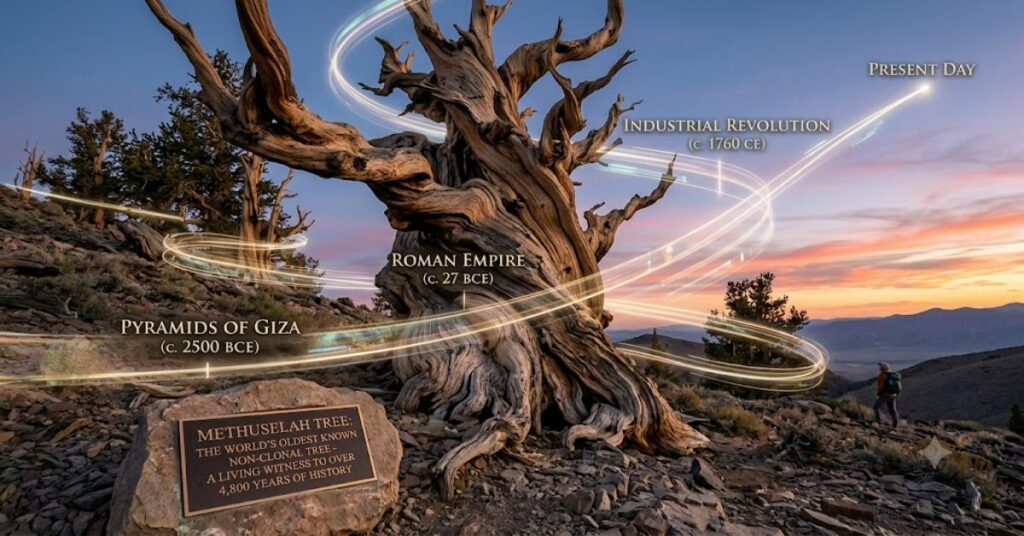
The Methuselah tree is one of Earth’s greatest natural wonders. Growing high in California’s White Mountains, this Great Basin bristlecone pine has survived for nearly five thousand years, making it the oldest confirmed non-clonal living tree ever recorded. While civilizations rose and fell across the globe, this remarkable tree quietly continued its slow growth in one of North America’s harshest mountain environments.
Unlike many famous landmarks, the Methuselah tree remains intentionally hidden. Visitors can explore the surrounding Ancient Bristlecone Pine Forest, but officials from the U.S. Forest Service do not reveal the tree’s exact location. This policy helps preserve one of the planet’s most valuable living organisms from accidental or intentional harm.
Its extraordinary age is not simply a curiosity. Researchers use ancient bristlecone pines to reconstruct thousands of years of climate history, improve radiocarbon dating, and understand how living organisms adapt to extreme environments. As climate change reshapes ecosystems worldwide, these ancient trees provide insights that are increasingly valuable to science.
What Is the Methuselah Tree?
The Methuselah tree is a Great Basin bristlecone pine (Pinus longaeva) growing in the White Mountains of Inyo County, eastern California.
Its estimated age of approximately 4,857 years means it began growing around 2830 BCE, during the era when ancient Egypt was building its earliest pyramids.
Unlike clonal organisms that reproduce through connected root systems, Methuselah is considered a non-clonal individual tree, meaning the living trunk itself has survived continuously throughout its remarkable lifespan.
Basic Facts
| Feature | Details |
| Species | Great Basin bristlecone pine |
| Estimated Age | Approximately 4,857 years |
| Location | White Mountains, Inyo County, California |
| Elevation | Over 9,500 feet (2,900 meters) |
| Status | World’s oldest confirmed non-clonal tree |
| Protection | Exact location undisclosed |
Why Has It Lived So Long?
One surprising reason for the Methuselah tree’s longevity is that it grows in conditions where few other trees can survive.
Several natural factors contribute to its lifespan:
- Thin mountain air reduces fungal growth.
- Dry conditions limit diseases.
- Rocky soils slow growth, creating extremely dense wood.
- Cold winters discourage many insects.
- High elevation reduces competition from larger tree species.
Rather than growing quickly, the tree invests its energy in survival. This slow-growth strategy has helped it endure droughts, storms, and changing climates over thousands of years.
The Science Behind Its Extraordinary Age
Scientists first confirmed Methuselah’s age through dendrochronology, the scientific study of tree rings.
Each year, the tree produces one growth ring. By extracting a narrow core sample without harming the tree, researchers count these rings to determine its age.
Ancient bristlecone pines are especially valuable because their rings preserve detailed records of environmental conditions including:
- Annual rainfall
- Temperature variations
- Volcanic eruptions
- Long-term drought cycles
- Solar activity
These natural records extend much further into the past than most written historical documents.
Comparison With Other Ancient Trees
| Tree | Location | Estimated Age | Notes |
| Methuselah | California, USA | ~4,857 years | Oldest confirmed non-clonal tree |
| Prometheus | Nevada, USA | ~4,900 years | Cut down in 1964 during research |
| General Sherman | California | ~2,200 years | Largest tree by volume |
| Jomon Sugi | Japan | 2,000–7,000 years (estimated) | Age remains uncertain |
One important distinction is that Methuselah holds the record for confirmed age, supported by scientific dating rather than estimates.
Why Is Its Location Secret?
Many visitors wonder why they cannot simply find the tree on a map.
The answer is conservation.
Following the destruction of another ancient bristlecone pine known as Prometheus in 1964 during scientific research, authorities adopted stronger protective measures.
Keeping Methuselah’s location confidential helps prevent:
- Bark damage
- Soil compaction
- Root disturbance
- Graffiti
- Unauthorized sampling
- Excessive tourism
Visitors are instead encouraged to enjoy the Ancient Bristlecone Pine Forest responsibly without seeking the specific tree.
Scientific Importance
The Methuselah tree contributes to multiple scientific fields.
Climate Research
Its annual growth rings provide one of the longest continuous climate records available in North America.
Radiocarbon Calibration
Ancient wood from bristlecone pines has helped improve the accuracy of carbon dating used in archaeology.
Ecology
Researchers study how extremely long-lived organisms survive environmental stress and adapt over millennia.
Conservation Biology
Methuselah demonstrates the importance of protecting ancient ecosystems that cannot be replaced within human timescales.
Cultural Significance
Although the tree has never been part of a major civilization, it has become a global symbol of endurance.
People often compare its lifespan with major historical events:
- Ancient Egyptian civilization
- Bronze Age societies
- Greek civilization
- Roman Empire
- Medieval Europe
- Industrial Revolution
- Modern technological era
Through all these changes, the tree has continued growing quietly in the mountains.
Challenges Facing Ancient Trees
Despite its resilience, Methuselah is not invulnerable.
Modern threats include:
| Threat | Potential Impact |
| Climate change | Longer droughts and heat stress |
| Wildfire | Damage to surrounding ecosystems |
| Human visitation | Soil and root disturbance |
| Disease | Emerging pathogens under changing climates |
| Air pollution | Long-term environmental stress |
Scientists believe protecting the surrounding ecosystem is just as important as protecting the tree itself.
The Future of the Methuselah Tree in 2027
Looking toward 2027, conservation efforts are expected to focus more heavily on climate resilience rather than tourism.
Researchers will likely continue monitoring:
- Mountain temperature changes
- Snowpack trends
- Soil moisture
- Forest health
- Long-term drought patterns
New remote sensing technologies and improved environmental monitoring may help scientists study ancient trees with even less physical disturbance.
While no one can guarantee the future of any living organism, continued protection by land managers gives Methuselah the best chance of surviving for many more generations.
Key Takeaways
- Methuselah is the oldest confirmed non-clonal living tree known to science.
- Its remarkable age results from slow growth and an extreme mountain environment.
- Tree-ring studies provide valuable climate records spanning thousands of years.
- Its hidden location is an important conservation strategy.
- Ancient trees remain essential for ecological and climate research.
- Protecting surrounding habitats is critical for long-term survival.
Conclusion
The Methuselah tree is far more than an unusually old pine. It is a living archive that connects modern society with thousands of years of environmental history. Growing quietly in California’s White Mountains, it has witnessed climatic shifts and human civilizations that few living organisms can rival.
Its story also reminds us that longevity often comes from resilience rather than speed. By adapting to one of the harshest mountain environments in North America, Methuselah has survived where many faster-growing species could not. As researchers continue studying ancient bristlecone pines, these remarkable trees will remain valuable guides for understanding climate change, conservation, and the long-term health of Earth’s ecosystems.
Frequently Asked Questions
How old is the Methuselah tree?
Scientists estimate the Methuselah tree is approximately 4,857 years old, making it the oldest confirmed non-clonal living tree.
Where is the Methuselah tree located?
It grows within California’s Ancient Bristlecone Pine Forest in the White Mountains of eastern California, but its precise location is intentionally kept secret to protect it.
Why is its location hidden?
Authorities keep the tree’s location confidential to prevent vandalism, excessive tourism, root damage, and other forms of human disturbance that could threaten its survival.
What species is the Methuselah tree?
The Methuselah tree is a Great Basin bristlecone pine (Pinus longaeva), a species renowned for its exceptional lifespan and ability to survive in harsh, high-altitude environments.
How do scientists know its age?
Researchers estimate its age through dendrochronology, the scientific study of tree rings. By examining annual growth rings from carefully collected core samples, scientists can accurately determine its age without harming the tree.
Is Methuselah the oldest living organism?
No. Some clonal organisms, such as certain aspen colonies and seagrasses, are believed to be much older because they reproduce through connected root systems. However, Methuselah remains the oldest confirmed non-clonal individual tree in the world.
Methodology
This article was prepared using information from scientific publications, the U.S. Forest Service, and peer-reviewed research on Great Basin bristlecone pines. Facts regarding age, species classification, dendrochronology, and conservation were cross-checked against authoritative sources. Because the exact location of the Methuselah tree is intentionally withheld, no attempt was made to identify or disclose it. The analysis aims to present a balanced overview while distinguishing confirmed scientific findings from broader interpretations.
References (APA)
- Ferguson, C. W. (1969). A 7104-year annual tree-ring chronology for bristlecone pine. University of Arizona.
- Speer, J. H. (2010). Fundamentals of Tree-Ring Research. University of Arizona Press.
- U.S. Forest Service. (2024). Ancient Bristlecone Pine Forest. https://www.fs.usda.gov/
- National Park Service. (2023). Great Basin Bristlecone Pine. https://www.nps.gov/
- International Union for Conservation of Nature. (2023). Pinus longaeva species information. https://www.iucnredlist.org/
Editorial Disclosure: This article was drafted with AI assistance and should be reviewed by a human editor before publication. All factual claims, references, and citations should be independently verified according to Postcard.fm editorial standards.