
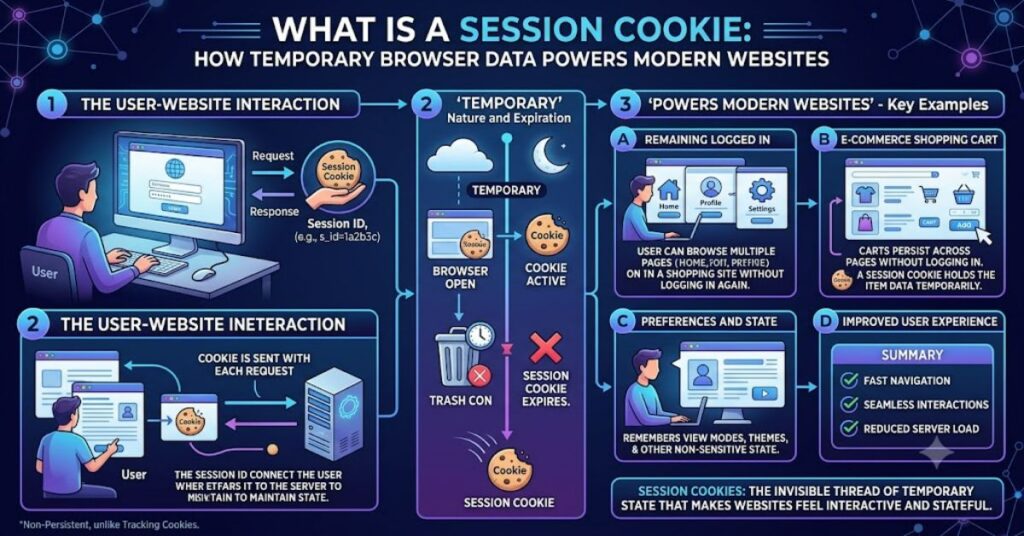
A session cookie is a small piece of temporary data stored in a user’s browser while they interact with a website. When users ask what is a session cookie, they are essentially referring to the mechanism that allows websites to remember who they are during a single browsing session without permanently storing that information.
Unlike persistent cookies, session cookies are deleted automatically once the browser is closed. This makes them critical for short-term authentication, shopping cart management, and secure browsing activities. Without session cookies, users would need to log in repeatedly on every page they visit, and websites would struggle to maintain continuity in user experience.
In modern web architecture, session cookies act as a bridge between stateless HTTP requests and stateful user interactions. Every time a user clicks a link or submits a form, the session cookie ensures the server understands that the actions belong to the same user session. This concept is foundational to how websites function today, especially in banking systems, e-commerce platforms, and cloud-based applications.
Understanding what is a session cookie is also essential for grasping broader topics like authentication, session management, and web security.
What is a Session Cookie?
A session cookie is a temporary identifier stored in browser memory during an active session.
Core Characteristics
- Stored in temporary memory
- Deleted when browser closes
- Contains session ID rather than personal data
- Used for authentication and tracking user state
Session cookies do not store long-term information. Instead, they reference server-side session data that holds user-specific details.
How Session Cookies Work
Step-by-Step Flow
- User visits a website
- Server creates a session ID
- Session ID is stored in a cookie
- Browser sends cookie with each request
- Server retrieves session data using ID
This mechanism ensures continuity without exposing sensitive information directly in the browser.
Session Cookie vs Persistent Cookie
Comparison Table
| Feature | Session Cookie | Persistent Cookie |
| Lifespan | Temporary | Long-term |
| Storage | Memory-based | Disk-based |
| Expiration | Browser close | Set by expiry date |
| Use Case | Login sessions | Preferences, tracking |
| Security Risk | Lower | Higher (if misused) |
Understanding this difference is essential when analyzing what is a session cookie in web development contexts.
Why Session Cookies Are Important
1. User Authentication
They keep users logged in while navigating a site.
2. Shopping Cart Management
E-commerce platforms use them to store cart items temporarily.
3. Security Control
Session IDs reduce exposure of sensitive data in transit.
4. Performance Efficiency
Servers avoid repeatedly asking users to re-authenticate.
Security Risks and Trade-Offs
Session cookies are powerful but must be handled carefully.
Common Risks
- Session hijacking through stolen cookies
- Cross-site scripting (XSS) attacks
- Session fixation vulnerabilities
- Improper expiration handling
Mitigation Strategies
- Use HTTPS encryption
- Enable HttpOnly flags
- Implement secure session rotation
- Set short session lifetimes
Real-World Use Cases
Banking Systems
Session cookies maintain secure login sessions during transactions.
E-Commerce Platforms
They track carts, wish lists, and checkout flows.
SaaS Applications
They manage authentication across dashboards and APIs.
Data Insight Table: Session Cookie Behavior
| Attribute | Behavior | Impact |
| Expiration | Ends on browser close | Enhances privacy |
| Storage location | RAM / temporary memory | Reduces persistence risk |
| Server dependency | High | Requires backend session store |
| Scalability | Moderate | Needs session management infrastructure |
Information Gain: Practical Insights
1. Hidden Limitation in Microservice Architectures
Session cookies require centralized session stores, which can become bottlenecks in distributed systems unless properly cached or sharded.
2. Performance Trade-Off in High-Traffic Apps
Frequent session validation increases server load, especially without token-based alternatives like JWT.
3. Security Blind Spot in Shared Devices
Session cookies can persist in memory longer than expected if browsers crash instead of closing normally, creating potential unauthorized access windows.
The Future of Session Cookies in 2027
Session cookies are gradually being supplemented—but not replaced—by token-based authentication systems.
Expected Trends
- Increased adoption of secure token authentication (JWT + OAuth)
- Stronger browser privacy restrictions (e.g., third-party cookie blocking)
- Serverless session handling in cloud environments
- AI-driven anomaly detection for session hijacking
Despite these changes, session cookies will remain foundational for traditional web sessions, especially in secure enterprise environments.
Key Takeaways
- Session cookies are temporary identifiers used during browsing sessions.
- They are essential for login systems, carts, and secure navigation.
- They improve usability but must be carefully secured.
- Modern systems often combine cookies with token-based authentication.
- Browser privacy changes are reshaping how session data is managed.
Conclusion
A session cookie is one of the most fundamental building blocks of modern web interaction. While invisible to users, it powers essential features such as login sessions, secure transactions, and seamless navigation across websites. By temporarily storing session identifiers, it allows servers to maintain continuity in otherwise stateless HTTP communication.
However, as web security threats evolve, session cookies must be implemented with strict safeguards to prevent hijacking or misuse. Technologies like HTTPS, secure flags, and session rotation play a critical role in protecting user data.
Even as newer authentication models emerge, understanding what is a session cookie remains essential for developers, security engineers, and anyone working with web technologies.
Frequently Asked Questions
What is a session cookie in simple terms?
A session cookie is a temporary file stored in your browser that helps websites remember you while you browse.
How long does a session cookie last?
It lasts only until you close your browser.
Are session cookies safe?
Yes, when properly configured with secure flags and encryption, they are generally safe.
What happens when a session cookie expires?
The server no longer recognizes the session, and the user may need to log in again.
Do session cookies store personal data?
No, they usually store only a session ID that references data stored on the server.
Can session cookies be hacked?
Yes, through attacks like session hijacking if security measures are not implemented.
Methodology
This article is based on standard web development principles, HTTP protocol behavior, and widely accepted browser security models documented in modern web engineering resources. Explanations are aligned with established practices in authentication and session management used across enterprise and consumer applications.
References
- Mozilla Developer Network. (2024). HTTP Cookies Overview.
- OWASP Foundation. (2023). Session Management Cheat Sheet.
- RFC 6265. (2011). HTTP State Management Mechanism.
- Google Web Fundamentals. (2023). Web Security Best Practices.
Editorial Disclosure
This article was drafted with AI assistance and should be reviewed by a technical editor before publication.