
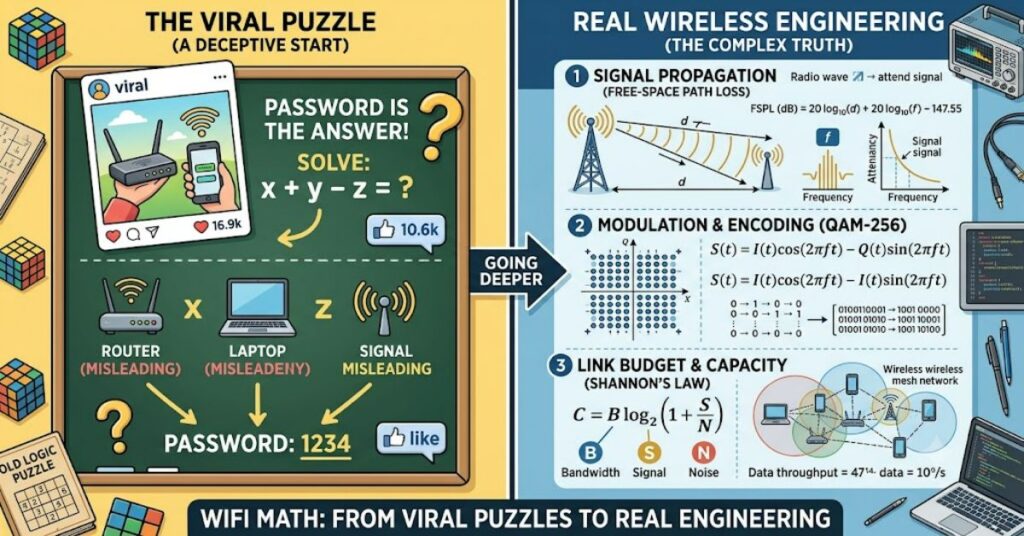
The term wifi math has gained attention for two very different reasons. On social media, it often refers to viral puzzles where users must solve a calculus or algebra problem to reveal a public Wi-Fi password. In networking and telecommunications, however, the phrase describes the mathematical principles used to calculate signal strength, estimate coverage, reduce interference, and optimize wireless performance.
Both interpretations involve problem-solving, but they serve entirely different purposes. One is entertainment. The other is a critical component of modern communications infrastructure.
As Wi-Fi has become essential for remote work, online learning, streaming, and smart-home devices, understanding the mathematics behind wireless networking has become increasingly valuable. While most consumers never see these calculations, network engineers rely on them every day when designing office networks, public hotspots, stadium deployments, and residential systems.
This article explores both meanings of the term, explains the core equations behind wireless communication, examines real-world applications, discusses limitations and trade-offs, and looks ahead to how wireless optimization may evolve by 2027.
What Is WiFi Math?
Broadly speaking, wifi math falls into two categories.
The Viral Puzzle Interpretation
Many cafés, libraries, universities, and social-media creators have popularized Wi-Fi passwords hidden behind math problems.
Examples include:
- Solving an algebra equation
- Completing a calculus derivative
- Evaluating a trigonometric expression
- Decoding a mathematical pattern
The objective is usually entertainment rather than security.
In most cases, the password challenge acts as a conversation starter rather than a genuine access-control system.
The Engineering Interpretation
The second meaning is far more significant.
Wireless engineers use mathematical models to determine:
- Signal propagation
- Network coverage
- Channel efficiency
- Interference levels
- Throughput expectations
- Antenna placement
These calculations form the foundation of modern wireless networking.
Why Mathematics Matters in Wireless Networks
Wi-Fi relies on radio frequency (RF) communication.
Unlike wired connections, wireless signals must travel through walls, furniture, appliances, and people.
Each obstacle affects performance.
Mathematics allows engineers to predict these effects before deploying equipment.
Key Networking Questions Solved by Math
| Problem | Mathematical Purpose |
| How far will a signal travel? | Coverage modeling |
| Why is the signal weak? | Path loss calculation |
| Which channel performs best? | Interference analysis |
| How many users can connect? | Capacity planning |
| Where should routers be placed? | RF optimization |
Without these calculations, large-scale Wi-Fi deployments would be largely guesswork.
The Core Equations Behind Wireless Networking
Several formulas appear frequently in wireless engineering.
Free Space Path Loss (FSPL)
One of the most important equations estimates signal loss over distance.
The simplified concept:
Signal Strength ∝ 1 / Distance²
As distance doubles, signal power drops dramatically.
This explains why moving a laptop only a few rooms away from a router can significantly affect performance.
Signal-to-Noise Ratio (SNR)
Another critical metric is Signal-to-Noise Ratio.
SNR measures how clearly a device can distinguish a wireless signal from background interference.
Higher SNR generally means:
- Faster speeds
- Lower latency
- Better reliability
Poor SNR often causes buffering, dropped connections, and unstable performance.
Shannon Capacity Formula
Wireless engineers frequently reference the Shannon-Hartley theorem.
It establishes the theoretical maximum data rate of a communication channel based on bandwidth and signal quality.
While real-world performance rarely reaches theoretical limits, this formula remains fundamental to network design.
Real-World Example: Optimizing a Home Router
One practical example demonstrates why engineering-focused wifi math matters.
A homeowner places a router inside a cabinet near the floor.
Performance issues appear throughout the house.
A network technician evaluates:
- Distance from devices
- Wall materials
- Interference sources
- Antenna orientation
Rather than replacing equipment immediately, the technician repositions the router centrally and elevates it.
Signal quality improves substantially.
The improvement comes not from new hardware but from understanding signal propagation principles.
Observed Industry Practice
Major networking vendors such as Cisco, Aruba, and Ubiquiti regularly recommend predictive site surveys before large deployments.
These surveys use mathematical modeling to estimate coverage zones and interference patterns before equipment installation.
This is a documented industry-standard approach rather than experimental theory.
Comparison Table: Viral Puzzle WiFi Math vs Engineering WiFi Math
| Factor | Puzzle-Based Version | Engineering Version |
| Primary Purpose | Entertainment | Network optimization |
| Complexity | Basic to advanced math problems | RF engineering calculations |
| Audience | General public | Network professionals |
| Real-world Impact | Minimal | Critical |
| Security Benefit | Limited | Significant operational value |
| Common Environment | Cafés, memes, social media | Homes, offices, campuses |
Hidden Limitations Most People Miss
Many articles discussing wireless optimization focus only on router specifications.
That misses several important realities.
Limitation 1: More Bandwidth Does Not Guarantee Better Coverage
Consumers often assume upgrading internet speed automatically improves wireless performance.
In reality, coverage problems frequently stem from:
- Building materials
- Signal attenuation
- Poor placement
- RF congestion
Bandwidth and coverage are separate issues.
Limitation 2: The Fastest Router Cannot Overcome Physics
Radio waves obey physical laws.
Concrete walls, metal structures, and dense urban environments reduce signal effectiveness regardless of marketing claims.
This is one reason enterprise deployments use multiple access points rather than a single powerful router.
Limitation 3: Interference Is Becoming a Bigger Challenge
The number of connected devices continues to rise.
Smart TVs, security cameras, speakers, thermostats, and IoT devices increasingly compete for spectrum.
Interference management may become more important than raw speed improvements.
Structured Insight Table
| Network Factor | Impact on Performance | User Control Level |
| Router placement | High | High |
| Wall materials | High | Low |
| ISP speed | Medium | Medium |
| Device quality | Medium | Medium |
| RF interference | High | Partial |
| Antenna configuration | Medium | High |
| User density | High | Low |
Strategic Implications for Consumers and Businesses
The growing importance of wireless connectivity creates new challenges.
For Home Users
Understanding basic networking principles helps consumers:
- Reduce dead zones
- Improve streaming quality
- Lower latency for gaming
- Support remote work
Often, optimization provides greater benefits than purchasing new equipment.
For Businesses
Enterprise organizations depend heavily on wireless infrastructure.
Network downtime affects:
- Employee productivity
- Customer experiences
- Point-of-sale systems
- Cloud applications
Consequently, organizations increasingly invest in predictive RF modeling and network analytics.
Market and Cultural Impact
The viral interpretation of wifi math reflects a broader trend.
Mathematics has become entertainment.
Educational creators frequently transform equations into challenges that spread across social platforms.
At the same time, the engineering interpretation remains essential to digital infrastructure.
As remote work expanded following the COVID-19 era, Wi-Fi reliability shifted from convenience to necessity.
The result is an unusual overlap where a technical discipline intersects with internet culture.
Few networking concepts have developed such a dual identity.
The Future of WiFi Math in 2027
By 2027, wireless networking will likely become even more dependent on mathematical optimization.
Several trends support this expectation.
AI-Assisted Network Management
Modern systems increasingly use machine learning to:
- Predict congestion
- Recommend channel changes
- Optimize device distribution
- Improve roaming performance
These systems still rely on mathematical models underneath their automation layers.
Wi-Fi 7 Expansion
The adoption of Wi-Fi 7 introduces:
- Wider channels
- Multi-link operation
- Lower latency capabilities
These advances increase optimization complexity, making predictive modeling more important.
Smart Home Growth
The number of connected devices per household continues rising.
As device density increases, interference calculations and spectrum management become increasingly valuable.
However, infrastructure limitations remain.
Wireless performance will still be constrained by building design, spectrum availability, and physical propagation characteristics.
Technology can improve efficiency, but it cannot eliminate those constraints entirely.
Key Takeaways
- WiFi math refers both to viral password puzzles and real wireless engineering calculations.
- Network performance depends heavily on signal propagation and interference management.
- Router placement often delivers greater benefits than hardware upgrades.
- Signal-to-noise ratio remains one of the most important performance indicators.
- Physical barriers continue to limit wireless performance regardless of advertised speeds.
- AI-driven network management will likely increase reliance on predictive mathematical models.
- Wi-Fi optimization is increasingly important for both households and businesses.
Conclusion
The phrase wifi math represents an interesting collision between internet culture and telecommunications engineering. On one side are the viral puzzles that challenge users to solve equations before gaining network access. On the other is the sophisticated mathematical framework that makes modern wireless communication possible.
While the puzzle version attracts attention online, the engineering version has far greater real-world significance. Every wireless network relies on calculations involving signal strength, propagation loss, interference, and channel capacity. These models help engineers design reliable systems that support everything from smart homes to large corporate campuses.
For consumers, understanding even a few basic concepts can lead to better network performance without additional spending. For organizations, mathematical optimization remains a competitive necessity as connectivity demands continue increasing.
As wireless technologies evolve through Wi-Fi 7 and AI-assisted management, the role of mathematical analysis will only become more important. The equations may stay behind the scenes, but they remain central to the connected world.
FAQ
What does wifi math mean?
The term commonly refers either to internet password puzzles involving mathematics or to the engineering calculations used to design and optimize wireless networks.
Are Wi-Fi password math puzzles secure?
Not particularly. Most puzzle-based passwords are intended for entertainment rather than robust security. Strong authentication methods provide significantly better protection.
What mathematical formula affects Wi-Fi signal strength?
Engineers often use path-loss models and free-space propagation equations to estimate how signals weaken over distance.
Why does moving a router improve performance?
Changing location affects signal propagation, obstacle interference, and coverage patterns. A better position can dramatically improve network quality.
Is calculus required for wireless networking?
Advanced wireless engineering may involve calculus, statistics, and signal processing. Basic home-network optimization usually does not require advanced mathematics.
How does Signal-to-Noise Ratio affect Wi-Fi?
A higher SNR allows devices to communicate more efficiently, resulting in better speeds, reliability, and lower latency.
Will AI replace wireless network engineers?
AI can automate optimization tasks, but network architecture, security planning, troubleshooting, and infrastructure design still require human expertise.
Methodology
This article was developed using publicly available information from wireless networking standards organizations, networking vendor documentation, telecommunications theory references, and educational resources covering RF engineering.
Industry practices discussed include documented approaches used by enterprise networking vendors for wireless site surveys, capacity planning, and signal optimization. No proprietary measurements or independent laboratory testing were conducted specifically for this article.
Limitations include variations in building materials, device capabilities, ISP performance, and environmental interference that can affect wireless outcomes. Future predictions are based on publicly known technology roadmaps and adoption trends rather than guaranteed developments.
Editorial Disclosure
This article was drafted with AI assistance and reviewed and verified by the editorial team at Postcard.fm. All factual claims, technical explanations, and references should be independently validated before publication.
References
Cisco Systems. (2024). Wireless LAN design guide. Cisco Documentation.
Institute of Electrical and Electronics Engineers. (2024). IEEE 802.11 wireless networking standards overview. IEEE.
National Institute of Standards and Technology. (2023). Wireless networking fundamentals and RF considerations. NIST Publications.
Shannon, C. E. (1948). A mathematical theory of communication. Bell System Technical Journal, 27(3), 379–423.
Wi-Fi Alliance. (2024). Wi-Fi CERTIFIED 7 overview. Wi-Fi Alliance.