
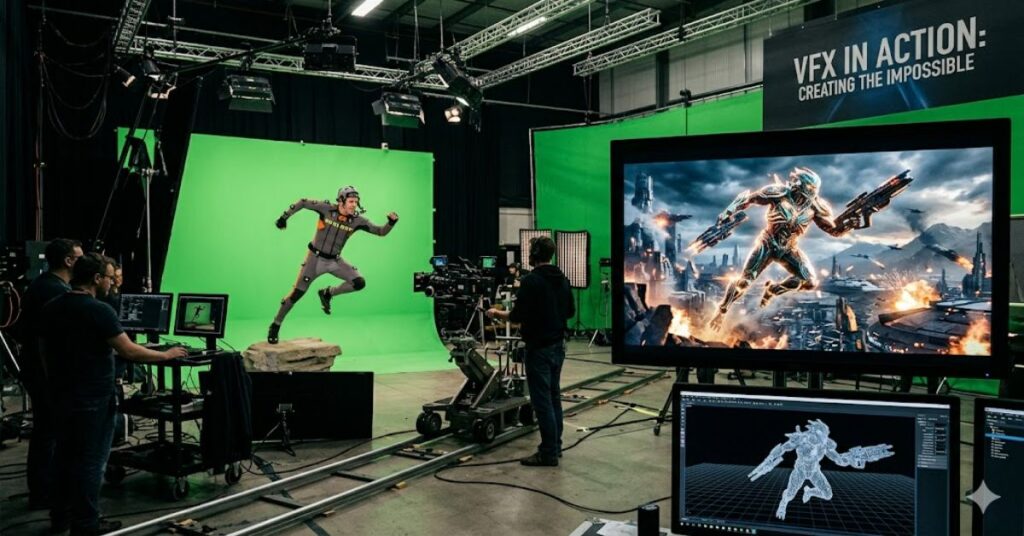
Visual effects techniques are the processes used to create or manipulate imagery outside a live-action shoot. They allow filmmakers, game developers, and advertisers to generate environments, creatures, explosions, weather systems, and impossible events that would be too dangerous, expensive, or physically impossible to capture in reality.
From blockbuster films such as Avatar and Dune: Part Two to streaming series and video game cinematics, VFX has become a foundational component of visual storytelling. Audiences often notice spectacular effects, but the most successful work frequently goes unnoticed. Invisible effects remove modern buildings from historical dramas, extend sets, and subtly enhance environments without attracting attention.
The modern VFX industry combines artistic creativity with sophisticated technical disciplines. Artists use modelling software, simulation engines, motion capture systems, compositing platforms, and rendering technologies to create believable imagery. What once required months of post-production can now be achieved through real-time rendering and virtual production technologies.
Understanding how these techniques work provides valuable insight into both modern entertainment and the broader technology ecosystem driving creative industries. Whether you are an aspiring artist, filmmaker, student, or simply curious about movie magic, knowing the fundamentals reveals just how much innovation exists behind every frame.
Understanding the Core Categories of Visual Effects
Visual effects are not a single technique. Instead, they consist of several specialised disciplines working together.
CGI (Computer-Generated Imagery)
CGI involves creating digital objects, environments, or characters using 3D software.
Common applications include:
- Digital creatures
- Vehicles and spacecraft
- Fantasy environments
- Architectural visualisations
- Crowd simulations
Studios often create detailed digital assets that can be reused across multiple productions, reducing production costs over time.
Compositing
Compositing combines multiple visual elements into a single final image.
Artists merge:
- Live-action footage
- CGI elements
- Matte paintings
- Particle effects
- Environmental enhancements
Software such as Nuke and After Effects remains central to modern compositing workflows.
Motion Capture
Motion capture records human movement and translates it into digital characters.
Well-known examples include performances by Andy Serkis in films such as The Lord of the Rings and Planet of the Apes.
Motion capture helps preserve subtle facial expressions and body language while enabling characters that could never exist physically.
Simulation Effects
Simulation systems recreate natural phenomena using physics-based algorithms.
Examples include:
- Fire
- Smoke
- Water
- Destruction
- Weather systems
- Explosions
These simulations often require substantial computing power because every particle must behave according to predefined physical rules.
Comparison of Major Visual Effects Techniques
| Technique | Primary Purpose | Advantages | Limitations |
| CGI | Create digital assets | Unlimited creativity | High rendering costs |
| Compositing | Combine visual elements | Flexible post-production | Requires precise integration |
| Motion Capture | Record human performance | Realistic movement | Equipment intensive |
| Simulation | Recreate physical phenomena | High realism | Computationally demanding |
| Matte Painting | Build environments | Cost efficient | Limited interaction |
| Virtual Production | Real-time visual environments | Faster decision-making | Expensive infrastructure |
The Evolution of Visual Effects
The history of VFX predates computers by decades.
Early filmmakers used practical techniques including:
- Miniature models
- Optical compositing
- Stop-motion animation
- Rear projection
The industry experienced a major shift after the release of Jurassic Park, which demonstrated how CGI creatures could convincingly coexist with live-action footage.
Another milestone arrived with The Matrix and its pioneering bullet-time photography.
By the 2010s, studios increasingly relied on digital production pipelines. Films could feature thousands of visual effects shots, many impossible to identify without specialised breakdown reels.
Why Modern Productions Depend on VFX
Visual effects have become a practical production solution rather than merely a creative luxury.
Safety Advantages
Certain scenes present unacceptable risks when performed physically.
Examples include:
- Large explosions
- Extreme weather
- Building collapses
- Dangerous stunts
Digital recreation reduces liability while maintaining visual impact.
Cost Management
Constructing enormous physical sets is often more expensive than creating digital environments.
Large productions routinely combine:
- Partial physical sets
- LED volume stages
- CGI extensions
This hybrid approach balances realism and efficiency.
Creative Freedom
Filmmakers can depict:
- Alien planets
- Historical cities
- Mythological creatures
- Futuristic technology
Without VFX, many contemporary stories would simply be impossible to produce.
Structured Industry Insight Table
| Industry Sector | Primary VFX Usage | Business Impact |
| Film | Character creation and environments | Higher production value |
| Television | Set extensions and world building | Faster content delivery |
| Gaming | Cinematics and real-time graphics | Enhanced immersion |
| Advertising | Product visualisation | Reduced production costs |
| Architecture | Virtual walkthroughs | Improved client presentations |
| Education | Scientific visualisation | Better knowledge transfer |
Real-World Examples and Industry Observations
One documented example comes from Top Gun: Maverick. While the film relied heavily on practical aerial photography, visual effects teams still enhanced cockpit backgrounds, removed equipment, and refined sequences that audiences perceived as entirely practical.
Another example is Dune: Part Two, where extensive environmental enhancement combined practical desert photography with digital set extensions and large-scale simulations.
Industry professionals consistently note that audiences often underestimate how much invisible VFX exists within modern productions. A scene may appear completely natural while containing dozens of digital modifications.
This observation highlights a critical reality: successful VFX often attracts no attention at all.
Hidden Challenges and Trade-Offs
Rising Production Complexity
One overlooked challenge is asset management.
Large productions may involve:
- Thousands of digital assets
- Multiple vendor studios
- Hundreds of artists
- Petabytes of storage
Coordinating these resources requires sophisticated pipeline management systems.
Render Costs
Rendering remains expensive despite advances in hardware.
Complex scenes involving:
- Volumetric lighting
- Particle simulations
- High-resolution textures
can require significant cloud computing resources.
Talent Shortages
Demand for experienced technical artists continues to exceed supply in several regions.
Studios increasingly seek professionals skilled in:
- Procedural workflows
- Real-time rendering
- Python automation
- Machine learning integration
Three Important Insights Often Missed in VFX Discussions
1. Invisible Effects Deliver the Most Value
Public discussions focus on explosions and monsters, yet much of the industry’s workload involves subtle enhancements.
Invisible corrections frequently improve production quality without audiences noticing.
2. Real-Time Workflows Are Changing Production Economics
Virtual production reduces the gap between filming and post-production.
Directors can evaluate shots immediately rather than waiting weeks for rendered previews.
3. Data Infrastructure Is Becoming as Important as Artistic Talent
Studios increasingly compete through pipeline efficiency rather than purely artistic capability.
Managing digital assets effectively can save millions in production costs.
The Future of Visual Effects Techniques in 2027
By 2027, several trends are likely to shape the industry.
AI-Assisted Workflows
Artificial intelligence is already helping artists with:
- Rotoscoping
- Object removal
- Animation clean-up
- Image enhancement
AI is expected to accelerate repetitive tasks rather than replace skilled artists entirely.
Expanded Virtual Production
LED volume technology popularised by productions such as The Mandalorian continues to mature.
More studios are investing in virtual stages that reduce location shooting requirements.
Real-Time Rendering Growth
Game engines such as Unreal Engine are increasingly integrated into film production pipelines.
The distinction between game development and filmmaking workflows may continue to blur.
Industry Constraints
Several factors may slow adoption:
- Infrastructure costs
- Energy consumption
- Talent shortages
- Intellectual property concerns regarding AI-generated content
As a result, progress is likely to be steady rather than revolutionary.
Key Takeaways
- Visual effects techniques combine artistry, software engineering, and advanced computing.
- CGI, compositing, simulation, and motion capture each serve distinct production needs.
- Invisible enhancements represent a substantial portion of professional VFX work.
- Real-time rendering is transforming traditional production timelines.
- Data management and pipeline efficiency increasingly influence studio competitiveness.
- AI tools are improving productivity but still require human oversight.
- Virtual production will continue expanding through 2027, particularly for high-budget projects.
Conclusion
Visual effects techniques have evolved from specialised cinematic tricks into an essential component of modern visual communication. Film, television, gaming, advertising, architecture, and education all rely on VFX to create experiences that would otherwise be impossible or prohibitively expensive.
The industry’s greatest achievement may not be its spectacular digital creatures or massive explosions. Instead, it is the seamless integration of technology and creativity that allows audiences to believe in worlds that never existed. Modern productions increasingly combine practical photography, virtual production, simulation technology, and real-time rendering to achieve this goal.
As AI-assisted workflows and virtual production platforms continue to mature, the profession will likely become more efficient without losing its reliance on human creativity. The tools will change, but the core objective remains the same: creating believable visual experiences that support compelling storytelling.
For anyone interested in technology, filmmaking, or digital art, understanding VFX offers a fascinating glimpse into one of the most innovative creative industries of the twenty-first century.
FAQ
What are visual effects techniques?
Visual effects techniques are methods used to create or manipulate imagery outside a live-action shoot. They include CGI, compositing, motion capture, simulation, and virtual production workflows.
What is the difference between VFX and CGI?
CGI is one component of VFX. Visual effects encompass multiple disciplines, while CGI specifically refers to computer-generated imagery created using 3D software.
Which industries use visual effects techniques?
Film, television, gaming, advertising, architecture, education, scientific visualisation, and corporate communications all use VFX technologies.
Are visual effects replacing practical effects?
Not entirely. Most modern productions combine practical effects and digital enhancements. Hybrid approaches often produce the most convincing results.
How difficult is it to learn VFX?
Learning basic compositing or 3D modelling is accessible, but mastering professional workflows requires years of technical and artistic development.
What software is commonly used in VFX?
Popular tools include Nuke, Autodesk Maya, Houdini, Blender, After Effects, and Unreal Engine.
Will AI replace VFX artists?
Current evidence suggests AI will automate repetitive production tasks but will not replace the creative judgement, technical expertise, and storytelling skills of experienced artists.
Methodology
This article was developed using publicly available industry resources, film production case studies, software documentation, and educational materials from recognised VFX organisations. Real-world examples were selected from documented productions with established visual effects pipelines. The analysis focuses on commonly accepted industry practices as of June 2026.
Limitations include the proprietary nature of many studio workflows and production budgets, which are not always publicly disclosed. Where future developments are discussed, projections are based on current adoption trends in virtual production, real-time rendering, and AI-assisted creative tools rather than speculative forecasts.
A balanced perspective has been maintained by considering both the benefits and operational challenges associated with visual effects production.
Editorial Disclosure: This article was drafted with AI assistance and reviewed and verified by the editorial team. All factual claims and references should be independently checked prior to publication.
References (APA)
Epic Games. (2025). Unreal Engine documentation. Epic Games.
Foundry. (2025). Nuke compositing software documentation. Foundry.
Industrial Light & Magic. (2024). Virtual production and visual effects case studies. ILM.
Pixar Animation Studios. (2024). Rendering and animation technologies overview. Pixar.
Visual Effects Society. (2025). Industry trends and workforce reports. Visual Effects Society.