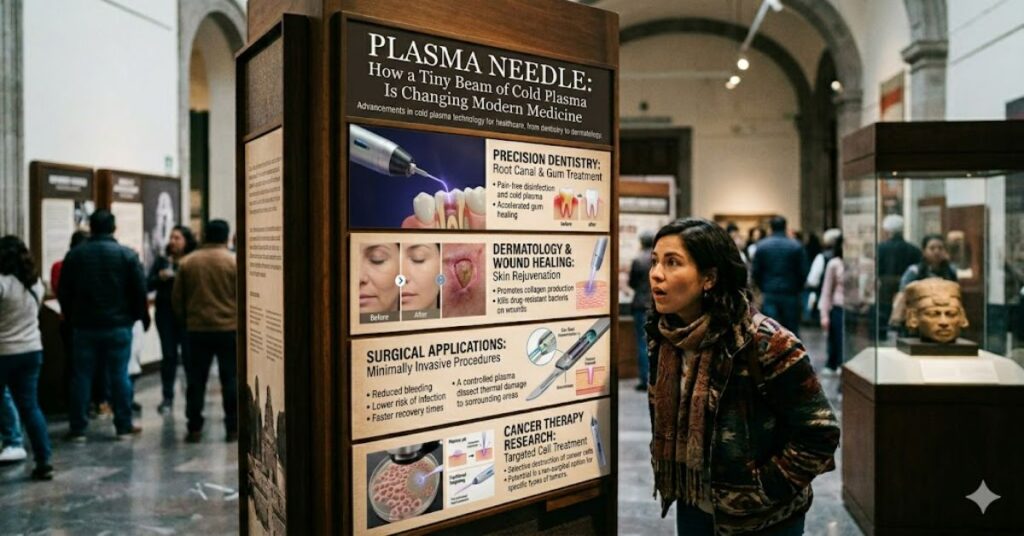
The plasma needle is a specialized device that generates a highly focused stream of non-thermal atmospheric plasma. Unlike surgical lasers or heat-based tools, it operates at temperatures that are generally safe for biological tissues, allowing clinicians and researchers to target microorganisms, damaged tissue, and cellular processes with remarkable precision.
Interest in plasma medicine has accelerated over the past decade because cold atmospheric plasma demonstrates antimicrobial effects while also influencing wound-healing mechanisms. Researchers have explored its ability to reduce bacterial contamination, stimulate tissue repair, and selectively affect diseased cells. Current evidence suggests that cold plasma may support wound healing and dermatological treatments while opening new possibilities in oncology and regenerative medicine.
Despite growing attention, confusion remains around the term. In healthcare and physics, a plasma needle refers to a micro-scale plasma-generating device. In blood donation settings, however, similar terminology can occasionally refer to equipment associated with plasma collection procedures, which is an entirely different technology. This article focuses on the medical and scientific plasma needle used in plasma medicine.
Understanding the science behind this technology helps separate realistic clinical potential from exaggerated claims. The field is advancing, but many applications remain under active investigation.
What Is a Plasma Needle?
A plasma needle is a miniature atmospheric-pressure plasma source designed to create a narrow plume of ionized gas. The device generates plasma using electrical energy and a working gas, often helium, argon, or air.
The resulting plasma contains:
- Reactive oxygen species (ROS)
- Reactive nitrogen species (RNS)
- Charged particles
- Ultraviolet photons
- Electric fields
These components interact with microorganisms, cells, and biological tissues in ways that researchers continue to study. Unlike conventional surgical instruments that rely on heat, a plasma needle typically produces “cold plasma,” allowing treatment of sensitive tissues without significant thermal injury.
Why Plasma Matters
Plasma is often called the fourth state of matter, alongside solids, liquids, and gases. When sufficient energy is applied to a gas, atoms become ionized and form plasma.
Examples include:
- Lightning
- Neon signs
- Auroras
- Industrial plasma systems
- Medical cold plasma devices
The plasma needle represents one of the most controlled and precise implementations of this physical phenomenon.
How a Plasma Needle Works
The operating principle is surprisingly straightforward.
- Electrical energy is applied to a gas.
- The gas becomes partially ionized.
- A small plasma plume forms at the device tip.
- Reactive species are delivered to the treatment area.
- Biological effects occur through chemical and cellular interactions.
Rather than burning tissue, the plasma plume influences biological processes at the molecular level.
Key Biological Mechanisms
| Mechanism | Observed Effect |
| Antimicrobial activity | Reduces bacterial contamination |
| Oxidative signaling | Influences cellular responses |
| Angiogenesis stimulation | May support wound repair |
| Cell proliferation regulation | Assists tissue regeneration |
| Apoptosis induction | Potentially affects abnormal cells |
Research indicates that treatment duration and plasma intensity significantly influence outcomes. Lower exposures may encourage tissue repair, while higher exposures can trigger cell death pathways.
Medical Applications of Plasma Needle Technology
Wound Care and Infection Control
One of the most studied uses of the plasma needle involves wound management.
Chronic wounds often contain biofilms and antibiotic-resistant bacteria that slow healing. Cold atmospheric plasma has demonstrated the ability to reduce microbial contamination while supporting tissue recovery processes. Studies report antimicrobial activity against a broad range of pathogens, including drug-resistant strains.
Real-World Clinical Context
Hospital-acquired wound infections remain a major healthcare challenge worldwide. Researchers have investigated plasma-based treatments as a supplementary approach alongside conventional wound care rather than a replacement for established protocols.
Dermatology and Skin Treatments
Dermatology has become another important area for plasma medicine.
Current research explores applications including:
- Acne management
- Chronic inflammatory skin conditions
- Skin rejuvenation
- Scar treatment
- Antimicrobial skin therapies
Recent reviews describe cold atmospheric plasma as a promising dermatological tool because of its antimicrobial and tissue-regeneration properties. However, long-term clinical evidence remains limited for several cosmetic applications.
Cancer Research
Perhaps the most intriguing application involves oncology.
Laboratory studies suggest that plasma-generated reactive species may selectively damage cancer cells while minimizing effects on surrounding healthy tissue under specific conditions. Researchers are investigating this mechanism in multiple cancer models.
This remains primarily a research area rather than a routine clinical treatment.
Diabetic Wound Management
Diabetic foot ulcers are notoriously difficult to heal.
Cold atmospheric plasma has attracted attention because of its ability to promote wound healing, improve microcirculation, and reduce microbial burden. Multiple reviews identify diabetic wound care as one of the most promising near-term medical applications.
Plasma Needle vs Traditional Medical Technologies
| Technology | Primary Function | Heat Generation | Precision | Current Clinical Adoption |
| Plasma Needle | Disinfection and cellular modulation | Very low | High | Emerging |
| Surgical Laser | Cutting and ablation | High | High | Established |
| Electrocautery | Tissue coagulation | High | Moderate | Established |
| Antibiotics | Infection treatment | None | Systemic | Established |
| UV Sterilization | Surface disinfection | None | Low | Established |
The plasma needle occupies a unique position because it combines antimicrobial activity with potential biological modulation.
Strategic Implications for Healthcare
The growing interest in plasma medicine reflects broader healthcare trends.
Reducing Antibiotic Dependence
Antibiotic resistance is a global concern. Technologies that reduce microbial burden without relying exclusively on antibiotics may become increasingly valuable. Plasma-based therapies are being studied partly for this reason.
Precision Treatment
Modern medicine increasingly favors targeted interventions. The plasma needle aligns with this direction by delivering highly localized treatment.
Outpatient Potential
Many plasma systems are relatively compact compared with traditional hospital equipment. This raises the possibility of broader outpatient use if future trials confirm safety and efficacy.
Risks, Limitations, and Trade-Offs
Despite encouraging findings, several challenges remain.
Limited Long-Term Clinical Data
Many studies involve laboratory settings, animal models, or small patient groups. Larger randomized clinical trials are still needed for many proposed applications.
Regulatory Complexity
Medical plasma devices face rigorous regulatory review because they interact directly with living tissue.
Dose Control Challenges
Plasma treatment outcomes depend on:
- Exposure time
- Device design
- Gas composition
- Power settings
- Tissue characteristics
Small variations can influence results.
Cost and Infrastructure
Although devices are becoming more practical, specialized equipment and trained operators remain necessary.
Three Underreported Insights About Plasma Needle Technology
1. The Greatest Value May Be Infection Prevention
Much public discussion focuses on cancer treatment. Yet wound management and infection control may reach widespread clinical adoption sooner because evidence is currently stronger in these areas.
2. Standardization Is a Bigger Challenge Than Most Coverage Suggests
Different plasma devices generate different reactive species profiles. Establishing treatment consistency across healthcare systems remains a significant hurdle.
3. Safety Engineering Is Becoming a Major Innovation Area
Recent research increasingly focuses on improving delivery systems, reducing electrical risks, and optimizing reactive species generation rather than simply increasing plasma intensity.
Market and Real-World Impact
The broader field of plasma medicine continues to expand across:
- Hospital wound care
- Dermatology clinics
- Regenerative medicine research
- Oncology research programs
- Medical device manufacturing
The technology also illustrates how physics, engineering, and medicine increasingly overlap in modern healthcare innovation.
While public awareness remains relatively low, plasma-based medical devices are attracting growing research investment globally.
The Future of Plasma Needle in 2027
By 2027, several trends are likely to shape plasma needle development.
Strongest Near-Term Opportunities
- Chronic wound treatment
- Diabetic ulcer management
- Infection control applications
- Dermatological therapies
Areas Requiring More Evidence
- Cancer treatment
- Deep-tissue applications
- Broad regenerative medicine claims
Regulatory Outlook
Regulators are expected to demand larger clinical datasets demonstrating safety, reproducibility, and long-term outcomes before approving expanded indications.
The most realistic scenario is steady clinical growth rather than rapid disruption. Plasma medicine shows genuine promise, but healthcare adoption moves according to evidence, not excitement.
Key Takeaways
- Plasma needles generate focused cold atmospheric plasma rather than heat-based energy.
- Their strongest evidence currently relates to wound care and antimicrobial applications.
- Plasma treatments may support tissue repair through complex cellular signaling mechanisms.
- Standardization remains a major technical challenge across devices.
- Cancer-related applications are promising but still largely investigational.
- Regulatory validation will determine the pace of adoption.
- The field sits at the intersection of physics, engineering, and medicine.
Conclusion
The plasma needle represents one of the most fascinating developments in modern plasma medicine. By generating a precise stream of non-thermal atmospheric plasma, the technology offers a fundamentally different approach to interacting with biological tissues. Research demonstrates encouraging results in wound care, infection management, dermatology, and experimental oncology.
At the same time, the field remains in an important transitional phase. While laboratory and early clinical findings are promising, broader adoption depends on larger clinical trials, standardized treatment protocols, and continued regulatory review.
The most compelling aspect of plasma needle technology is not a single breakthrough application but its versatility. A device originally rooted in plasma physics is now influencing conversations about wound healing, antimicrobial resistance, tissue regeneration, and precision medicine.
For healthcare professionals, researchers, and patients alike, the key is balancing optimism with evidence. Plasma needles may become a valuable part of future medical practice, but their long-term role will be defined by clinical outcomes rather than theoretical potential.
FAQ
What is a plasma needle?
A plasma needle is a medical or research device that produces a focused stream of non-thermal atmospheric plasma for applications such as wound treatment, microbial control, and experimental tissue therapies.
Is a plasma needle the same as a surgical laser?
No. Surgical lasers use concentrated light and often generate significant heat. Plasma needles use ionized gas and typically operate at much lower temperatures.
Can a plasma needle kill bacteria?
Research indicates that cold atmospheric plasma has strong antimicrobial activity against many microorganisms, including some antibiotic-resistant strains.
Is plasma needle treatment approved for cancer?
Cancer-related plasma therapies remain primarily investigational. Researchers continue studying their effectiveness and safety in laboratory and clinical settings.
Does plasma needle treatment hurt?
Patient experiences vary depending on the application and device. Many cold plasma treatments produce minimal discomfort because temperatures remain relatively low.
What is non-thermal plasma?
Non-thermal plasma, often called cold plasma, is ionized gas in which electrons carry high energy while the overall gas temperature remains relatively low.
What industries use plasma needle technology?
Healthcare, biomedical research, dermatology, regenerative medicine, and medical device development are among the primary sectors exploring plasma needle applications.
Methodology
This article was developed using peer-reviewed medical literature, biomedical reviews, and published research on cold atmospheric plasma and plasma medicine. Priority was given to recent reviews, PubMed-indexed studies, and established scientific journals. Claims regarding wound healing, antimicrobial activity, dermatology, and experimental oncology were cross-checked across multiple sources.
Limitations include the evolving nature of plasma medicine and the fact that many applications remain under investigation rather than fully established clinical practice. Where evidence remains preliminary, this article reflects that uncertainty rather than presenting future outcomes as settled facts.
Balanced coverage was maintained by discussing both demonstrated benefits and ongoing limitations related to regulation, standardization, and long-term clinical evidence.
Editorial Disclosure
This article was drafted with AI assistance and reviewed and verified by [Author Name]. All data, citations, and claims should be independently confirmed by the editorial team at Postcard.fm before publication.
References (APA)
Barjasteh, A., Kaushik, N., Choi, E. H., & Kaushik, N. K. (2023). Cold atmospheric pressure plasma: A growing paradigm in diabetic wound healing—Mechanism and clinical significance. International Journal of Molecular Sciences, 24(23), 16657.
Bolgeo, T., Maconi, A., Gardalini, M., Gatti, D., Di Matteo, R., Lapidari, M., et al. (2023). The role of cold atmospheric plasma in wound healing processes in critically ill patients. Journal of Personalized Medicine, 13(5), 736.
Khalaf, A. T., Abdalla, A. N., Ren, K., & Liu, X. (2024). Cold atmospheric plasma (CAP): A revolutionary approach in dermatology and skincare. European Journal of Medical Research, 29, 487.
Laroussi, M. (2021). Cold gas plasma sources and the science behind their applications in biology and medicine. arXiv.
Singh, V., Kaushal, A., & collaborators. (2022). Cold atmospheric plasma therapy in wound healing. Process Biochemistry, 112, 112–123.
Yoon, H. J., Shon, C. H., Kim, K., & Lee, H. J. (2008). The effect of RF electric fields from an atmospheric micro-plasma needle device on the death of cells. Journal of the Korean Institute of Electrical Engineers.