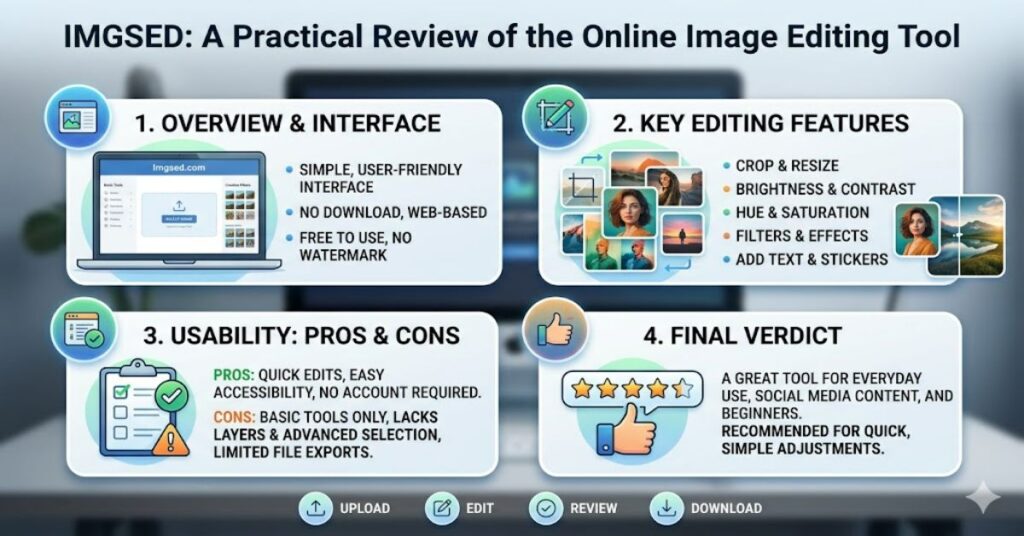
Imgsed is an online image processing application aimed at people who need to make elementary changes to photos in just a few minutes. Rather than competing with professional creative suites, the platform appears designed around simplicity, convenience, and browser-based access.
The demand for lightweight editing tools has increased significantly over the past decade. Social media publishing, e-commerce listings, digital portfolios, and remote collaboration have created a need for quick image modifications that do not require advanced software skills. For many users, downloading a large editing application is unnecessary when the task involves cropping a photo, resizing an image, or applying a minor adjustment.
This is where browser-based tools have carved out a niche. They reduce setup time, eliminate installation requirements, and often work across devices. Imgsed falls into this category of lightweight editing platforms.
However, simplicity always involves trade-offs. Features that make a tool easy to use can also limit its suitability for professional workflows. Understanding those trade-offs is essential for anyone evaluating online image editors.
This article examines how Imgsed works, where it fits in today’s editing ecosystem, its advantages and limitations, and what users should realistically expect from a browser-based photo editing platform.
What Is Imgsed?
Imgsed is an online image editing application that allows users to perform basic photo modifications through a web browser.
Typical functions offered by tools in this category include:
- Cropping
- Resizing
- Rotating
- Format conversion
- Simple color adjustments
- Basic filters
- Compression and optimization
The primary appeal is convenience. Users can upload an image, make changes, and download the result without installing dedicated software.
The Rise of Lightweight Editing Platforms
The growth of browser-based productivity tools has transformed user expectations.
Today many users prefer:
- No software installation
- Fast processing
- Mobile compatibility
- Cross-platform accessibility
- Minimal learning curves
These expectations have helped create a market for streamlined editing services.
How Imgsed Fits Into the Image Editing Market
The image editing market generally consists of three categories.
| Category | Examples | Primary Audience | Complexity |
| Professional Software | Adobe Photoshop, Affinity Photo | Designers and professionals | High |
| Mid-Level Online Platforms | Canva, Pixlr | Content creators and businesses | Medium |
| Quick Editing Tools | Imgsed and similar utilities | Casual users | Low |
Imgsed appears positioned within the third category.
Its value proposition is speed rather than extensive creative control.
Core Features Users Typically Need
When evaluating a lightweight editing tool, functionality matters more than feature count.
Image Resizing
Resizing remains one of the most common editing tasks.
Examples include:
- Social media posts
- Website uploads
- Marketplace product photos
- Email attachments
A browser-based solution can simplify these routine tasks.
Cropping and Composition
Cropping helps users improve framing and remove unnecessary elements.
For non-designers, this may be the single most valuable editing feature available.
File Format Adjustments
Many users encounter situations where a platform requires a specific image format.
Common formats include:
- JPEG
- PNG
- WebP
- GIF
Simple conversion tools save time and reduce workflow friction.
Basic Enhancement Tools
Exposure, brightness, contrast, and saturation adjustments often provide enough control for everyday image improvement.
Practical Use Cases
Imgsed is particularly suited for straightforward workflows.
Social Media Publishing
Content creators frequently need quick edits before publishing.
Examples include:
- Resizing Instagram images
- Cropping profile photos
- Optimizing images for LinkedIn posts
- Preparing Facebook cover graphics
E-Commerce Product Listings
Small business owners often need simple product image adjustments.
Tasks may include:
- Background cleanup
- Cropping
- Compression
- Dimension adjustments
Educational Projects
Students and educators often require fast image modifications for:
- Presentations
- Reports
- Digital assignments
- Learning materials
Website Content
Website managers frequently resize and compress images before publication.
A lightweight editor can accelerate this process.
Comparison Table: Imgsed vs Alternative Solutions
| Feature | Imgsed | Canva | Pixlr | Photoshop |
| Browser-Based | Yes | Yes | Yes | Partial |
| Installation Required | No | No | No | Usually |
| Learning Curve | Low | Low | Medium | High |
| Advanced Layer Editing | Limited | Limited | Moderate | Extensive |
| Professional Retouching | Limited | Limited | Moderate | Extensive |
| Cost Barrier | Typically Low | Freemium | Freemium | Subscription |
Real-World Trade-Offs
The strengths of browser-based tools often create corresponding limitations.
Advantages
- Fast setup
- Easy access
- Beginner-friendly workflow
- Device independence
- Lower technical requirements
Limitations
- Fewer advanced editing controls
- Potential upload size restrictions
- Dependence on internet connectivity
- Limited color management tools
- Reduced support for complex workflows
Users should evaluate whether convenience outweighs these constraints.
Structured Insight Table
| User Type | Primary Goal | Imgsed Suitability |
| Student | Quick assignment graphics | High |
| Blogger | Basic image optimization | High |
| Social Media Manager | Fast publishing edits | Moderate to High |
| Professional Photographer | Advanced editing | Low |
| Graphic Designer | Multi-layer projects | Low |
| Small Business Owner | Product image preparation | Moderate |
Three Insights Often Missing From Basic Reviews
1. Speed Is Usually More Valuable Than Features
Many users perform the same three editing tasks repeatedly: crop, resize, and export.
For these users, workflow efficiency often matters more than advanced functionality.
2. Browser-Based Editing Reduces Device Dependency
Cloud-accessible tools allow users to work across multiple computers without transferring software licenses or project files.
3. Simplicity Can Improve Productivity
Feature-rich software can slow occasional users.
For straightforward tasks, fewer controls often translate into faster outcomes.
Security and Privacy Considerations
Whenever images are uploaded to an online platform, users should evaluate:
- Data retention policies
- Privacy disclosures
- File deletion procedures
- Storage practices
- Regulatory compliance
Organizations handling sensitive images should review platform documentation carefully before adoption.
Business Risk Perspective
Many discussions about online image editors focus on features.
Data governance deserves equal attention.
For companies operating under privacy regulations, image handling policies can be just as important as editing capabilities.
Market Impact and Industry Context
The broader image editing market continues shifting toward accessibility.
Recent trends include:
- AI-assisted editing
- Browser-native workflows
- Cloud collaboration
- Mobile-first design
- Faster publishing pipelines
Tools such as Imgsed benefit from these trends because users increasingly prioritize convenience over extensive feature sets.
The Future of Imgsed in 2027
Several developments are likely to influence lightweight image editing platforms by 2027.
AI-Assisted Editing
Artificial intelligence is expected to automate:
- Background removal
- Image enhancement
- Object selection
- Content-aware resizing
Browser Performance Improvements
Web technologies continue reducing the performance gap between browser applications and desktop software.
Privacy Expectations
Regulators and users are paying closer attention to how online platforms manage uploaded content.
Future competitiveness may depend as much on trust and transparency as on editing features.
Market Outlook
The strongest demand is likely to remain among casual creators, small businesses, educators, and marketers who value speed over advanced design capabilities.
Key Takeaways
- Imgsed targets users seeking simple image modifications.
- Browser accessibility is one of its most practical advantages.
- Quick workflows make it attractive for casual and business users.
- Professional designers may require more advanced software.
- Privacy considerations should be evaluated before uploading sensitive files.
- Simplicity often improves productivity for repetitive editing tasks.
- Future growth will depend on usability, trust, and AI integration.
Conclusion
Imgsed occupies a practical position within the image editing ecosystem. Rather than competing directly with professional creative software, it addresses a different need: helping users make quick image adjustments without installing complex applications.
For students, bloggers, marketers, and small business owners, this approach can be highly effective. Most everyday image tasks require speed and convenience rather than advanced retouching or sophisticated design workflows.
The platform’s greatest strength is accessibility. Users can complete common editing tasks in minutes, often with little technical knowledge. At the same time, professionals working with layered compositions, color-critical workflows, or advanced image manipulation will likely require more capable tools.
The long-term success of platforms like Imgsed will depend on balancing simplicity with evolving user expectations. As browser technologies improve and AI-powered editing becomes more common, lightweight editors may become even more capable while preserving the speed that makes them valuable.
FAQ
What is Imgsed used for?
Imgsed is used for basic online image editing tasks such as resizing, cropping, rotating, and making simple photo adjustments through a web browser.
Is Imgsed free to use?
Availability and pricing may vary. Users should review the platform’s current terms and feature access model directly before relying on it for ongoing projects.
Can Imgsed replace Photoshop?
For simple edits, it may be sufficient. For advanced retouching, layered compositions, and professional design workflows, dedicated software remains more capable.
Is Imgsed suitable for social media content?
Yes. Quick resizing, cropping, and optimization tasks align well with social media publishing requirements.
Does Imgsed work on mobile devices?
Most browser-based image editors are designed to function across desktop and mobile environments, although performance may vary by device.
Is it safe to upload photos to online editors?
Users should review privacy policies, storage practices, and file retention procedures before uploading sensitive or confidential images.
Who benefits most from Imgsed?
Students, bloggers, content creators, educators, and small business owners are among the users most likely to benefit from a lightweight editing workflow.
Methodology
This analysis was prepared using publicly available information about browser-based image editing platforms and general industry practices. The article evaluates Imgsed within the broader context of lightweight online image editors.
Limitations exist because platform features, pricing structures, and privacy policies may change over time. Any specific capability should be verified directly through the platform before publication.
Where future developments are discussed, they are based on observable industry trends rather than guaranteed outcomes.
Editorial Disclosure
This article was drafted with AI assistance and reviewed and verified by [Author Name]. All data, citations, and claims should be independently confirmed by the editorial team at Postcard.fm before publication.
References
Because Imgsed-specific academic or authoritative sources may be limited, all claims regarding features, privacy practices, pricing, and platform capabilities should be verified directly from the service’s official documentation before publication.
Human editorial verification is required before adding formal APA citations.