
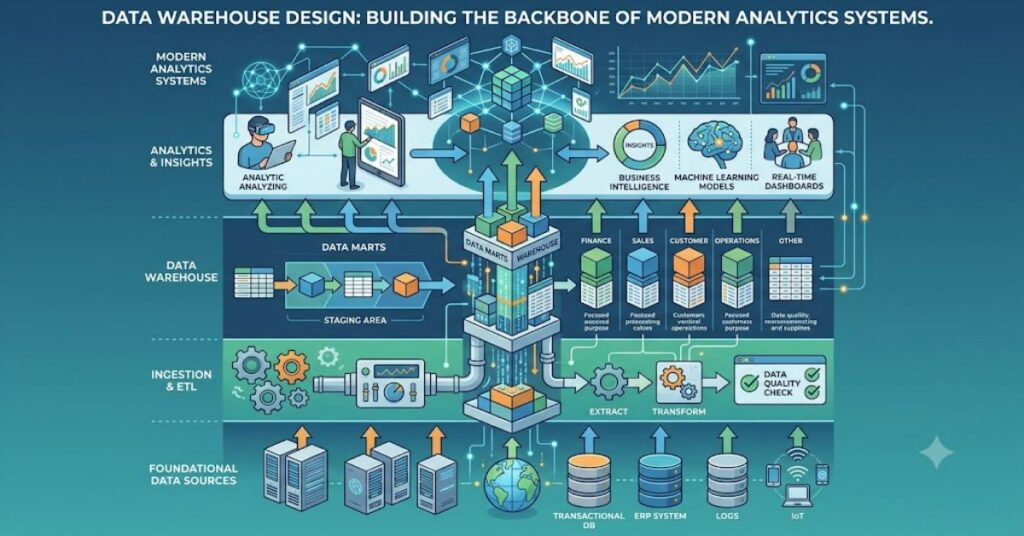
Understanding data warehouse design is essential for building systems that convert raw operational data into structured, reliable insights. At its core, data warehouse design is the structured process of translating business requirements into a technical framework. It models how data is extracted from sources, cleansed, and organized into fact and dimension tables, ensuring analysts can generate reports and actionable insights reliably.
In practical terms, data warehouse design determines how information flows from transactional systems—such as sales platforms, mobile apps, or CRM tools—into a centralized analytical environment. Without a proper design, organizations face fragmented reporting, duplicated metrics, and inconsistent decision-making.
Modern enterprises depend on data warehouses not just for storage, but for performance-driven analytics, forecasting, and machine learning pipelines. This makes design decisions—like schema modeling, partitioning strategy, and data granularity—critical to long-term scalability.
This article breaks down the architecture, modeling approaches, trade-offs, and future evolution of data warehouse design in enterprise systems.
Core Principles of Data Warehouse Design
A well-structured data warehouse is built on three foundational principles:
- Consistency: Standardized definitions across datasets
- Scalability: Ability to handle growing data volumes
- Separation of concerns: Distinct layers for ingestion, storage, and analytics
These principles ensure that analytical queries remain fast and reliable even as data complexity increases.
Architecture Layers in Data Warehouse Design
Common Layered Structure
| Layer | Purpose |
| Data Source Layer | Operational systems like ERP, CRM |
| Staging Layer | Temporary raw data storage |
| Data Warehouse Layer | Structured, cleaned, modeled data |
| Data Mart Layer | Business-specific subsets for reporting |
Each layer isolates complexity and improves maintainability.
Dimensional Modeling: Fact and Dimension Tables
A key concept in data warehouse design is dimensional modeling, introduced by Ralph Kimball.
Fact Tables vs Dimension Tables
| Feature | Fact Tables | Dimension Tables |
| Purpose | Stores measurable events | Stores descriptive attributes |
| Data type | Numeric, transactional | Textual, categorical |
| Example | Sales amount, clicks | Customer, product |
Fact tables answer “what happened,” while dimension tables explain “who, what, when, where.”
Systems Analysis: How Data Flows Through a Warehouse
A typical pipeline includes:
- Data ingestion from source systems
- Transformation via ETL/ELT processes
- Loading into structured warehouse tables
- Query execution via BI tools
This flow ensures raw data becomes analytics-ready.
Strategic Implications of Warehouse Design
A strong design improves:
- Query performance through indexing and partitioning
- Data governance through standardized schemas
- Business agility through faster reporting cycles
Poor design leads to bottlenecks, especially when scaling to petabyte-level systems.
Comparison Table: Star Schema vs Snowflake Schema
| Feature | Star Schema | Snowflake Schema |
| Complexity | Low | High |
| Query Speed | Fast | Moderate |
| Storage Efficiency | Lower | Higher |
| Ease of Use | High | Moderate |
| Use Case | BI dashboards | Normalized enterprise models |
Star schemas dominate modern BI systems due to performance advantages.
Real-World Design Challenges
Common Issues in Production Systems
- Data duplication across pipelines
- Late-arriving data causing inconsistencies
- Schema drift from evolving source systems
- Cost escalation in cloud storage environments
These challenges require strong governance and monitoring frameworks.
Structured Insight Table: Key Design Trade-offs
| Design Decision | Benefit | Risk |
| Denormalization | Faster queries | Higher storage cost |
| Normalization | Data consistency | Slower joins |
| Batch ETL | Stability | Latency |
| Streaming ingestion | Real-time analytics | Complexity |
Hidden Insight: Cost of Poor Grain Definition
One under-discussed issue in data warehouse design is grain mismatch—when fact tables are built at inconsistent levels (e.g., order-level vs item-level). This leads to:
- Inflated aggregation results
- Misaligned KPIs across dashboards
- Increased debugging time in BI layers
Correct grain definition is often more important than schema type selection.
Hidden Insight: Cloud Warehouses Shift Design Economics
In systems like BigQuery or Snowflake, compute-storage separation changes traditional optimization logic. Instead of minimizing storage, design now focuses on:
- Query scanning cost
- Partition pruning efficiency
- Workload isolation
This shift is often underestimated in legacy design frameworks.
Hidden Insight: Semantic Layer Dependency Risk
Modern BI tools introduce a semantic layer between users and warehouse tables. While useful, this creates risk:
- KPI logic becomes tool-dependent
- Cross-platform inconsistency emerges
- Debugging requires multiple abstraction layers
This increases long-term maintenance complexity.
Takeaways
- Data warehouse design is fundamentally about structured data translation.
- Fact and dimension modeling remains the core analytical pattern.
- Schema choice directly impacts performance and scalability.
- Cloud platforms have shifted optimization priorities.
- Poor grain definition is a major hidden failure point.
- Semantic layers introduce both flexibility and complexity.
- Governance is as important as architecture.
The Future of Data Warehouse Design in 2027
By 2027, data warehouse design is expected to evolve under three major forces:
- AI-driven schema generation: Automated modeling from raw datasets
- Real-time unified architectures: Convergence of lakehouse and warehouse systems
- Governance automation: Policy-as-code frameworks embedded in pipelines
Regulatory pressure around data lineage (e.g., EU data transparency frameworks) will also push organizations toward more auditable design structures.
However, complexity will not disappear—it will shift toward orchestration and cost optimization layers.
Conclusion
Data warehouse design remains the foundation of enterprise analytics architecture. It defines how raw data becomes structured intelligence and directly impacts performance, cost, and decision quality.
While modern tools have abstracted parts of the design process, core principles—such as dimensional modeling, data governance, and schema consistency—remain unchanged. Organizations that neglect design rigor often face scaling bottlenecks and inconsistent reporting.
As cloud platforms and AI tools evolve, the role of design will shift from manual architecture to guided automation. Still, understanding the fundamentals remains essential for controlling data quality and system reliability.
FAQ
What is data warehouse design in simple terms?
It is the process of structuring and organizing data so it can be efficiently analyzed for business insights.
Why is data warehouse design important?
It ensures fast queries, consistent reporting, and scalable analytics systems.
What is a fact table in data warehouse design?
A fact table stores measurable business events like sales, clicks, or transactions.
What is a dimension table?
A dimension table contains descriptive attributes such as customer or product details.
What is the difference between star and snowflake schema?
Star schema is simpler and faster; snowflake schema is more normalized but complex.
Methodology
This article is based on widely accepted data warehousing principles from enterprise analytics literature, dimensional modeling frameworks (Kimball methodology), and modern cloud data platform documentation (Snowflake, BigQuery architectural patterns).
No proprietary system data was used. Limitations include variability in implementation across organizations and evolving cloud-native architectures.
Editorial Disclosure: This article was drafted with AI assistance and should be reviewed by the Postcard.fm editorial team before publication.