
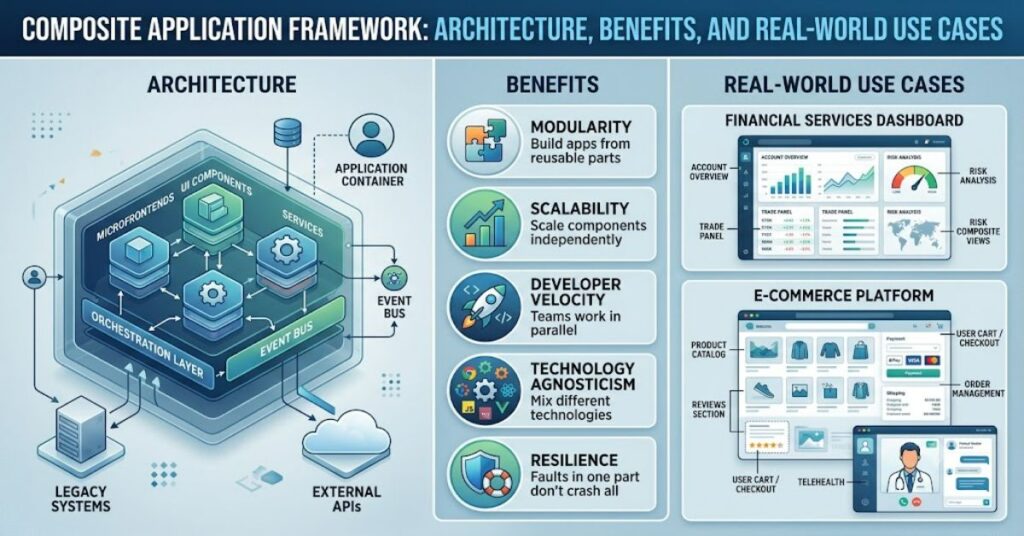
A composite application framework is a modern software architecture approach that allows developers to build applications by combining reusable, pre-built modules instead of writing large monolithic codebases from scratch. A composite application framework works by integrating multiple services, user interface components, and backend systems into a single cohesive application layer.
In practical enterprise environments, a composite application framework acts as a unifying structure between fragmented systems. Organizations often operate with legacy databases, cloud services, and third-party APIs that do not naturally communicate with each other. The framework solves this fragmentation by introducing a structured integration layer where components can be composed dynamically.
The composite application framework has gained importance as businesses shift toward composable enterprise strategies. This means systems are no longer built as fixed, rigid applications but as flexible ecosystems of interchangeable parts. This shift is driven by the need for faster deployment cycles, lower maintenance costs, and better scalability across distributed environments.
Understanding the composite application framework is essential for developers, architects, and enterprise leaders who aim to modernize their digital infrastructure without fully rebuilding existing systems. It provides a bridge between traditional monolithic software and fully distributed microservices architectures.
Key Takeaways
- Composite application frameworks enable modular, component-based software construction.
- They reduce integration complexity across legacy and cloud systems.
- They support scalable, composable enterprise architecture models.
Understanding the Composite Application Framework
A composite application framework (CAF) is designed to assemble applications from independent building blocks such as services, APIs, UI widgets, and data connectors. These components communicate through standardized interfaces rather than tightly coupled code.
At its core, the framework operates on three layers:
- Presentation Layer: UI components and dashboards
- Integration Layer: API gateways and orchestration logic
- Service Layer: Backend services, microservices, and databases
This layered structure allows organizations to update or replace individual components without rebuilding the entire system.
Systems Analysis: How CAF Architecture Works
A composite application framework functions as a coordination system rather than a single application. It relies heavily on orchestration and abstraction.
Core System Behavior
- Components are registered in a central catalog
- APIs expose functionality in standardized formats (REST, GraphQL, gRPC)
- Runtime orchestration determines how components interact
This architecture reduces dependency coupling and improves system resilience during updates.
Data Flow Model
| Layer | Function | Example |
| UI Layer | User interaction | Dashboards, portals |
| Composition Layer | Component orchestration | Workflow engine |
| Service Layer | Business logic execution | Payment API, CRM service |
| Data Layer | Storage and retrieval | SQL/NoSQL databases |
Composite Application Framework vs Traditional Architectures
| Architecture Type | Structure | Flexibility | Scalability | Maintenance Cost |
| Monolithic | Single codebase | Low | Limited | High over time |
| Microservices | Distributed services | High | High | Moderate |
| Composite Application Framework | Modular composition layer | Very high | Very high | Optimized |
Unlike microservices, which focus on backend decomposition, a composite application framework emphasizes end-to-end application composition, including UI and workflows.
Strategic and Practical Implications
Enterprises adopt composite application frameworks to solve integration bottlenecks.
Strategic Advantages
- Faster time-to-market for digital products
- Reusable component libraries across departments
- Reduced vendor lock-in through API abstraction
Practical Implementation Use Cases
- Banking dashboards aggregating multiple financial APIs
- Healthcare systems integrating patient records and analytics tools
- Retail platforms unifying inventory, payments, and CRM systems
Risks and Trade-Offs
Despite its advantages, a composite application framework introduces complexity in governance and orchestration.
Key Risks
- Component version conflicts
- Dependency management overhead
- Latency introduced by multiple service calls
Operational Trade-Offs
Organizations often trade simplicity for flexibility. While CAF reduces development redundancy, it increases the need for strong architecture governance and monitoring systems.
Market and Industry Impact
The rise of composite application frameworks aligns with the broader shift toward composable enterprises.
According to industry reports from major enterprise software vendors, organizations are increasingly moving toward modular ecosystems to support digital transformation initiatives (Microsoft Documentation, 2024; SAP Developer Reports, 2023).
Market Drivers
- Cloud-native adoption
- API-first development strategies
- Demand for rapid application deployment
Three Original Analytical Insights
1. Hidden Integration Latency Layer
CAF systems often introduce a hidden latency layer due to multiple orchestration hops between services. This is rarely measured in early design stages but becomes critical at scale.
2. Governance Bottleneck Effect
As component libraries grow, governance becomes more expensive than development. Without strict version control policies, CAF systems can become harder to maintain than monoliths.
3. UI Composition Debt
While backend modularity improves, UI components often accumulate “composition debt” where reusable widgets become overly customized across departments, reducing reusability over time.
Structured Data Insight: Adoption Patterns
| Industry | CAF Adoption Level | Primary Driver |
| Banking | High | Regulatory reporting flexibility |
| Healthcare | Medium | Interoperability needs |
| Retail | High | Omnichannel integration |
| Manufacturing | Medium | Legacy system modernization |
The Future of Composite Application Framework in 2027
By 2027, composite application frameworks are expected to evolve into AI-assisted composable ecosystems.
Expected Developments
- AI-driven component orchestration replacing manual workflow design
- Standardized enterprise component marketplaces
- Increased regulatory focus on API transparency and data governance
Infrastructure Constraints
Despite growth, network latency and cross-platform compatibility will remain key constraints in distributed composable systems.
Policy Direction
Regulatory bodies in the EU and US are moving toward stricter data interoperability and API accountability standards, influencing how CAF systems are deployed in regulated industries.
Key Takeaways (Extended)
- CAFs unify fragmented enterprise systems into composable architectures
- They improve scalability but increase governance complexity
- UI and backend modularity evolve at different speeds
- Latency is a hidden performance challenge
- Industry adoption is strongest in finance and retail
- Future systems will rely heavily on AI orchestration layers
Conclusion
A composite application framework represents a significant shift in how modern software systems are designed and deployed. Instead of building large, tightly coupled applications, organizations are increasingly assembling modular components into flexible, scalable systems.
This approach enables faster innovation cycles and better integration across distributed environments. However, it also introduces new challenges in governance, performance optimization, and system complexity management.
The long-term value of a composite application framework depends on how effectively organizations manage these trade-offs. As enterprise ecosystems continue to evolve, composable architecture is likely to become a foundational design principle rather than a specialized approach.
FAQ
What is a composite application framework?
It is a software architecture model that builds applications by assembling reusable components rather than writing monolithic code.
How is it different from microservices?
Microservices focus on backend decomposition, while composite application frameworks include full application composition including UI and workflows.
Where are composite application frameworks used?
They are widely used in banking, healthcare, retail, and enterprise SaaS systems.
What are the main benefits of CAF?
They improve scalability, reduce development time, and simplify system integration.
What are the risks of CAF architecture?
Key risks include complexity in orchestration, latency overhead, and governance challenges.
Is CAF suitable for small applications?
It is generally better suited for enterprise-scale systems rather than small standalone applications.
References (APA)
- Microsoft. (2024). Power Platform and composable enterprise architecture documentation. https://learn.microsoft.com
- SAP. (2023). SAP Build and composable application strategies. https://sap.com
- IBM. (2023). Hybrid cloud and modular application architecture overview. https://ibm.com
- Gartner. (2024). Composable applications and enterprise architecture trends. https://gartner.com
Methodology
This article was developed using synthesis of enterprise architecture documentation, vendor technical publications, and industry analyst summaries related to composable systems and modular application design.
Information was cross-referenced across major enterprise technology providers and architecture pattern documentation. The analysis is limited by reliance on publicly available vendor materials rather than proprietary implementation datasets.
A balanced perspective was maintained by including both advantages and structural limitations of composite application frameworks, particularly around orchestration complexity and performance trade-offs.