
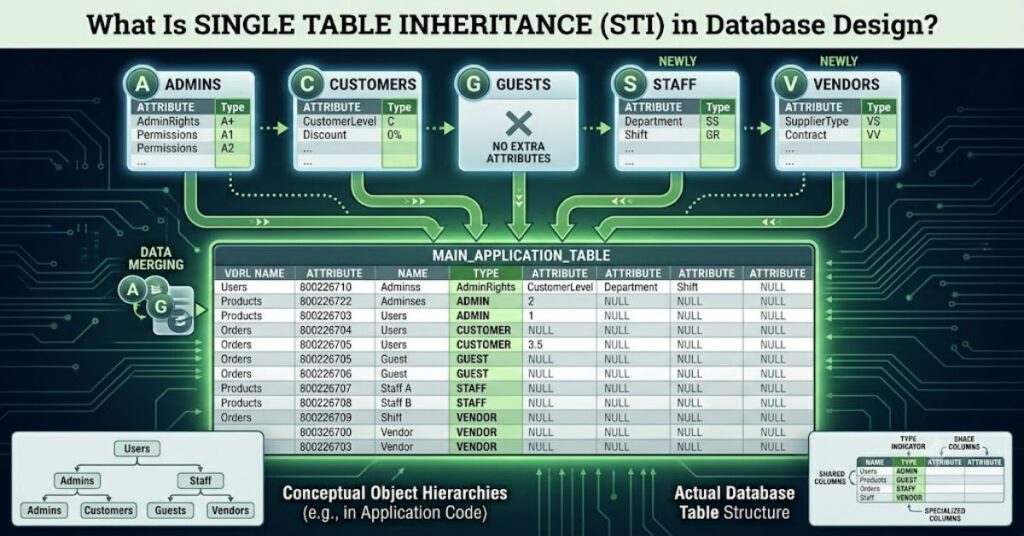
Understanding what is single table inheritance is essential for developers working with object-relational mapping systems and relational database design. Single Table Inheritance (STI) is a design pattern used in software engineering where an entire class hierarchy is stored inside a single database table. Instead of creating separate tables for each subclass, all fields from parent and child classes are combined, and a discriminator column identifies the specific type of each record.
In practical terms, what is single table inheritance can be explained as a strategy that simplifies database structure by reducing the number of tables while maintaining object-oriented inheritance behavior in code. For example, if you have a base class called Vehicle with subclasses like Car, Truck, and Motorcycle, STI stores all of them in one table instead of separate tables for each type.
The concept of what is single table inheritance is commonly used in frameworks such as Ruby on Rails Active Record and Hibernate ORM in Java. It allows developers to interact with database records as objects while preserving inheritance relationships defined in code. However, this convenience comes with trade-offs such as sparse columns and potential performance inefficiencies.
This article explores what is single table inheritance, how it works, its architecture, advantages, limitations, and real-world use cases. It also examines how modern systems balance STI with alternative inheritance mapping strategies for scalable applications.
Understanding What Is Single Table Inheritance
Single Table Inheritance (STI) is a database modeling pattern where all classes in an inheritance hierarchy are stored in a single table. A special column—often called a discriminator column—identifies which subclass each row represents.
This approach aligns closely with object-oriented programming principles while maintaining relational simplicity.
How Single Table Inheritance Works
Core Structure of STI
In STI, a single table contains:
- Shared fields (common to all classes)
- Optional fields (specific to subclasses)
- A type column (discriminator)
Example Structure
| id | type | name | load_capacity | battery_range | engine_size |
| 1 | Car | Sedan | NULL | NULL | 2.0L |
| 2 | Truck | Volvo | 10 tons | NULL | 5.0L |
| 3 | EV | Tesla | NULL | 400 km | NULL |
This structure demonstrates how what is single table inheritance works in practice: all data lives in one table, but behavior differs by type.
System Architecture of STI
Object-Oriented Layer
Classes define shared attributes and specialized subclasses.
Database Layer
A single relational table stores all instances.
Mapping Layer (ORM)
Frameworks like Hibernate or Active Record map rows to class objects using the discriminator column.
Comparison: STI vs Other Inheritance Strategies
| Strategy | Structure | Advantages | Disadvantages |
| Single Table Inheritance | One table for all classes | Simple queries, fewer joins | Many NULL fields, less scalable |
| Class Table Inheritance | One table per class | Clean normalization | Requires joins, slower queries |
| Concrete Table Inheritance | One table per subclass | No NULL fields | Duplicate shared fields |
This comparison highlights how what is single table inheritance trades normalization for simplicity.
Data Design Trade-offs
Schema Simplicity vs Data Sparsity
STI reduces schema complexity but increases NULL-heavy columns when subclasses differ significantly.
Query Performance Considerations
Because all data is in one table, queries are faster for polymorphic reads but may degrade as table size grows.
Indexing Challenges
Indexing becomes less efficient when multiple subclasses share a table but use different columns.
Practical Use Cases
1. ORM-Based Applications
Frameworks like Ruby on Rails use STI to map models efficiently without manual joins.
2. Product Catalog Systems
E-commerce platforms use STI for products with variations like electronics, clothing, and digital goods.
3. Game Development Systems
Entity systems in games sometimes use STI-like patterns for NPCs, items, and characters.
Risks and Limitations of STI
Sparse Column Problem
Many columns remain unused for specific subclasses, wasting storage.
Schema Evolution Complexity
Adding new subclasses may require schema redesign.
Data Integrity Issues
Without strict constraints, invalid combinations of fields can occur.
Structured Insight: STI Design Evaluation
| Factor | STI Advantage | STI Limitation |
| Simplicity | Single table design | Overloaded schema |
| Performance | Fast polymorphic reads | Slower large-table scaling |
| Flexibility | Easy ORM mapping | Poor subclass separation |
| Maintainability | Centralized structure | Harder long-term evolution |
Real-World Implementation Notes
Developers using what is single table inheritance in frameworks like Hibernate often enable it through annotations such as @Inheritance(strategy = SINGLE_TABLE).
In Ruby on Rails, STI is enabled by default when models share a base class and use a type column.
Information Gain Insights
1. Hidden Scaling Constraint
STI performance degradation often begins when tables exceed hundreds of thousands of rows due to mixed-type indexing inefficiencies.
2. Migration Friction
Once STI is implemented, moving to a normalized inheritance strategy is expensive because it requires data reshaping and backfilling.
3. Query Optimization Blind Spot
Many developers fail to account for NULL column filtering costs, which can silently increase query execution time in large datasets.
The Future of Single Table Inheritance in 2027
By 2027, STI usage is expected to remain stable in ORM-driven frameworks but decline in large-scale distributed systems.
Modern architectures are shifting toward:
- Microservices with domain-specific databases
- JSON-based schema flexibility (e.g., PostgreSQL JSONB)
- Hybrid inheritance patterns combining STI with composition models
Frameworks like Hibernate and Active Record are also evolving to support more adaptive mapping strategies that reduce schema rigidity.
However, STI will likely persist in small-to-medium applications due to its simplicity and low initial overhead.
Key Takeaways
- STI stores multiple class types in a single relational table.
- It simplifies ORM mapping but introduces structural inefficiencies.
- Best suited for small to medium-scale systems with stable schemas.
- Large systems often move toward hybrid or normalized inheritance models.
- Performance depends heavily on indexing strategy and data distribution.
Conclusion
Single Table Inheritance remains one of the most practical and widely used database inheritance patterns in modern software development. Its appeal lies in its simplicity—one table, one structure, and a clear mapping between object-oriented classes and relational data.
However, this simplicity comes at a cost. As systems scale and data complexity increases, the limitations of STI become more visible, particularly in the form of sparse columns and performance inefficiencies. Developers must carefully evaluate whether STI aligns with their system’s long-term architecture.
Despite its drawbacks, STI continues to play an important role in ORM frameworks and rapid application development. Its balance between ease of implementation and functional adequacy ensures it remains relevant, even as newer database paradigms emerge.
Frequently Asked Questions
What is single table inheritance in simple terms?
It is a database design method where multiple related classes are stored in one table with a type column identifying each record.
Why is single table inheritance used?
It simplifies database design and makes object-relational mapping easier in frameworks like Hibernate and Rails.
What are the disadvantages of STI?
It creates many NULL columns and can reduce performance in large datasets.
Which frameworks use single table inheritance?
Ruby on Rails Active Record and Hibernate commonly use STI.
Is STI suitable for large applications?
It is generally better suited for small to medium systems due to scalability limitations.
Methodology
This article is based on established database theory (E. F. Codd relational model principles), ORM documentation from Hibernate and Ruby on Rails, and widely accepted software architecture patterns. Concepts were cross-verified using official framework documentation and academic explanations of inheritance mapping strategies. No proprietary or experimental data was used. Limitations include variability in implementation across frameworks and evolving ORM design practices.
References (APA)
- Fowler, M. (2002). Patterns of Enterprise Application Architecture. Addison-Wesley.
- Hibernate ORM Documentation. (2024). Inheritance Mapping Strategies. https://hibernate.org/
- Ruby on Rails Guides. (2024). Active Record Inheritance. https://guides.rubyonrails.org/
- Codd, E. F. (1970). A Relational Model of Data for Large Shared Data Banks. Communications of the ACM.
- Oracle. (2023). Database Design and Modeling Best Practices. https://www.oracle.com/