
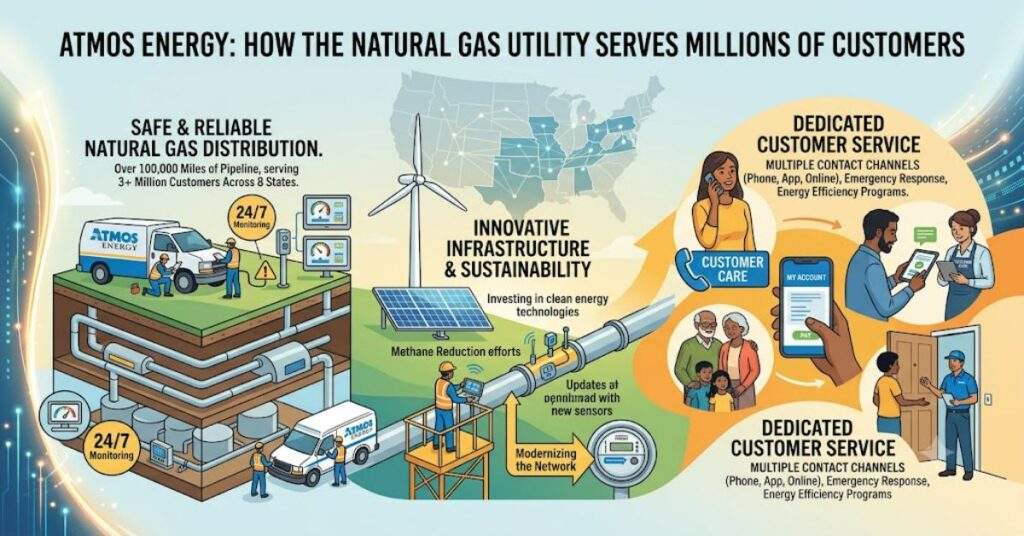
Atmos Energy is a major US natural gas utility headquartered in Dallas, Texas. The company operates a regulated natural gas distribution business serving approximately 3.4 million customers across more than 1,400 communities in eight states. It also manages pipeline and storage infrastructure, including Atmos Pipeline-Texas, one of the largest intrastate natural gas pipeline operations in Texas.
The company’s roots go back to 1906, when it began operations in the Texas Panhandle. Over more than a century, its business expanded from a regional gas operation into a large regulated utility serving residential, commercial and industrial customers.
For customers, the company is primarily experienced through gas delivery, billing, service connections and safety programmes. For investors and energy analysts, however, its business is better understood through its regulated asset base, infrastructure spending, regulatory relationships and long-term capital requirements.
Atmos Energy is therefore not simply a company that sells natural gas. Its core role is operating the infrastructure that transports and distributes gas safely and reliably to customers. That distinction matters because utility economics depend heavily on regulation, infrastructure investment and approved rates rather than simply on commodity prices.
How Atmos Energy’s Business Works
Atmos Energy operates through two principal areas: regulated distribution and pipeline and storage activities. The distribution business delivers natural gas through local networks, while its pipeline operations transport and store gas for Atmos Energy and other customers.
| Business area | Main function | Strategic importance |
| Regulated distribution | Delivers gas to homes and businesses | Largest customer-facing operation |
| Pipeline and storage | Transports and stores natural gas | Supports reliability and supply flexibility |
| Infrastructure modernisation | Replaces and upgrades assets | Improves safety and reliability |
| Environmental programmes | Reduces methane and operational emissions | Addresses regulatory and environmental pressure |
Atmos Pipeline-Texas operates approximately 5,700 miles of transmission pipelines and five underground storage facilities in Texas. Its network connects production areas across central, northern, western and eastern Texas with customers and distribution systems.
This infrastructure creates an important operational advantage: distribution and transportation assets can work together. Storage can also provide flexibility when demand changes, particularly during periods of extreme weather.
Why Infrastructure Spending Matters
A major theme in Atmos Energy’s recent strategy is system modernisation. In fiscal 2025, the company reported directing 87% of its capital spending towards modernising distribution, transmission and storage systems for safety and reliability. Its latest corporate responsibility report also states that the company operates more than 80,000 miles of natural gas pipelines.
| Recent indicator | Reported figure |
| Distribution customers | Approximately 3.4 million |
| Communities served | More than 1,400 |
| States served | 8 |
| Pipeline network | More than 80,000 miles |
| Fiscal 2025 capital spending directed to modernisation | 87% |
| 2025 methane-reduction progress | About 25% reduction from 2017 baseline |
These figures show why capital expenditure is central to the business. Gas utilities operate physical infrastructure that can remain in service for decades, but ageing pipes, service lines and other assets require continuous inspection, maintenance and replacement.
Atmos Energy reported replacing more than 900 miles of distribution and transmission pipe during fiscal 2023. The company has also used technologies such as advanced imaging and acoustic monitoring to identify potential leaks at storage and compression facilities.
The practical implication is significant: modernisation is simultaneously a safety programme, an operational investment and a financial strategy.
Safety, Methane and Regulatory Pressure
Natural gas infrastructure faces a particular environmental challenge because methane is a potent greenhouse gas. Atmos Energy has established a target of reducing methane emissions from its distribution-system mains and services by 50% from its 2017 baseline by 2035.
According to the company’s 2026 sustainability reporting, it had achieved an approximately 25% reduction as of December 31, 2024.
This creates a measurable link between infrastructure management and environmental performance. Replacing older equipment can reduce leak risk while also improving reliability.
The trade-off is cost. Large-scale pipeline replacement requires substantial capital, skilled labour, engineering work and regulatory approval. Utilities must balance those investments against customer affordability and the need to maintain reliable service.
The Business Model and Its Risks
Atmos Energy’s regulated structure provides an important degree of predictability because utility rates are generally established through regulatory processes. That can make long-term infrastructure investment more feasible than in a purely competitive commodity business.
However, regulation is also a constraint. Large capital programmes do not automatically mean that every expenditure can immediately be recovered through customer rates. Regulatory decisions, interest rates, construction costs and changing energy policies can all influence returns.
There is also a broader energy-transition question. Natural gas remains important for heating, commercial activity and power-system reliability, but policymakers and consumers are increasingly examining methane emissions and long-term decarbonisation.
The strategic challenge for Atmos Energy is therefore not simply expanding its network. It is maintaining the economic value and safety of existing infrastructure while responding to changing environmental expectations.
Documented Community Impact
The company’s infrastructure role extends beyond physical pipelines. Atmos Energy reported that in fiscal 2025 it donated more than $21 million to nonprofit organisations across the communities it serves. It also helped approximately 56,000 households access nearly $21 million through energy-assistance programmes including LIHEAP and Sharing the Warmth.
These programmes illustrate another aspect of regulated utility operations: affordability can become a business and policy issue during periods of higher household energy costs.
The Future of Atmos Energy in 2027
By 2027, the company’s central priorities are likely to remain infrastructure reliability, pipeline replacement, methane management and regulatory compliance. The strongest evidence comes from its existing capital programme and long-term modernisation strategy rather than from speculative expansion.
Atmos Energy has identified approximately $17 billion in capital investment through 2028, with more than 82% focused on safety-related areas in its reported planning framework.
The main uncertainty is the pace of US energy-policy change. Natural gas infrastructure will continue to face scrutiny over methane emissions, while utilities must also consider the cost and reliability implications of alternative energy systems.
For Atmos Energy, the most realistic 2027 scenario is therefore continued investment in existing networks, improved leak detection and a gradual adaptation to changing environmental requirements rather than a sudden transformation of its core business.
Key Takeaways
- Atmos Energy operates a large regulated natural gas distribution network rather than functioning primarily as a commodity producer.
- Its pipeline and storage assets give the company an important infrastructure role in Texas and other markets.
- Modernisation spending is closely tied to safety, reliability and environmental performance.
- Methane reduction is becoming increasingly important to the company’s operational strategy.
- Regulation remains both a source of stability and a potential constraint on investment recovery.
- Energy-transition policies represent a long-term strategic uncertainty for gas utilities.
Conclusion
Atmos Energy represents the infrastructure side of America’s natural gas system. Its approximately 3.4 million customers depend on a large network of pipelines, storage facilities, service lines and operational teams rather than on a simple retail energy product.
The company’s recent strategy shows that infrastructure modernisation is at the centre of its business. Safety spending, pipeline replacement, leak detection and methane reduction are increasingly interconnected rather than separate initiatives.
The model also carries limitations. Atmos Energy must work within state and federal regulatory frameworks while managing capital requirements, customer affordability and changing expectations around natural gas. Its future will depend partly on how effectively it can maintain reliable service while adapting its infrastructure to environmental and policy pressures.
For investors, customers and energy observers, the most useful way to understand the company is therefore as a regulated infrastructure operator whose long-term performance depends on the quality, safety and economic usefulness of the network it manages.
Frequently Asked Questions
What is Atmos Energy?
Atmos Energy is a US natural gas utility headquartered in Dallas, Texas. It provides regulated natural gas distribution services and operates pipeline and storage infrastructure.
How many customers does Atmos Energy serve?
Atmos Energy serves approximately 3.4 million distribution customers across eight states and more than 1,400 communities, according to company information published in 2025 and 2026.
What states does Atmos Energy serve?
Its regulated operations cover Colorado, Kansas, Kentucky, Louisiana, Mississippi, Tennessee, Texas and Virginia.
Is Atmos Energy publicly traded?
Yes. Atmos Energy Corporation trades on the New York Stock Exchange under the ticker symbol ATO and is an S&P 500 company.
What does Atmos Pipeline-Texas do?
Atmos Pipeline-Texas operates a regulated intrastate natural gas transmission and storage network in Texas. It has approximately 5,700 miles of transmission pipelines and five underground storage facilities.
Does Atmos Energy work on methane reduction?
Yes. The company has a goal of reducing methane emissions from its distribution-system mains and services by 50% from a 2017 baseline by 2035. Its reported data showed approximately a 25% reduction as of December 31, 2024.
Methodology
This article was prepared using publicly available Atmos Energy corporate reports, investor disclosures and sustainability materials, with emphasis on information published through 2026. Company-reported customer numbers, infrastructure figures, investment information and environmental targets were checked against primary company sources.
The analysis does not claim firsthand testing or personal observation of Atmos Energy facilities. Documented company programmes and reported infrastructure activities are used instead of fabricated firsthand experience. Company disclosures also represent the company’s perspective, so statements about strategy and environmental performance should be read with that limitation in mind.
Editorial disclosure: This article was drafted with AI assistance and should be reviewed by a human editor before publication. Statistics, named claims, citations and the author bio should be independently verified before publication.
References
Atmos Energy Corporation. (2025). 2025 proxy statement and notice of annual meeting. Atmos Energy.
Atmos Energy Corporation. (2025, November 5). Atmos Energy Corporation reports earnings for fiscal 2025; initiates fiscal 2026 guidance; raises dividend. Atmos Energy Investor Relations.
Atmos Energy Corporation. (2026, April 22). Atmos Energy’s latest CRS report demonstrates commitment to our communities, people and operations. Atmos Energy.
Atmos Energy Corporation. (2026). Fueling our future: Corporate responsibility and sustainability report. Atmos Energy.
Atmos Energy Corporation. (2026). Atmos Pipeline-Texas. Atmos Energy.