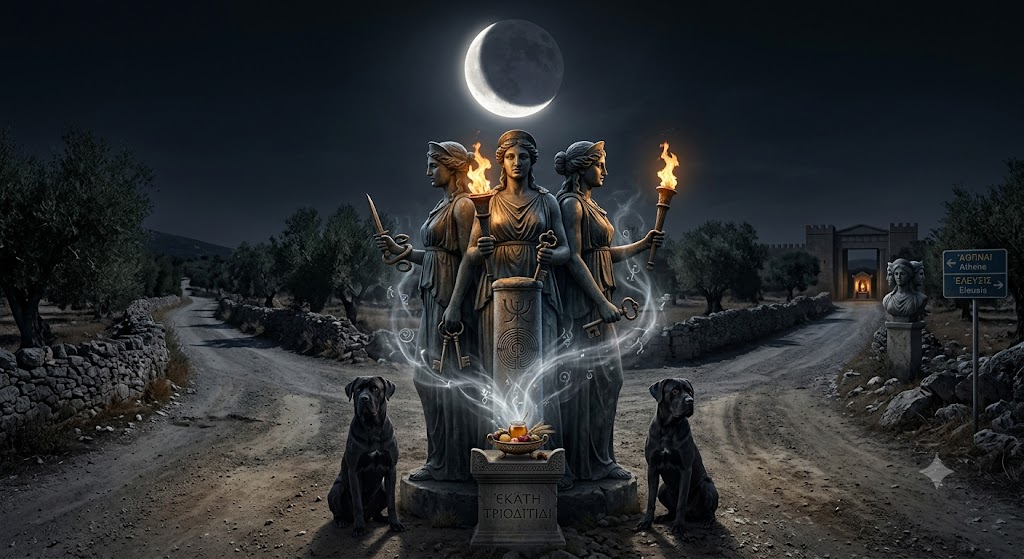
The Hecate goddess is one of the most distinctive figures in ancient Greek religion. She was associated with magic, crossroads, night, doorways, the underworld, and forms of protection. Ancient representations commonly show her carrying torches, while later sculpture frequently presents her as a triple-bodied figure facing different directions.
Hecate’s history is more complicated than the modern image of a mysterious goddess of witchcraft suggests. In Hesiod’s Theogony, composed in the archaic period, she receives an unusually broad share of honour from Zeus, with privileges connected to earth, sea, and heaven. She is therefore not introduced simply as a minor deity of magic. Her early literary profile is considerably broader. (Hesiod, Theogony, c. 8th–7th century BCE)
Over time, however, her associations with nighttime activity, crossroads, ghosts, magic, and the boundaries between different realms became increasingly prominent. Archaeological evidence and surviving sculpture show how these ideas influenced her worship.
Her symbolism is especially important. A torch can represent illumination in darkness, while a key suggests access, boundaries, or passage. The threefold form reflects her relationship with crossroads and multiple directions. Together, these symbols help explain why Hecate remained a powerful figure in ancient religious imagination.
Who Was Hecate?
Hecate was a goddess whose identity developed over centuries of Greek religious practice. Ancient sources give different accounts of her parentage, although Hesiod identifies her as the daughter of Perses and Asteria.
One important feature of Hesiod’s description is Hecate’s unusually broad divine authority. Rather than restricting her to a single function, the Theogony describes her as having honoured privileges across earth, sea, and heaven.
This makes her early profile different from simplified modern descriptions. She was not originally defined only as a goddess of witchcraft.
Later traditions increasingly connected her with nocturnal practices, magic, ghosts, doorways and crossroads. The British Museum describes her as a chthonic goddess with both benevolent and frightening aspects, associated with magic, witchcraft, lunar lore, doorways and crossroads.
Hecate and the Crossroads
The crossroads became one of the strongest symbols associated with Hecate.
A crossroads is literally a meeting point between different paths. In religious symbolism, that makes it a natural location for a deity connected with transition and boundaries.
The Metropolitan Museum of Art describes Hecate as presiding over pathways and crossroads, particularly at night. It also notes her connection with movement between the underworld and the earthly world.
Ancient communities placed images known as hekataia at crossroads and near private homes. These images could function as protective markers, creating a connection between Hecate and physical boundaries.
This association also explains why keys became one of her important attributes. A key symbolises access: something can be opened, closed, entered or protected.
Torches, Keys, Dogs, and Other Symbols
Hecate’s symbolism developed through literature, religious practice and visual art.
| Symbol | Common Association | Significance |
| Torch | Night and illumination | Guidance through darkness |
| Key | Boundaries and access | Opening or guarding passages |
| Dog | Protection and the night | Associated with her cult and imagery |
| Crossroads | Choice and transition | Meeting point between paths |
| Triple form | Multiple directions | Connection with crossroads |
The torch is especially important. Ancient artistic representations often show Hecate holding one or two torches. The image conveys illumination in darkness and reinforces her nighttime associations.
Dogs were also closely connected with her worship. The British Museum records that her rites could include dog sacrifices, while ancient sources associate her with nocturnal and boundary-related activity.
These symbols should not be treated as having one fixed meaning across every period. Ancient religious imagery was flexible, and meanings could change between communities and historical periods.
The Triple Form of Hecate
Perhaps the most recognisable representation of Hecate is her triple form.
Rather than showing three completely separate goddesses, ancient artists could represent Hecate as three bodies or figures joined together and facing different directions. This became particularly appropriate for a goddess associated with crossroads.
The Metropolitan Museum’s Roman-period hekataion, dated to the 1st–2nd century CE, provides a surviving example of this tradition. Triple-bodied images were also used at crossroads and near homes.
A British Museum relief dated to the Roman period shows Hecate in triple form. The three figures carry different attributes, including a key, torches, a dagger and a serpent. (British Museum, n.d.)
This is an important reminder that the triple form was not simply an artistic curiosity. It connected directly with the goddess’s wider religious symbolism.
Hecate and Magic
Hecate became increasingly associated with magic and supernatural practices in later Greek and Roman traditions.
Ancient magical texts and objects provide evidence for this connection. A Roman-period magical gem in the British Museum, dated to the 3rd century CE, depicts Hecate in triple form with torches, daggers and other attributes.
Her connection with magic also brought her closer to figures such as Medea and Circe in later literary traditions. These associations helped reinforce her reputation as a powerful supernatural deity.
However, describing her simply as an ancient Greek “witchcraft goddess” can be misleading. Her religious identity was broader, particularly in earlier sources.
Hecate in Greek and Roman Religion
Hecate’s importance continued beyond the classical Greek period.
Her worship appeared in different forms, including household practices and sacred sites. Ancient evidence indicates that small shrines associated with her could be placed near homes and boundaries.
Her role also interacted with other deities. She became connected in different contexts with Artemis, Persephone and other figures associated with night, hunting, the underworld or transition.
This adaptability may help explain her longevity. Rather than being restricted to one narrow function, Hecate could occupy several connected religious roles.
Three Important Insights About Hecate
Her early role was broader than magic: Hesiod gives Hecate significant privileges across multiple realms, showing that her earliest literary profile was not limited to witchcraft.
The triple form reflects place as much as identity: The three-bodied representation makes particular sense in relation to crossroads, where paths extend in different directions.
Her symbols communicate transition: Torches, keys, doorways and crossroads repeatedly connect Hecate with movement between darkness and light, outside and inside, or one path and another.
The Future of Hecate Goddess Studies in 2027
Interest in ancient mythology is likely to remain strong through 2027, particularly as museums continue digitising collections and making archaeological objects available to wider audiences.
Hecate is well suited to this renewed interest because her surviving evidence exists across literature, sculpture, inscriptions, magical objects and religious archaeology. Digital museum collections can place these different forms of evidence side by side.
The main challenge will be separating ancient evidence from modern reinterpretation. Contemporary popular culture often presents Hecate through a modern concept of witchcraft that does not necessarily reflect her historical development.
Future scholarship and museum interpretation will therefore remain important in distinguishing ancient religious practices from later cultural reinvention.
Key Takeaways
- Hecate was associated with crossroads, night, magic, boundaries and protection.
- Hesiod’s account gives her a broader role than the modern stereotype suggests.
- Torches represented one of her most recognisable attributes.
- Keys reflected her connection with access and boundaries.
- Triple-bodied representations became closely associated with crossroads.
- Her religious identity developed across Greek and Roman periods.
- Modern portrayals should be distinguished from ancient evidence.
Conclusion
The Hecate goddess occupies a fascinating position in ancient Greek religion because her identity cannot be reduced to one simple function. She was associated with crossroads, night, magic, boundaries, protection and movement between different realms.
Her imagery makes those associations particularly visible. Torches connect her with illumination in darkness, keys suggest access and boundaries, while dogs appear in her cultic and artistic traditions. The triple-bodied Hecate became especially significant because three directions naturally corresponded with the symbolism of the crossroads.
Ancient evidence also shows that her role changed over time. Hesiod’s early account presents a powerful goddess with privileges across earth, sea and heaven, while later traditions increasingly emphasised magic, ghosts and nocturnal activity.
That historical development is what makes Hecate important to study. She represents not only mystery and magic, but also the ancient Greek fascination with thresholds, choices, protection and the uncertain spaces between one state and another.
FAQ
Who was the Hecate goddess?
Hecate was an ancient Greek goddess associated with crossroads, night, magic, boundaries and protection. Her role developed over time across Greek and Roman religious traditions.
What was Hecate the goddess of?
Hecate was associated with several areas, including crossroads, magic, night, doorways, ghosts and protection. Earlier literary evidence gives her a broader divine role.
Why is Hecate shown with three bodies?
The triple form became associated with Hecate because of her connection with crossroads and multiple directions. Ancient hekataia often represented her as three figures facing different ways.
What do Hecate’s torches represent?
Torches are strongly associated with Hecate’s nighttime imagery. They can be understood as symbols of illumination and guidance through darkness, although ancient symbolism did not always have one fixed interpretation.
Why does Hecate carry a key?
The key is one of Hecate’s recurring attributes and fits her association with doors, boundaries and access. A key can symbolically represent the ability to open or guard a passage.
Was Hecate a goddess of witchcraft?
Hecate became strongly associated with magic and witchcraft in later Greek and Roman traditions. However, her historical identity was broader and included crossroads, night, protection and other forms of boundary-related activity.
Methodology
This article was researched using surviving ancient literary evidence alongside records from major museum collections. Hesiod’s Theogony was used to establish Hecate’s early literary profile and her relationship with Zeus. Museum records from the British Museum and Metropolitan Museum of Art were used to verify surviving representations, attributes, dates and the use of triple-bodied imagery.
The British Museum’s collection records provide evidence for Hecate’s associations with magic, witchcraft, lunar lore, doorways and crossroads, as well as specific objects showing her carrying keys, torches and other attributes. The Metropolitan Museum provides evidence for hekataia and Hecate’s association with pathways and crossroads.
A key limitation is that ancient Greek religion changed over several centuries and varied between locations. Symbols such as torches, keys and the triple form should therefore not be treated as having one universal meaning. Modern interpretations of Hecate also frequently combine ancient material with later occult traditions, so this article prioritises identifiable ancient and museum evidence.
Editorial disclosure: This article was drafted with AI assistance and should be reviewed and independently verified by a human editor before publication. Historical claims, dates and references should be checked against the original sources during final editorial review.
References
British Museum. (n.d.). Hecate: Collection records and related objects. British Museum.
Hesiod. (c. 8th–7th century BCE). Theogony.
Metropolitan Museum of Art. (n.d.). Marble hekataion (statuette of triple-bodied Hekate) and the three Graces. The Metropolitan Museum of Art.
Metropolitan Museum of Art. (n.d.). Wood statuette of Hekate. The Metropolitan Museum of Art.
Theoi Classical Texts Library. (n.d.). Hecate: Greek goddess of witchcraft, magic and ghosts. Classical mythology source collection.