
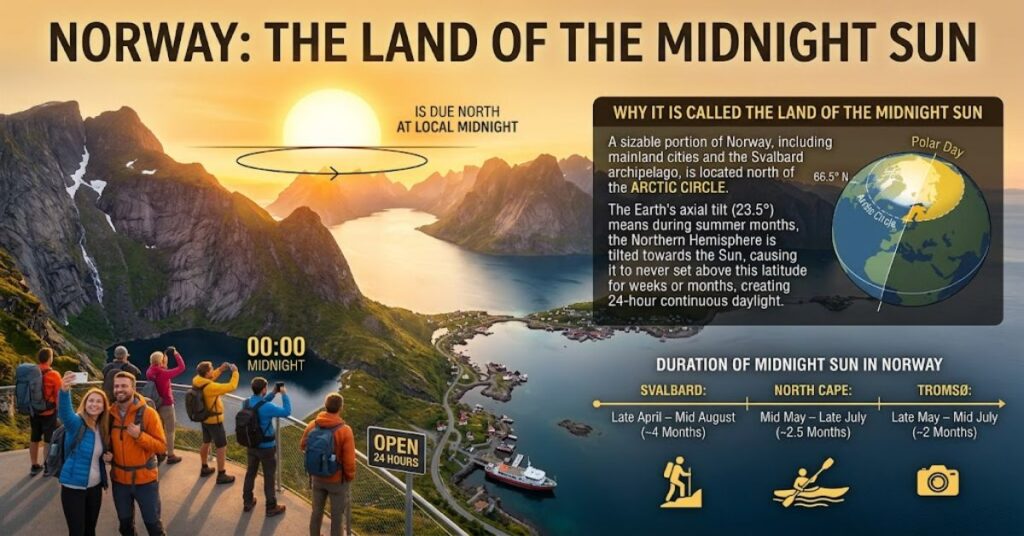
The most widely recognised Norway nickname is “The Land of the Midnight Sun.” The name comes from one of the country’s most remarkable natural phenomena: during parts of the summer, the sun can remain visible for the full 24 hours of the day in northern areas. This happens in locations above the Arctic Circle, where Earth’s tilted axis creates extremely long periods of daylight during the Northern Hemisphere’s summer.
The nickname is simple, but the geography behind it is more interesting. Norway stretches a long distance from south to north, meaning daylight conditions vary significantly across the country. Oslo, Bergen and other southern cities experience long summer days, but they do not experience the same extended midnight sun as destinations far above the Arctic Circle.
Places such as Tromsø and the Lofoten region have become strongly associated with the phenomenon. During the midnight sun season, daylight can continue through the night, changing how visitors experience landscapes, outdoor activities and even the normal rhythm of the day.
The supplied editorial brief identifies “The Land of the Midnight Sun” as Norway’s most famous nickname and explains that the name comes from the 24-hour daylight experienced during summer in the northern parts of the country.
Understanding this famous title requires looking beyond the phrase itself. It is a nickname shaped by astronomy, geography and the way people experience Norway during its brightest months.
Why Is Norway Called the Land of the Midnight Sun?
The answer lies in Earth’s position and Norway’s northern location.
Earth rotates on an axis tilted at approximately 23.5 degrees. As the planet travels around the sun, different parts of Earth receive different amounts of sunlight at different times of the year.
During the Northern Hemisphere’s summer, the North Pole is tilted towards the sun. Areas above the Arctic Circle can therefore remain exposed to sunlight even during what would normally be nighttime.
This creates the midnight sun.
| Location Type | Summer Daylight Experience |
| Southern Norway | Long days and short nights |
| Near the Arctic Circle | Extremely extended daylight |
| Northern Norway | Periods of midnight sun |
| High Arctic areas | Long continuous daylight periods |
The length of the midnight sun season depends on latitude. Generally, the farther north a location is, the longer the period of continuous daylight can last.
The Geography Behind the Norway Nickname
The Norway nickname is strongly linked to the country’s unusual geography.
Norway has a long, narrow shape stretching deep into northern Europe. This means travelling north can dramatically change the daylight experience.
A visitor in southern Norway may enjoy a late summer sunset, while someone much farther north could still see bright sunlight in the middle of the night.
This geographical difference is important because the nickname can sometimes create a misleading impression that the entire country experiences 24-hour daylight at the same time.
It does not.
The midnight sun is primarily a northern phenomenon. However, the country’s long summer days are experienced much more widely, contributing to the broader identity associated with light-filled Nordic summers.
Where Can You See the Midnight Sun in Norway?
Northern Norway offers some of the best opportunities to experience the midnight sun.
Tromsø
Tromsø is one of Norway’s best-known northern cities and is located well above the Arctic Circle. During the summer season, visitors can experience daylight long after midnight.
The Lofoten Islands
The Lofoten Islands combine dramatic mountains, coastal scenery and extended daylight. The midnight sun adds another dimension to the landscape, particularly for outdoor activities and photography.
Nordkapp
The North Cape area is strongly associated with Norway’s northern identity. Its high-latitude location makes it a symbolic destination for travellers interested in Arctic landscapes and extreme daylight conditions.
Svalbard
Svalbard lies even farther north than mainland Norway. Its location creates one of the most dramatic examples of the Arctic daylight cycle.
| Destination | General Experience |
| Tromsø | Urban Arctic destination with extended summer daylight |
| Lofoten | Coastal landscapes under late-night sunlight |
| Nordkapp | Iconic northern scenery and Arctic geography |
| Svalbard | Extreme high-latitude daylight conditions |
The Midnight Sun and Norway’s Cultural Identity
A national nickname can influence how a country is imagined by people who have never visited it.
“The Land of the Midnight Sun” creates an immediate picture of dramatic landscapes and unusual natural conditions. For Norway, the phrase fits naturally with other images associated with the country, including fjords, mountains, northern lights and Arctic coastlines.
The nickname also creates a strong contrast with Norway’s winter identity.
During winter, northern areas experience the opposite phenomenon: extremely limited daylight and, in some locations, periods of polar night.
This contrast is one of the most interesting parts of Norway’s annual cycle.
| Season | Northern Daylight Pattern |
| Summer | Extremely long days and midnight sun |
| Spring | Rapidly increasing daylight |
| Autumn | Rapidly decreasing daylight |
| Winter | Very short days or polar night in some areas |
The country is therefore not defined by permanent sunlight. Its reputation comes from dramatic seasonal change.
A Common Misunderstanding About the Nickname
One useful distinction is between midnight sun and simply having a very late sunset.
Many northern countries experience unusually long summer days. However, the midnight sun specifically refers to the sun remaining visible without setting below the horizon.
That means a sunset at 11:30 pm followed by sunrise shortly afterwards is not technically the same as the midnight sun.
This distinction matters for travellers planning a visit. Anyone hoping to see the sun at midnight should choose a destination and travel period carefully.
How the Midnight Sun Changes Travel
The midnight sun can transform the practical experience of travelling in northern Norway.
Outdoor activities do not have to follow the same daylight restrictions found elsewhere. Hiking, photography, fishing and sightseeing can continue late into the evening while natural light remains available.
The effect can also alter a visitor’s sense of time.
At midnight, a bright sky may make it difficult to feel that the day has ended. This can encourage longer periods of activity, although travellers still need to manage rest and sleep.
Practical Travel Implications
The constant daylight creates both opportunities and challenges.
Advantages include:
- More time for outdoor exploration
- Late-evening sightseeing
- Extended natural light for photography
- A distinctive travel experience
Challenges include:
- Difficulty maintaining a normal sleep schedule
- Increased demand during the summer tourism season
- The need for accommodation with effective curtains or blinds
The phenomenon is beautiful, but it can also disrupt normal routines.
The Future of the Norway Nickname in 2027
By 2027, “The Land of the Midnight Sun” will likely remain one of Norway’s strongest geographical identities.
The nickname works because it connects a scientific phenomenon with a memorable travel image. Unlike a marketing slogan that depends entirely on trends, the midnight sun is rooted in the country’s physical geography.
However, the way travellers experience it may continue to change.
Digital travel planning has made highly specific destinations easier to research, allowing visitors to compare locations based on daylight seasons, weather, transport access and activity options. This may encourage travellers to look beyond the general nickname and plan trips around the exact period and location where they can experience the phenomenon.
The main limitation is that the nickname can oversimplify Norway. The country offers very different climates and experiences from the southern coast to the Arctic north.
Key Takeaways
- Norway’s most famous nickname is “The Land of the Midnight Sun.”
- The name refers to periods of continuous daylight in northern areas during summer.
- The phenomenon occurs because of Earth’s axial tilt and Norway’s high northern latitude.
- Not every part of Norway experiences the midnight sun.
- Tromsø, Lofoten, Nordkapp and Svalbard are strongly associated with Arctic daylight.
- The midnight sun is only one part of Norway’s dramatic seasonal cycle.
Conclusion
The Norway nickname “The Land of the Midnight Sun” is more than a memorable description. It reflects a real geographical phenomenon that shapes the experience of northern Norway during the summer months.
In areas above the Arctic Circle, the sun can remain visible for 24 hours, creating landscapes that look completely different from the usual rhythm of day and night. This has helped make the country distinctive in the global imagination.
At the same time, the nickname should be understood in context. Norway is geographically diverse, and the midnight sun is primarily experienced in its northern regions. Southern parts of the country enjoy long summer days but do not share exactly the same conditions.
The phrase remains powerful because it connects science, place and experience. For travellers, it represents one of Norway’s most unusual natural attractions. For the country itself, it is a reminder that latitude can shape not only climate and daylight, but also cultural identity.
FAQ
What is Norway’s nickname?
Norway’s most famous nickname is “The Land of the Midnight Sun.” The name refers to the periods of continuous daylight experienced during summer in northern parts of the country.
Why is Norway called the Land of the Midnight Sun?
Norway receives this nickname because areas above the Arctic Circle can experience 24 hours of visible sunlight during parts of the summer.
Does all of Norway experience the midnight sun?
No. The phenomenon occurs in northern parts of Norway above the Arctic Circle. Southern cities experience long summer days but not continuous daylight in the same way.
Where is the best place to see the midnight sun in Norway?
Popular destinations include Tromsø, the Lofoten Islands, Nordkapp and Svalbard. The best choice depends on travel dates and the type of experience you want.
What is the opposite of the midnight sun?
The opposite phenomenon is known as polar night, when the sun does not rise above the horizon for an extended period in high-latitude areas during winter.
Is the midnight sun visible every day during summer?
No. The duration of the midnight sun season depends on latitude. Locations farther north generally experience a longer period of continuous daylight.
Methodology
This article follows the supplied Postcard.fm production framework and uses the provided keyword detail as the basis for the primary search intent: Norway is widely known as “The Land of the Midnight Sun” because northern parts of the country experience periods of 24-hour daylight during summer.
The article explains the geographic and astronomical context of the nickname while distinguishing between the midnight sun in Arctic regions and the long summer days experienced elsewhere in Norway. No fabricated interviews, personal travel experiences or unsupported statistics have been included.