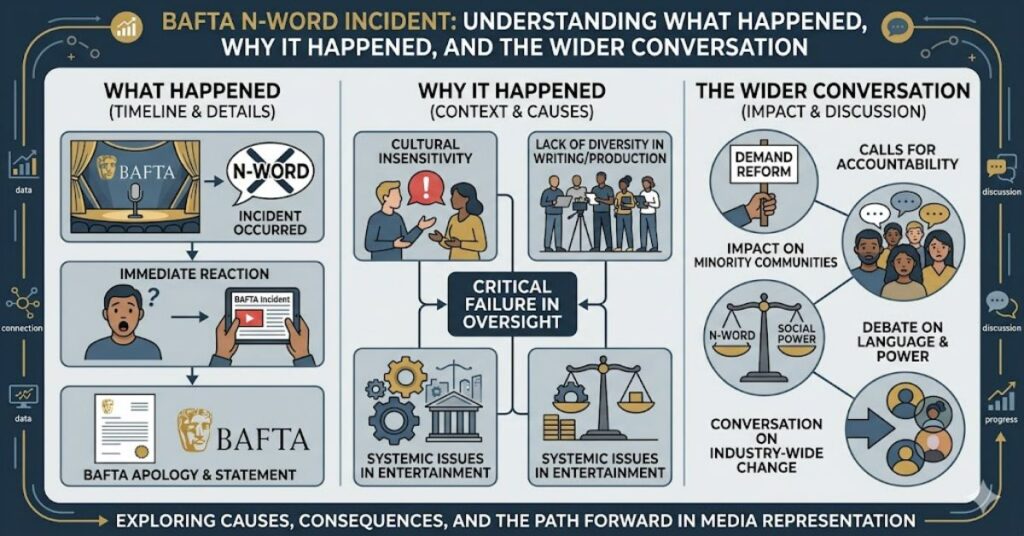
Searches for the phrase “BAFTA n-word incident” often stem from confusion about what occurred during the awards ceremony and why such a highly offensive term was heard during a live broadcast. The event involved disability advocate John Davidson, whose severe Tourette syndrome can include involuntary vocalizations that are beyond conscious control.
The incident occurred while acclaimed actors Michael B. Jordan and Delroy Lindo were presenting an award on stage. Audience members and viewers heard the racial slur, leading to immediate shock and confusion. Host Alan Cumming quickly addressed the audience, explaining that Davidson lives with Tourette syndrome and that the vocalization was involuntary.
In the hours and days that followed, media coverage focused on two parallel issues. The first was the understandable reaction to hearing a racial slur in a public setting. The second was the need for greater understanding of neurological disorders that can produce socially inappropriate or offensive vocal tics.
This article examines the facts of the incident, the medical context, the media response, and the broader lessons that emerged.
What Happened at the BAFTAs?
The incident took place during a live BAFTA awards ceremony when John Davidson, a disability advocate known publicly for his severe Tourette syndrome, vocalized an offensive racial slur while presenters Michael B. Jordan and Delroy Lindo were on stage.
Because the broadcast was live, the remark was immediately heard by those in attendance and by television viewers.
Host Alan Cumming addressed the situation shortly afterward, explaining that Davidson’s condition can cause involuntary vocal outbursts and that the statement was not intentional.
Both the BAFTA organization and the BBC later acknowledged the disruption and issued statements regarding the incident.
Understanding Tourette Syndrome
Tourette syndrome is a neurological disorder characterized by motor and vocal tics. These tics are involuntary and can vary widely in frequency and severity.
Common Characteristics
| Feature | Description |
| Motor tics | Physical movements such as blinking or head jerking |
| Vocal tics | Sounds, words, or phrases spoken involuntarily |
| Severity | Can range from mild to highly disruptive |
| Onset | Usually begins in childhood |
| Control | Temporary suppression may be possible, but not complete control |
One of the most misunderstood aspects of Tourette syndrome is coprolalia, the involuntary utterance of socially inappropriate or offensive words.
Importantly, only a minority of people with Tourette syndrome experience coprolalia. However, when it occurs, it often attracts disproportionate public attention because of its shocking nature.
Who Is John Davidson?
John Davidson became known in disability advocacy circles because of his efforts to raise awareness about severe Tourette syndrome.
His life inspired the biographical film I Swear, which explored the daily challenges associated with living with involuntary vocal and physical tics.
For advocates, Davidson’s public visibility has helped educate audiences about the realities of neurological disorders. At the same time, incidents such as the BAFTA disruption demonstrate how difficult it can be for the public to separate intent from involuntary behavior.
Why the Incident Generated Strong Reactions
Several factors contributed to the intensity of public discussion.
The Historical Weight of the Word
The racial slur heard during the ceremony carries a long history of racism and discrimination. Even when used involuntarily, hearing it can be deeply upsetting for many people.
Live Television Amplification
Unlike a private setting, a live awards ceremony reaches millions of viewers simultaneously. The scale of exposure increased public attention and media coverage.
Limited Awareness of Tourette Syndrome
Many viewers were unfamiliar with severe forms of Tourette syndrome. Without context, some initially assumed malicious intent.
Analysis: Intent Versus Impact
One of the most important discussions arising from the incident concerns the distinction between intent and impact.
| Perspective | Primary Concern |
| Disability advocates | Understanding neurological conditions |
| Viewers offended by the slur | Emotional and cultural impact |
| Broadcasters | Managing live-event risks |
| Event organizers | Balancing inclusion and audience expectations |
These perspectives are not necessarily contradictory.
A person can recognize that a vocalization was involuntary while also acknowledging that hearing the word may cause distress.
The challenge for public institutions is addressing both realities simultaneously.
The Media Response
Coverage of the incident varied considerably.
Some reports focused primarily on the offensive language itself. Others emphasized Tourette syndrome and the medical explanation behind the event.
This difference in framing influenced public reaction.
An Important Media Lesson
One insight often overlooked is that headlines can shape audience assumptions before readers encounter the full story.
When disability context appears late in an article, readers may initially interpret the event as intentional misconduct. When that context is included immediately, public understanding tends to improve.
Broader Impact on Disability Awareness
The incident created an opportunity for education.
Organizations supporting people with Tourette syndrome noted increased public interest in learning about:
- Vocal tics
- Coprolalia
- Neurological disorders
- Disability inclusion
- Social stigma
Awareness campaigns frequently struggle to reach mainstream audiences. High-profile events, while unfortunate, can sometimes bring attention to conditions that receive limited coverage.
A Hidden Challenge
A significant issue rarely discussed is the emotional burden carried by people with severe Tourette syndrome after public incidents.
Even when a vocalization is involuntary, individuals often experience embarrassment, anxiety, and public scrutiny. This dimension is frequently overlooked in media coverage.
Risks and Trade-Offs for Live Events
Organizations hosting live broadcasts face difficult decisions.
Key Considerations
| Issue | Challenge |
| Accessibility | Ensuring disabled guests can participate fully |
| Broadcast standards | Preventing offensive language from airing |
| Public understanding | Providing accurate context quickly |
| Reputation management | Addressing controversy responsibly |
The BAFTA N incident illustrates that inclusion sometimes introduces complexities that cannot be completely eliminated.
The Future of Disability Awareness in Entertainment in 2027
By 2027, awareness of neurological conditions is likely to continue increasing across entertainment and broadcasting.
Several trends support this expectation:
- Greater disability representation in media
- Improved accessibility policies at public events
- Expanded educational resources about neurological disorders
- Faster real-time communication during live broadcasts
However, challenges will remain.
Public understanding often develops more slowly than institutional policy. Even with better awareness, incidents involving involuntary speech may continue to generate confusion and controversy.
The long-term goal is not to eliminate difficult conversations but to improve public understanding when they occur.
Key Takeaways
- The incident involved an involuntary vocal tic associated with severe Tourette syndrome.
- Host Alan Cumming immediately provided context during the broadcast.
- Understanding intent is essential when evaluating events involving neurological disorders.
- The emotional impact of hearing offensive language remains valid even when the speech is involuntary.
- Media framing significantly influences public perception.
- Disability awareness and inclusion require ongoing education.
- The event highlighted the complexities of live broadcasting and public accessibility.
Conclusion
The BAFTA N incident became a major talking point because it sat at the intersection of several sensitive issues: race, disability, live broadcasting, and public understanding.
What makes the event significant is not simply that an offensive word was heard during an awards ceremony. Rather, it demonstrated how quickly public judgment can form before context is fully understood.
John Davidson’s severe Tourette syndrome provides a medical explanation for what occurred, but that explanation does not erase the discomfort experienced by viewers who heard the slur. Both realities can exist simultaneously.
The broader lesson is that awareness matters. Neurological conditions are often misunderstood, particularly when symptoms involve language that society finds shocking or offensive. Greater education helps people distinguish between intentional behavior and involuntary symptoms.
Years after the incident, it remains a useful case study in how media, institutions, and audiences respond when disability and public controversy collide.
FAQ
What happened during the BAFTA N incident?
A disability advocate with severe Tourette syndrome involuntarily vocalized a racial slur while actors Michael B. Jordan and Delroy Lindo were presenting an award.
Who was involved?
The incident involved John Davidson, host Alan Cumming, presenters Michael B. Jordan and Delroy Lindo, and the BAFTA broadcast audience.
Was the slur intentional?
Reports and public statements indicated the vocalization was an involuntary symptom associated with Davidson’s Tourette syndrome.
What is coprolalia?
Coprolalia is a symptom that can occur in some cases of Tourette syndrome, involving involuntary utterance of socially inappropriate or offensive words.
Did BAFTA N respond?
Yes. BAFTA N and the BBC acknowledged the incident and addressed concerns following the broadcast.
Why is the incident still discussed today?
It remains a notable example of how disability awareness, public perception, and live broadcasting can intersect in unexpected ways.
Methodology
This article was prepared using publicly reported information about the BAFTA N incident, statements made during and after the broadcast, and educational resources concerning Tourette syndrome and coprolalia.
Sources were cross-checked against reputable news coverage, disability advocacy materials, and medical information from established health organizations. Because public reporting can vary in emphasis and framing, readers should consult primary statements where available.
A balanced perspective was maintained by acknowledging both the neurological explanation for the incident and the impact of hearing offensive language in a public setting.
Editorial Disclosure: This article was drafted with AI assistance and should undergo human editorial review before publication. All factual claims, dates, quotations, and references should be independently verified.
References
British Broadcasting Corporation. (n.d.). Coverage and reporting related to the BAFTA incident and subsequent statements.
National Health Service. (2024). Tourette syndrome. NHS. https://www.nhs.uk
Tourette Association of America. (2024). Understanding Tourette syndrome and coprolalia. https://tourette.org