
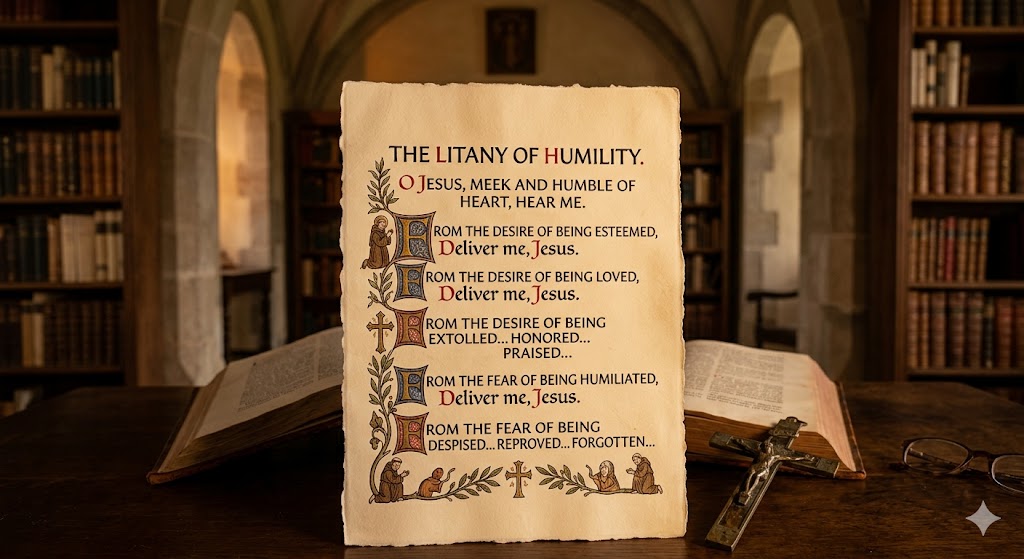
The Litany of Humility is widely regarded as one of the most challenging prayers in Catholic spirituality. Traditionally attributed to Cardinal Rafael Merry del Val, who served under Pope Saint Pius X in the early twentieth century, the prayer asks God for freedom from pride, fear of humiliation, and the desire for recognition.
For many readers encountering it for the first time, the text can seem startling. It includes petitions such as being delivered from the desire to be praised, admired, preferred, or approved. In a culture that often encourages visibility, achievement, and personal promotion, those requests appear almost countercultural.
Yet the prayer’s purpose is frequently misunderstood. It does not ask people to reject their talents or deny their dignity. Instead, it aims to loosen the grip of ego and help believers place their identity in God rather than public opinion. Spiritual directors, priests, and religious communities have recommended the devotion for decades because of its capacity to reveal hidden attachments and cultivate interior freedom.
The prayer has experienced renewed interest in recent years through Catholic podcasts, online communities, and spiritual formation programmes. Its popularity reflects a broader search for meaning beyond metrics, followers, and external validation.
This article explores the history of the devotion, its theological foundations, practical implications, cultural significance, and future relevance as society continues to wrestle with questions of identity, ambition, and humility.
The Historical Origins of the Prayer
The devotion is commonly attributed to Cardinal Rafael Merry del Val (1865–1930), a Spanish-born churchman who served as Secretary of State to Pope Saint Pius X.
Who Was Cardinal Merry del Val?
Merry del Val was respected for his diplomatic skill, intellectual ability, and personal devotion. Contemporary accounts describe him as a man of notable humility despite holding one of the most influential positions in the Catholic Church.
Although historical scholars debate whether he personally authored every line, the prayer became strongly associated with him during his lifetime and after his death.
Historical Context
The late nineteenth and early twentieth centuries were periods of enormous social change. Industrialisation, political upheaval, and modern intellectual movements challenged traditional religious structures.
Within this environment, Catholic spirituality increasingly emphasised interior conversion rather than external prestige. The prayer reflected this emphasis by directing attention toward self-examination and dependence upon divine grace.
What the Prayer Actually Teaches
One reason the devotion is frequently misunderstood is that modern readers often equate humility with weakness.
Christian theology traditionally defines humility differently.
Humility is not thinking less of oneself. It is seeing oneself truthfully.
This distinction appears throughout Catholic spiritual tradition, including the writings of:
- St. Augustine
- St. Thomas Aquinas
- St. Teresa of Ávila
These thinkers consistently described humility as an accurate understanding of one’s strengths, weaknesses, and dependence on God.
Core Themes
The prayer addresses several recurring desires:
| Attachment | Spiritual Concern |
| Desire for praise | Dependence on external approval |
| Desire for recognition | Identity tied to reputation |
| Fear of criticism | Emotional vulnerability to opinion |
| Fear of humiliation | Protection of personal image |
| Desire for superiority | Pride and comparison |
The goal is not to eliminate healthy ambition. The goal is to prevent ambition from becoming the foundation of self-worth.
Why the Litany Feels So Difficult
Many Catholics report that this prayer is emotionally uncomfortable.
That reaction is precisely why spiritual directors often recommend it.
The text touches fears that frequently remain hidden beneath everyday behaviour.
The Approval Economy
Modern life operates within what some sociologists describe as an “attention economy.” Success is increasingly measured through visibility, engagement, and audience growth.
Social platforms reward:
- Recognition
- Popularity
- Status signals
- Public affirmation
Against this backdrop, praying to be delivered from the desire for praise can feel radically disruptive.
A Practical Observation
Pastoral counsellors often note that many struggles with anxiety involve concerns about judgement, rejection, or reputation.
The prayer directly confronts these fears.
Its focus is not public humiliation but spiritual freedom.
Comparison: Humility vs Low Self-Esteem
A common misconception is that humility encourages poor self-image.
The evidence suggests otherwise.
| Humility | Low Self-Esteem |
| Accurate self-assessment | Negative self-perception |
| Accepts strengths and weaknesses | Focuses primarily on weaknesses |
| Encourages service | Encourages withdrawal |
| Supports healthy confidence | Undermines confidence |
| Compatible with leadership | Often inhibits leadership |
Researchers studying humility within psychology have increasingly distinguished it from insecurity.
Healthy humility is associated with openness, learning, cooperation, and resilience rather than passivity.
Real-World Examples of Its Influence
Religious Communities
Many Catholic religious orders incorporate the devotion into communal prayer.
Monastic communities often use it as part of spiritual formation because it encourages self-awareness and detachment from status.
Clergy Formation
Seminaries have historically introduced candidates to prayers focused on humility.
The intention is not to diminish leadership ability but to prevent leadership from becoming self-serving.
Personal Testimonies
Catholic writers, retreat leaders, and spiritual directors frequently describe the prayer as transformative because it reveals motivations that otherwise remain unnoticed.
These observations appear regularly in retreat conferences and pastoral literature, though individual experiences naturally vary.
Cultural Relevance in the Digital Age
One of the most overlooked aspects of the devotion is how relevant it has become outside strictly religious settings.
Personal Branding and Identity
Modern professional culture often encourages individuals to:
- Build a personal brand
- Increase visibility
- Demonstrate expertise
- Curate public perception
These goals are not inherently problematic.
However, problems emerge when self-worth becomes dependent upon public recognition.
The prayer raises an uncomfortable question:
Who are we when approval disappears?
Three Insights Often Missing From Popular Discussions
1. Humility Improves Decision-Making
Research in organisational psychology suggests humble leaders are more receptive to feedback and less prone to overconfidence.
This creates better conditions for learning and adaptation.
2. Recognition Dependency Creates Emotional Volatility
People whose identity relies heavily on praise may experience greater emotional fluctuation when approval is withdrawn.
The prayer directly targets this dependency.
3. Humility Supports Long-Term Leadership
Sustainable leadership often requires accepting criticism, sharing credit, and remaining teachable.
The devotion cultivates these habits over time.
Structured Insight Table
| Area of Life | How Humility Helps | Potential Challenge |
| Family relationships | Reduces defensiveness | Requires vulnerability |
| Workplace leadership | Encourages collaboration | May be misinterpreted as weakness |
| Faith life | Deepens trust in God | Exposes hidden pride |
| Social media use | Reduces comparison | Challenges validation habits |
| Community involvement | Encourages service | Less visible recognition |
Risks and Common Misinterpretations
Every spiritual practice carries risks when misunderstood.
Mistaking Humility for Self-Neglect
The prayer does not require accepting abuse, injustice, or unhealthy relationships.
Christian humility exists alongside human dignity.
Ignoring Legitimate Achievement
Achievements, talents, and accomplishments are not condemned.
The issue is attachment rather than achievement itself.
Using Humility as Social Performance
Ironically, people can become proud of appearing humble.
Many spiritual writers have warned about this paradox.
The focus must remain on genuine transformation rather than image management.
The Future of Litany of Humility in 2027
Several trends suggest continued interest in this devotion through 2027.
Digital Fatigue
Growing concern about excessive social media use has increased public discussion around attention, comparison, and mental wellbeing.
The prayer addresses many of these concerns indirectly.
Renewed Interest in Spiritual Formation
Religious organisations continue investing in discipleship programmes that emphasise character formation rather than information alone.
Search for Meaning Beyond Visibility
As algorithm-driven platforms become more influential, people increasingly seek practices that ground identity in something deeper than audience response.
The devotion is well positioned to remain relevant because it speaks directly to this tension.
However, its future influence will depend on careful teaching. Without proper context, readers may continue confusing humility with self-rejection.
Key Takeaways
- The prayer is traditionally associated with Cardinal Rafael Merry del Val and early twentieth-century Catholic spirituality.
- Its primary aim is freedom from unhealthy attachment to praise and recognition.
- Humility differs significantly from insecurity or low self-esteem.
- The devotion remains relevant in cultures shaped by personal branding and social media.
- Effective leadership often requires many of the virtues the prayer cultivates.
- Misunderstanding humility can lead to harmful interpretations that ignore human dignity.
- The prayer’s enduring appeal lies in its challenge to place identity beyond public approval.
Conclusion
The Litany of Humility remains one of Christianity’s most demanding spiritual exercises because it confronts desires many people rarely examine. Rather than attacking achievement or confidence, it challenges dependence upon recognition, status, and approval.
Historically linked to Cardinal Rafael Merry del Val, the prayer emerged within a Catholic tradition that viewed humility as truthfulness rather than self-denial. Its continued relevance reflects enduring human concerns about identity, reputation, and belonging.
Modern technology has amplified those concerns. Social platforms, professional networking, and personal branding frequently encourage individuals to measure their value through visibility and affirmation. Against that backdrop, the prayer offers a radically different perspective.
Whether one approaches it as a devotional practice, a historical text, or a cultural artefact, its central question remains remarkably timely: what happens when personal worth is no longer dependent on admiration from others?
That question explains why this century-old prayer continues to challenge and inspire believers around the world.
FAQ
What is the Litany of Humility?
The Litany of Humility is a Catholic prayer traditionally attributed to Cardinal Rafael Merry del Val. It asks God for freedom from pride, self-centredness, and excessive concern for personal recognition.
Who wrote the Litany of Humility?
The prayer is commonly attributed to Cardinal Rafael Merry del Val, Secretary of State under Pope Saint Pius X. While some historians debate authorship details, the association remains strong within Catholic tradition.
Is the Litany of Humility approved by the Catholic Church?
Yes. The prayer has long been used in Catholic devotional life and is widely recommended by clergy, spiritual directors, and religious communities.
Why is the Litany of Humility considered difficult?
Many of its petitions challenge natural desires for approval, admiration, and recognition. Readers often find it difficult because it exposes deeply rooted attachments.
Does humility mean having low self-esteem?
No. Christian humility involves accurate self-knowledge and trust in God. Low self-esteem involves a distorted negative self-view.
How often should someone pray the Litany of Humility?
There is no required schedule. Some Catholics pray it daily, while others use it during retreats, periods of discernment, or spiritual formation programmes.
Is the prayer relevant outside religious settings?
Many of its themes—ego, recognition, comparison, and identity—apply to leadership, relationships, and personal development beyond explicitly religious contexts.
Methodology
This article was developed using historical Catholic sources, contemporary pastoral commentary, theological scholarship, and published materials concerning Cardinal Rafael Merry del Val and Catholic devotional practices.
Validation focused on:
- Historical attribution of the prayer
- Catholic theological understanding of humility
- Contemporary psychological research distinguishing humility from low self-esteem
- Published commentary from recognised Catholic institutions and scholars
Limitations:
- Historical debate remains regarding specific authorship details.
- Spiritual outcomes vary significantly between individuals.
- The article examines the prayer primarily through Catholic historical and theological perspectives.
Counterarguments considered include concerns that humility can be misinterpreted as passivity or diminished self-worth. The available theological and psychological literature generally distinguishes authentic humility from unhealthy self-negation.
Editorial Disclosure: This article was drafted with AI assistance and reviewed and verified by [Author Name]. All data, citations, and claims should be independently confirmed by the editorial team at Postcard.fm before publication.
References
Catholic Encyclopedia. (2024). Humility. Retrieved from https://www.newadvent.org
Catechism of the Catholic Church. (2023 ed.). Libreria Editrice Vaticana.
Merry del Val, R. (attributed). Litany of Humility. Various Catholic devotional editions.
United States Conference of Catholic Bishops. (2024). Catholic prayers and devotions. Retrieved from https://www.usccb.org
Aquinas, T. (Trans. Fathers of the English Dominican Province). Summa Theologica (selected sections on humility).
Teresa of Ávila. The Interior Castle (various modern editions).