Rule 35 is part of the Federal Rules of Criminal Procedure in the United States and provides limited circumstances under which a federal criminal sentence may be corrected or reduced. While many people assume a prison sentence is final once imposed, Rule 3’5 creates narrow exceptions that allow a court to revisit a sentence. These exceptions exist to correct obvious sentencing mistakes or to reward defendants who provide meaningful assistance to law enforcement after sentencing.
Understanding Rule 3’5 is important for defendants, attorneys, and anyone interested in the federal criminal justice system. However, its scope is often misunderstood. It is not a second trial, an appeal, or a way to request a lighter sentence simply because circumstances have changed. Instead, Rule 3’5 follows specific legal standards that federal judges must apply.
This guide explains what Rule 35 is, how it works, who may qualify for relief, and why its application remains limited under federal law.
What Is Rule 35?
Rule 3’5 is a federal procedural rule that permits a judge to modify a previously imposed criminal sentence under certain conditions.
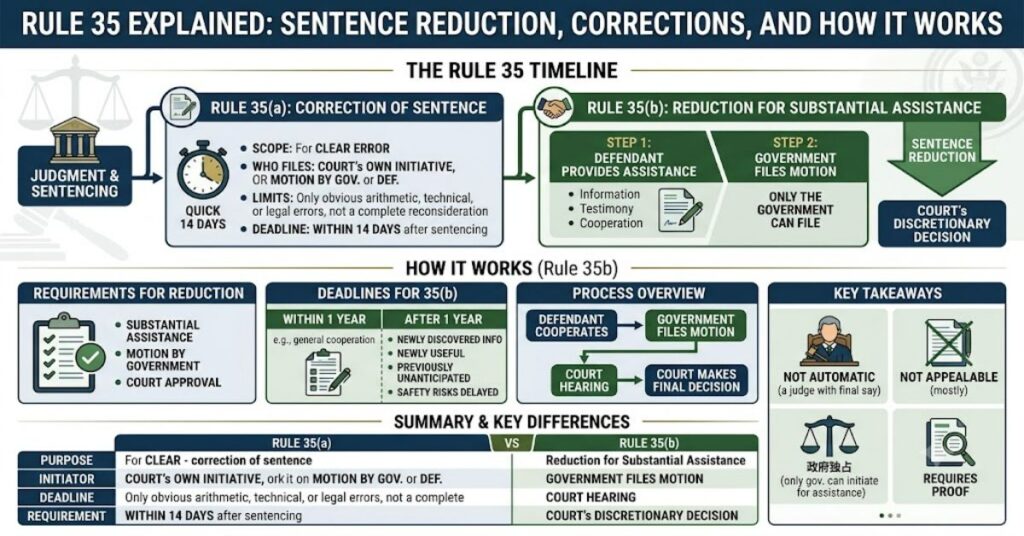
The rule generally contains two primary provisions:
- Correcting a sentence that resulted from a clear error.
- Reducing a sentence when the defendant provides substantial assistance in investigating or prosecuting another person.
Because sentencing is intended to provide finality, Rule 3’5 is interpreted narrowly by federal courts.
Rule 35(a): Correcting Clear Errors
Rule 3’5(a) allows a court to correct a sentence that resulted from an obvious legal or mathematical error.
Examples include:
- Incorrect calculation of sentencing guidelines.
- Clerical or arithmetic mistakes.
- Accidental omissions during sentencing.
- Technical legal errors apparent from the record.
Importantly, this provision cannot be used simply because the judge changes their mind about the sentence. It is reserved for genuine, identifiable mistakes.
Rule 35(b): Sentence Reduction for Substantial Assistance
The most widely known part of Rule 3’5 involves sentence reductions based on substantial assistance.
If a defendant provides valuable information that helps the government investigate or prosecute another individual after sentencing, prosecutors may ask the court to reduce the sentence.
Examples of substantial assistance include:
- Providing reliable information about criminal organizations.
- Testifying against co-defendants.
- Assisting ongoing investigations.
- Helping recover criminal proceeds.
The motion for a reduction generally must be filed by the government, not the defendant.
Who Can Benefit from Rule 35?
Not every federal prisoner qualifies for Rule 3’5 relief.
Potential candidates include:
| Situation | Possible Rule 35 Relief |
| Sentencing calculation error | Correction under Rule 35(a) |
| Clerical mistake | Correction under Rule 35(a) |
| Cooperation with investigators | Reduction under Rule 35(b) |
| Assistance after sentencing | Possible reduction if government files motion |
Eligibility depends entirely on the facts of each case and compliance with federal procedural rules.
Rule 35 vs. Criminal Appeals
Many people confuse Rule 3’5 with the appeals process.
| Rule 35 | Criminal Appeal |
| Limited sentence correction | Challenges legal errors during trial |
| Applies after sentencing | Reviews conviction or sentence |
| Narrow legal grounds | Broader constitutional issues |
| Usually short deadlines | Different appellate timelines |
An appeal examines whether legal mistakes occurred during trial or sentencing, while Rule 3’5 addresses only specific post-sentencing circumstances.
Time Limits Matter
One of the most important aspects of Rule 3’5 is timing.
For correcting clear errors, courts have only a short period after sentencing to make corrections. Missing that deadline generally removes the court’s authority to act.
Sentence reductions for substantial assistance may occur later, but only if prosecutors determine the defendant’s cooperation significantly benefited the government.
Because these deadlines are strict, defendants should seek legal advice promptly if Rule 3’5 may apply.
Limitations of Rule 35
Although Rule 3’5 offers valuable relief in certain situations, it has significant limitations.
The rule cannot be used to:
- Retry a criminal case.
- Introduce new evidence unrelated to sentencing.
- Challenge the jury’s verdict.
- Request a lighter sentence based solely on personal hardship.
- Replace the federal appeals process.
Courts consistently emphasize that Rule 3’5 is an exception rather than a routine method for changing criminal sentences.
Why Rule 35 Exists
Rule 3’5 serves two important purposes within the federal justice system.
First, it allows judges to quickly correct obvious sentencing mistakes without requiring lengthy appellate proceedings.
Second, it encourages defendants to cooperate with law enforcement by offering the possibility of reduced sentences when that cooperation meaningfully advances criminal investigations.
These objectives help improve both fairness and efficiency within the federal criminal justice system.
Practical Considerations
Attorneys evaluating Rule 3’5 relief typically consider several factors:
- Whether a sentencing error clearly exists.
- Whether cooperation occurred after sentencing.
- The quality and usefulness of the defendant’s assistance.
- Whether prosecutors are willing to file a motion.
- Applicable deadlines and procedural requirements.
Because Rule 3’5 is highly technical, experienced legal representation is often essential.
Frequently Asked Questions
Is Rule 35 available in every criminal case?
No. Rule 35 applies only to federal criminal cases and only under the specific circumstances outlined in the Federal Rules of Criminal Procedure.
Can a defendant request a Rule 35 reduction alone?
Generally, sentence reductions for substantial assistance require a motion filed by the government. Defendants usually cannot obtain this relief independently.
Does Rule 35 overturn a conviction?
No. Rule 3’5 concerns modifying a sentence, not reversing a criminal conviction.
Can a judge reduce any sentence under Rule 35?
No. Judges may act only within the authority provided by Rule 3’5 and applicable federal law.
Is Rule 35 the same as compassionate release?
No. Compassionate release operates under different federal statutes and addresses separate circumstances, such as serious medical conditions or extraordinary situations.
Conclusion
Rule 35 is an important but narrowly tailored part of the Federal Rules of Criminal Procedure. It allows federal courts to correct clear sentencing errors and provides a mechanism for reducing sentences when defendants offer substantial assistance to government investigations. However, the rule is governed by strict procedural requirements, limited eligibility, and firm deadlines.
Understanding what Rule 3’5 can—and cannot—do helps prevent unrealistic expectations about post-sentencing relief. While it offers meaningful opportunities in qualifying cases, it is not a substitute for an appeal or a general request for leniency. Anyone considering Rule 3’5 should consult a qualified federal criminal defense attorney to evaluate whether the rule applies to their specific circumstances and to ensure all procedural requirements are met.