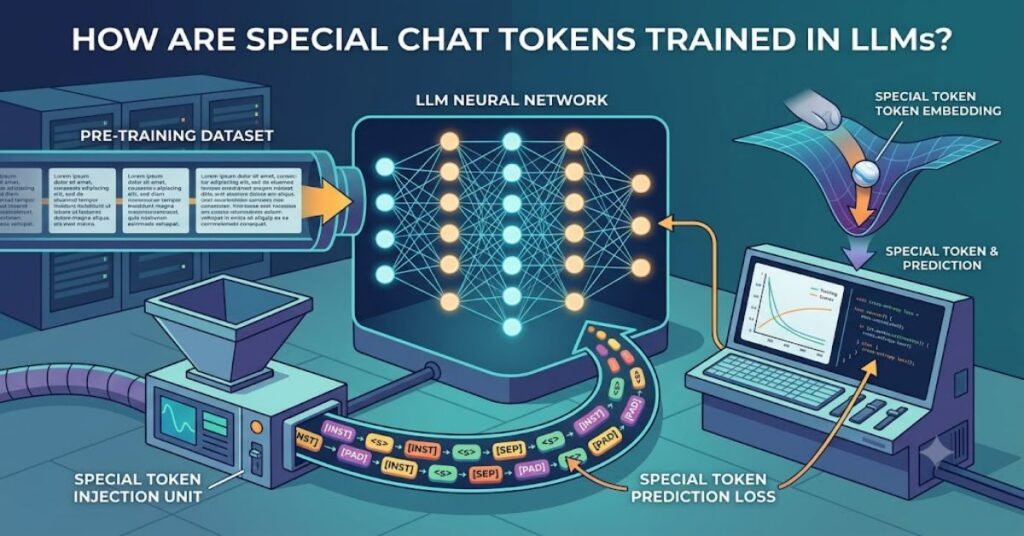
If you’ve ever wondered how are special chat tokens trained in LLM, the short answer is that they are introduced during instruction fine-tuning and learned like any other token in a language model’s vocabulary. Tokens such as <|im_start|>, <|im_end|>, <|assistant|>, <|user|>, and <|start_header_id|> act as invisible formatting markers that teach a model where messages begin, who is speaking, and how conversational context should be interpreted.
Without these markers, modern AI assistants would struggle to separate user instructions from system directives or assistant responses. Although users rarely see them directly, these special symbols play a central role in the behaviour of models such as GPT-style assistants, Llama chat models, and many open-source conversational systems.
The topic has become increasingly important since the widespread adoption of instruction-tuned models between 2022 and 2025. Earlier language models were primarily trained to predict the next word in large bodies of text. Modern assistants, however, must follow instructions, maintain dialogue state, respect system messages, and interact with tools. Special chat tokens provide the structure needed to accomplish these tasks.
This article explores how these tokens are created, embedded, trained, and utilised inside large language models. It also examines the practical implications for AI developers, the limitations of chat templates, and where conversational formatting may evolve by 2027.
What Are Special Chat Tokens?
Special chat tokens are reserved symbols added to a model’s vocabulary for conversational formatting.
Examples include:
<|system|>
<|user|>
<|assistant|>
<|im_start|>
<|im_end|>
<|start_header_id|>
<|end_header_id|>
Unlike ordinary words, these tokens are not intended to represent concepts such as “tree” or “computer”. Instead, they provide structural information.
Think of them as punctuation on a much larger scale.
A model interprets them as signals that indicate:
- A new message is beginning
- A message has ended
- The speaker has changed
- System instructions are being presented
- Tool outputs are being inserted
- Context boundaries exist
Without these markers, conversation history would appear as an unstructured stream of text.
The Evolution from Text Models to Chat Models
Early transformer models such as GPT-2 were trained on plain text.
Their training looked roughly like this:
The cat sat on the mat.
The dog barked loudly.
There was no concept of a user or assistant.
By contrast, modern conversational datasets contain structured exchanges:
<|user|>
What is machine learning?
<|assistant|>
Machine learning is…
This transition required a new vocabulary of structural tokens.
Comparison Table
| Traditional Language Models | Chat-Based Models |
| Plain text prediction | Structured conversation prediction |
| No role awareness | Role-aware responses |
| Single text stream | Multiple message types |
| Minimal formatting tokens | Extensive chat formatting |
| General completion tasks | Instruction following |
The rise of instruction tuning after 2022 accelerated the need for dedicated conversation markers.
How New Chat Tokens Enter the Vocabulary
A model cannot understand a token unless it exists in its tokenizer vocabulary.
The process usually involves:
| Step | Description |
| Vocabulary Extension | New tokens are added to the tokenizer |
| Embedding Initialisation | Vector representations are created |
| Fine-Tuning Exposure | Tokens appear repeatedly in training data |
| Behaviour Learning | Model associates tokens with conversation structure |
| Reinforcement Optimisation | Alignment training strengthens correct usage |
Initially, these tokens are simply identifiers.
They have no inherent meaning.
The model learns their function through repeated exposure.
Embedding Initialisation: The First Stage
Before training begins, every token receives an embedding vector.
An embedding is a numerical representation used inside the neural network.
When new special tokens are introduced:
- The vocabulary expands.
- New embedding slots are created.
- Initial values are assigned.
- Fine-tuning adjusts those values.
Different organisations use different approaches:
- Random initialisation
- Average existing embeddings
- Copy-based initialisation
- Custom embedding strategies
At this stage, <|assistant|> has no understanding of what “assistant” means.
It is simply a vector waiting to be trained.
How Instruction Fine-Tuning Teaches Chat Structure
The most important training phase occurs during instruction tuning.
A dataset may contain millions of examples formatted like this:
<|system|>
You are a helpful assistant.
<|user|>
Explain gravity.
<|assistant|>
Gravity is…
The model repeatedly predicts the next token.
Over time it learns patterns such as:
- Assistant responses usually follow assistant markers.
- User messages usually contain requests.
- System messages contain instructions.
- End markers signal response termination.
Eventually, these patterns become embedded within the model’s parameters.
This is the primary answer to the question: how are special chat tokens trained in LLM.
They are not manually programmed.
They are statistically learned through exposure.
The Hidden Grammar of Conversational AI
One useful way to think about chat tokens is as grammatical rules.
Human languages use:
- Full stops
- Commas
- Paragraph breaks
Chat models use:
- Role markers
- Header markers
- Tool markers
- Message boundaries
These structures help the model maintain coherence.
Structured Insight Table
| Token Type | Purpose |
| System Token | Defines behaviour rules |
| User Token | Marks human input |
| Assistant Token | Marks model output |
| Tool Token | Indicates tool responses |
| Boundary Token | Separates messages |
| Header Token | Identifies metadata sections |
The model eventually treats these markers as part of its conversational grammar.
Why Chat Templates Matter
Most developers never feed raw text directly into modern assistants.
Instead, they use chat templates.
For example:
messages = [
{“role”:”user”,”content”:”Hello”}
]
A framework converts this into:
<|user|>
Hello
<|assistant|>
The template ensures consistency.
A poorly formatted template can significantly reduce response quality.
One overlooked insight is that many model performance issues stem not from model capability but from formatting mismatches between training templates and deployment templates.
Risks and Trade-Offs
Although special chat tokens are powerful, they introduce limitations.
Prompt Injection Risks
Since system instructions rely on formatting, attackers may attempt to manipulate conversational structure.
Template Incompatibility
Different models use different token schemes.
For example:
- OpenAI-style formats
- Llama chat templates
- Mistral instruction templates
- Custom enterprise templates
Mixing them can reduce performance.
Context Consumption
Every chat token occupies context window space.
Although small individually, thousands of messages create overhead.
Training Cost
Additional tokens require extra training examples and alignment work.
Real-World Impact on AI Development
Between 2023 and 2026, chat templates became standard across the AI industry.
Developers increasingly rely on:
- Role separation
- Tool calling
- Agent frameworks
- Multi-turn memory
None of these systems work effectively without structured conversational tokens.
A practical observation from open-source experimentation is that identical models can behave dramatically differently when using the wrong prompt format. Community benchmarks on instruction-tuned models frequently show measurable performance drops when expected role markers are removed.
Another important insight is that many developers focus on model size while overlooking prompt formatting. In production environments, template correctness often provides greater gains than increasing parameter counts.
Emerging Trends in Chat Token Design
Several developments are shaping the future:
Tool-Specific Tokens
Modern AI agents increasingly use dedicated markers for:
- Search
- Code execution
- Database access
- Function calling
Multimodal Tokens
Vision-language models require markers for:
- Images
- Audio
- Video
- Documents
Agent Collaboration Tokens
Future systems may include explicit markers for:
- Planner agents
- Worker agents
- Verification agents
These specialised structures are already appearing in advanced research systems.
The Future of Special Chat Tokens in 2027
By 2027, chat tokens are likely to become more sophisticated rather than disappear.
Several trends support this prediction:
- Larger context windows require better structural organisation.
- AI agents need clearer role separation.
- Tool use continues expanding.
- Multimodal interactions demand richer formatting standards.
One likely development is industry-wide standardisation. Today, each model family often uses its own chat template. As enterprise adoption grows, interoperability will become increasingly valuable.
Another possibility is hierarchical token systems where messages contain nested structures for tools, memory, planning, and reasoning workflows.
However, complete standardisation remains uncertain because model providers continue to optimise formats for their own architectures and alignment methods.
Key Takeaways
- Special chat tokens function as the structural grammar of conversational AI.
- They are introduced through vocabulary expansion and embedding initialisation.
- Instruction fine-tuning teaches models what each token represents.
- Role markers help distinguish users, assistants, tools, and system messages.
- Template mismatches can reduce model performance significantly.
- Future AI systems will likely use more specialised conversational tokens.
- Understanding token structure helps developers build more reliable AI applications.
Conclusion
Understanding how are special chat tokens trained in LLM reveals an important truth about modern AI systems: conversational intelligence depends as much on structure as it does on model scale. Tokens such as <|user|>, <|assistant|>, and related markers provide the framework that allows language models to interpret dialogue correctly.
These tokens begin as simple additions to a tokenizer vocabulary. Through instruction fine-tuning, they acquire meaning and become part of the model’s internal representation of conversation. Over time, the model learns that different roles carry different expectations, enabling coherent multi-turn interactions.
For developers, prompt engineers, and researchers, recognising the importance of chat formatting can unlock better performance and fewer deployment issues. The future of conversational AI will likely involve increasingly sophisticated structural markers, particularly as models gain tool-use capabilities and multimodal understanding.
The hidden grammar of AI may be invisible to most users, but it remains one of the foundations upon which modern language assistants are built.
FAQ
What are special chat tokens in LLMs?
Special chat tokens are reserved markers that identify message boundaries, speaker roles, and conversation structure inside a language model.
Are chat tokens learned or hard-coded?
Their existence is defined by developers, but their meaning is learned through instruction fine-tuning and training data exposure.
Why do models need user and assistant tokens?
These markers help distinguish who is speaking, allowing the model to generate appropriate responses and maintain dialogue consistency.
Can an LLM work without chat tokens?
Yes, but conversational performance is typically worse because the model lacks explicit structural cues.
What is embedding initialisation for special tokens?
It is the process of creating vector representations for newly added tokens before training begins.
Do all models use the same chat tokens?
No. Different model families often use different templates and token conventions.
Are special tokens important for AI agents?
Yes. Tool calling, memory systems, and agent workflows depend heavily on structured role and boundary markers.
Methodology
This article was created using established concepts from transformer architecture, tokenizer design, instruction fine-tuning research, open-source chat model implementations, and publicly documented conversational AI frameworks. The analysis focuses on the general mechanisms by which special chat tokens are introduced, embedded, and learned.
Limitations include variation between proprietary and open-source implementations. Different organisations may use distinct token sets, chat templates, and alignment procedures. The underlying principle, however, remains broadly consistent: structural tokens acquire meaning through repeated exposure during supervised instruction training.
Balanced consideration was given to both the advantages and limitations of chat-token-based architectures, including compatibility challenges, prompt injection concerns, and deployment trade-offs.