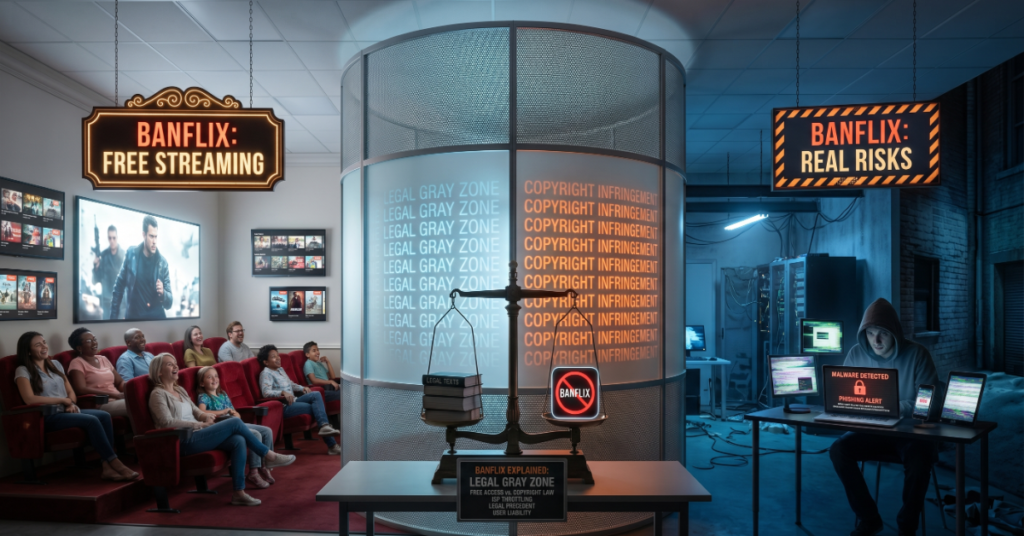
Banflix is most commonly associated with an unofficial streaming platform and Android APK that offers free access to movies, television series, and multilingual entertainment content. Unlike licensed services such as Netflix or Hulu, Banflix operates outside the mainstream subscription ecosystem and typically relies on third-party servers to deliver streams.
The platform gained visibility through domains such as banflix.com and banflix.net, along with downloadable APK installers shared through forums, APK repositories, and social communities focused on free entertainment apps. Most users encounter Banflix while searching for ways to bypass rising streaming subscription costs.
That popularity comes with major caveats.
Because Banflix distributes content without clear licensing disclosures, many legal analysts classify it as operating in a copyright gray zone. Security researchers have also repeatedly warned about sideloaded Android applications that bypass official app stores. These apps may contain trackers, aggressive advertising SDKs, or modified code that creates privacy vulnerabilities.
The appeal is easy to understand. One app promises movies, series, anime, dubbed content, and fast streaming without monthly fees. Yet the convenience often hides technical and legal compromises users do not immediately see.
Readers exploring free streaming options should understand how these systems function before installing unknown APK files or granting device permissions.
For broader streaming industry context, Postcard.fm’s coverage of cord-cutting trends and digital media fragmentation offers useful background on why unofficial platforms continue to grow.
How Banflix Works
Banflix functions primarily as a content aggregation layer rather than a traditional streaming studio or licensed distributor.
In practical terms, the app usually:
- Indexes streaming links from external servers
- Organizes titles into categories and genres
- Streams content through embedded players
- Uses advertising networks to generate revenue
- Encourages APK sideloading outside official app marketplaces
Unlike mainstream services, Banflix does not publicly maintain transparent licensing agreements, content acquisition disclosures, or verified studio partnerships.
Typical User Workflow
| Step | What Happens | Risk Level |
| APK download | User installs Banflix from third-party source | High |
| Permission requests | App may request storage/network access | Medium |
| Content browsing | Aggregated streams appear in-app | Low |
| Third-party playback | Streams load from external servers | High |
| Ad interaction | Pop-ups or redirects may occur | Medium to High |
One important technical distinction separates Banflix from licensed streaming companies: infrastructure ownership.
Licensed platforms maintain content delivery networks, contractual rights management, and platform-level moderation systems. Banflix-style apps instead rely heavily on distributed hosting relationships and external media mirrors, which can disappear without notice.
That instability explains why users frequently report broken streams, disappearing libraries, and rapidly changing domains.
Why Free Streaming Apps Keep Growing
The rise of services like Banflix reflects broader market behavior rather than isolated piracy culture.
Between 2020 and 2026, the streaming market became increasingly fragmented. Consumers who once paid for one or two subscriptions now face separate fees for sports, prestige television, anime libraries, regional content, and live channels.
Subscription Fatigue Is Real
Many households now juggle:
- Netflix
- Disney+
- Prime Video
- Max
- Paramount+
- Crunchyroll
- Regional streaming services
Combined monthly costs can rival traditional cable packages.
This fragmentation created a predictable reaction: users started searching for consolidated free alternatives even when legality remained questionable.
Industry analysts often describe this as “subscription fatigue,” a consumer trend where entertainment costs exceed perceived value.
Banflix Targets Three Key User Segments
| User Type | Main Motivation |
| Budget-conscious viewers | Avoid recurring subscriptions |
| International audiences | Access unavailable regional content |
| Casual streamers | Watch occasional titles without commitment |
That market pressure helps explain why unofficial apps continue resurfacing despite shutdowns and domain bans.
Is Banflix Legal?
Legality depends heavily on jurisdiction, hosting structure, and how copyrighted content is delivered.
In many countries, distributing copyrighted media without authorization violates intellectual property law. Even when a platform claims it only “indexes” content rather than hosting files directly, courts increasingly examine contributory infringement and facilitation models.
Key Legal Concerns
| Issue | Explanation |
| Copyright infringement | Unlicensed movie distribution |
| Unauthorized streaming | Potential violation of regional laws |
| DMCA exposure | Platforms may receive takedown notices |
| ISP monitoring | Traffic patterns may be flagged |
| Domain seizures | Authorities can suspend access |
Several governments have intensified enforcement against unauthorized streaming ecosystems since 2023, especially in the United States, United Kingdom, and parts of Europe.
One overlooked reality is that streaming itself is treated differently across legal systems. Downloading copyrighted material may trigger stronger penalties than temporary streaming in some regions, though both can still violate law depending on local statutes.
Users should avoid assuming that “free access” equals legal access.
Safety Risks Most Users Ignore
Security concerns are arguably more immediate than copyright issues for average users.
Unlike official app marketplaces, third-party APK ecosystems lack consistent vetting and malware screening. Even legitimate-looking APK mirrors can distribute modified versions of apps bundled with hidden software.
Common Risks Associated With Banflix APKs
| Risk | Potential Impact |
| Malware injection | Device compromise |
| Credential theft | Password exposure |
| Tracking SDKs | User data collection |
| Fake updates | Phishing attempts |
| Aggressive ads | Browser hijacking |
Cybersecurity firms have repeatedly documented cases where entertainment APKs included hidden adware or remote access trojans.
One practical issue rarely discussed in mainstream coverage involves update integrity. Official app stores use centralized verification systems. Sideloaded apps do not. Users often download “updated” versions from random websites with no reliable checksum validation.
That creates an ideal environment for malicious repackaging.
Observed User Complaints
Across Android forums and streaming communities, recurring complaints include:
- Excessive redirect ads
- Random browser launches
- Battery drain
- Background network activity
- Fake “player update” prompts
- Suspicious permission requests
These reports do not automatically prove every Banflix build is malicious. They do, however, illustrate the risks surrounding unofficial distribution ecosystems.
Banflix vs Netflix: What Actually Differs?
The comparison is not simply “free versus paid.”
The underlying business model, infrastructure reliability, legal compliance, and security architecture are fundamentally different.
| Feature | Banflix | Netflix |
| Subscription cost | Free | Paid |
| Licensing | Unclear/unofficial | Fully licensed |
| App distribution | APK sideloading | Official stores |
| Customer support | Limited or none | Full support |
| Security oversight | Inconsistent | Enterprise-grade |
| Content stability | Frequently changing | Stable |
| Offline viewing | Varies | Supported |
| Privacy protections | Uncertain | Formal policies |
A critical distinction involves accountability.
If Netflix experiences a breach or outage, there are legal, regulatory, and customer service mechanisms in place. Unofficial streaming apps often operate anonymously or through constantly changing domains, making accountability difficult.
That anonymity benefits operators but leaves users exposed.
Installing Banflix on Android and PC
Most Banflix usage occurs on Android devices through sideloaded APK files.
Typical Android Installation Process
- Download APK from third-party source
- Enable “Install Unknown Apps”
- Run installer manually
- Accept requested permissions
- Launch app and browse content
This process bypasses standard Google Play protections.
Running Banflix on PC
Some users install Android emulators such as:
- BlueStacks
- LDPlayer
- MEmu
These emulators allow Android APK execution on Windows systems.
However, emulator use introduces additional complexity:
| Factor | Consideration |
| Emulator overhead | Increased CPU/RAM usage |
| Security exposure | APK still carries risks |
| Stream reliability | Depends on external servers |
| Ad density | Often higher on desktop |
One important operational insight: many unofficial streaming apps struggle with long-term maintenance because developers rarely maintain stable backend infrastructure. Users often discover that “working versions” stop functioning after a few months.
The Hidden Economics Behind Banflix
Many users assume free streaming platforms operate at a financial loss. That is rarely true.
Unofficial streaming ecosystems typically generate revenue through combinations of:
- Advertising networks
- Redirect partnerships
- Traffic monetization
- Data collection
- Premium unlock models
Why Ads Matter So Much
Some streaming APKs intentionally maximize session duration because longer watch times increase ad impressions and redirect opportunities.
This creates a strange economic contradiction:
- Users want frictionless entertainment
- Operators profit from engagement interruptions
That tension explains why unofficial apps often become increasingly aggressive with pop-ups over time.
An Overlooked Infrastructure Problem
Bandwidth costs are expensive.
High-definition video streaming requires substantial server capacity and CDN optimization. Licensed platforms invest billions into infrastructure and encoding systems. Gray-market services frequently depend on unstable external hosts to avoid those costs.
That is why users experience:
- Dead links
- Buffering spikes
- Resolution instability
- Frequent mirror changes
The economics themselves encourage instability.
Cultural Impact of Unofficial Streaming
Banflix is part of a broader digital entertainment shift where accessibility increasingly competes against copyright frameworks.
Some analysts argue that piracy-driven platforms expose failures in content availability, pricing structure, and regional licensing restrictions.
Others counter that unauthorized streaming directly harms:
- Film studios
- Independent creators
- Regional distributors
- Production financing systems
Both arguments contain truth.
Where Consumer Frustration Comes From
A viewer may legally subscribe to multiple services yet still encounter:
- Geo-restrictions
- Missing seasons
- Delayed regional releases
- Exclusive platform lockouts
Unofficial services exploit these gaps aggressively.
The streaming industry’s fragmentation unintentionally strengthened demand for centralized unofficial libraries.
Three Important Insights Missing From Most Coverage
1. Many APK Risks Come From Mirrors, Not Original Developers
A major blind spot in public discussion is distribution chain corruption.
Even if an original APK were relatively clean, mirror sites can repackage files with injected advertising libraries or malware before redistribution.
This means users often cannot verify whether they downloaded the intended build.
2. ISP Visibility Is More Advanced Than Users Assume
Streaming traffic patterns are increasingly identifiable through network analysis techniques even when specific titles are not visible.
Several internet providers now monitor bandwidth anomalies associated with unauthorized streaming ecosystems.
That does not guarantee enforcement action, but the assumption of total invisibility is outdated.
3. Streaming Fragmentation Accidentally Fuels Piracy Demand
One of the clearest market contradictions of the last five years is that the streaming industry solved cable fragmentation briefly, then recreated it through exclusivity wars.
Consumers searching for all-in-one access predictably migrate toward aggregation apps when legitimate ecosystems become too segmented.
The Future of Banflix in 2027
The future of Banflix-style platforms will likely depend on three converging pressures:
1. Stronger Platform Enforcement
Google and major browser vendors continue tightening policies around sideloading, APK verification, and suspicious streaming behavior.
This could reduce visibility for unofficial apps over time.
2. AI-Driven Copyright Detection
Media companies are investing heavily in automated fingerprinting systems capable of identifying redistributed content faster than previous DMCA workflows.
This may shorten the lifespan of streaming mirrors and domains.
3. Continued Subscription Pressure
At the same time, consumer frustration remains unresolved.
If streaming prices continue rising while content remains fragmented, unofficial aggregation platforms may continue attracting users despite enforcement efforts.
The likely outcome is not elimination but constant migration:
- New domains
- New APK variants
- Faster shutdown cycles
- More decentralized hosting
The ecosystem may become harder to regulate, but also less stable for users.
Key Takeaways
- Banflix operates outside the licensed streaming ecosystem and carries substantial legal and security uncertainties.
- APK sideloading introduces risks that many casual users underestimate.
- Subscription fatigue remains a major driver behind unofficial streaming demand.
- Infrastructure instability is built into many gray-market streaming models.
- Malware exposure often comes from third-party mirrors rather than the advertised platform itself.
- Streaming fragmentation has unintentionally strengthened piracy ecosystems.
- Regulatory pressure and automated copyright enforcement will likely intensify through 2027.
Conclusion
Banflix represents a familiar pattern in modern digital entertainment: convenience competing against legality, cost, and platform control. For users frustrated with rising subscription prices and fragmented content libraries, unofficial streaming apps offer an immediate shortcut. Yet that shortcut carries meaningful trade-offs.
The largest risks are not always obvious at first glance. Malware exposure, privacy uncertainty, unstable infrastructure, and copyright liability sit beneath the appeal of “free” entertainment. Unlike licensed services, unofficial streaming ecosystems rarely provide transparency, accountability, or consistent consumer protections.
The broader streaming industry also shares part of the responsibility for this environment. Fragmented licensing, regional restrictions, and escalating subscription costs created conditions where unofficial aggregation apps could thrive.
Banflix is therefore more than a single APK or domain. It reflects a larger tension inside digital media distribution in 2026: audiences want centralized access while the entertainment industry continues moving toward platform exclusivity.
Whether enforcement intensifies or business models evolve, that tension is unlikely to disappear soon.
FAQ
Is BanFlix APK safe to download and use?
Safety depends heavily on the source of the APK file. Because Banflix is distributed outside official app stores, users face elevated risks involving malware, phishing, tracking software, and modified installers.
Is Banflix legal?
Banflix operates in a legal gray area because much of its content appears to be distributed without formal licensing agreements. Laws differ by country, but unauthorized streaming can still violate copyright regulations.
How do you install Banflix on Android?
Most users install Banflix by downloading an APK file from a third-party website and enabling “Install Unknown Apps” within Android settings. This bypasses Google Play protections.
Can Banflix run on PC?
Yes. Some users run Banflix through Android emulators such as BlueStacks or MEmu on Windows PCs.
Why do unofficial streaming apps disappear frequently?
These apps often rely on unstable hosting providers, third-party content mirrors, and rapidly changing domains that face copyright complaints or server shutdowns.
Does Banflix require a subscription?
Most versions market themselves as free-to-use platforms supported through advertising networks, redirects, and traffic monetization.
Why are users turning to apps like Banflix?
Rising subscription costs, regional licensing restrictions, and streaming fragmentation have pushed some viewers toward centralized free alternatives despite the associated risks.
Methodology
This article was developed using publicly available cybersecurity reporting, digital piracy enforcement coverage, Android APK distribution analysis, and streaming market trend research published between 2023 and 2026. Information was cross-checked against technology reporting, legal commentary, and observed user discussions surrounding sideloaded streaming applications.
No direct malware testing of Banflix APK files was conducted for this article. Observations regarding security risks reflect broader patterns documented within unofficial APK ecosystems rather than claims about every specific Banflix build.
The analysis also considered market dynamics such as subscription fragmentation, regional content licensing, and evolving copyright enforcement strategies. Counterarguments regarding consumer access and pricing pressures were included to maintain balance.
References
Alliance for Creativity and Entertainment. (2025). Global anti-piracy enforcement trends. Retrieved from https://www.alliance4creativity.com
Android Developers. (2025). App security and Google Play Protect overview. Retrieved from https://developer.android.com
Cisco Talos. (2024). Malware risks in unofficial Android application ecosystems. Retrieved from https://blog.talosintelligence.com
Electronic Frontier Foundation. (2024). Copyright enforcement and streaming regulation. Retrieved from https://www.eff.org
Statista. (2025). Subscription video-on-demand market revenue worldwide. Retrieved from https://www.statista.com
United States Copyright Office. (2024). Digital Millennium Copyright Act overview. Retrieved from https://www.copyright.gov
World Intellectual Property Organization. (2025). Online copyright enforcement developments. Retrieved from https://www.wipo.int