
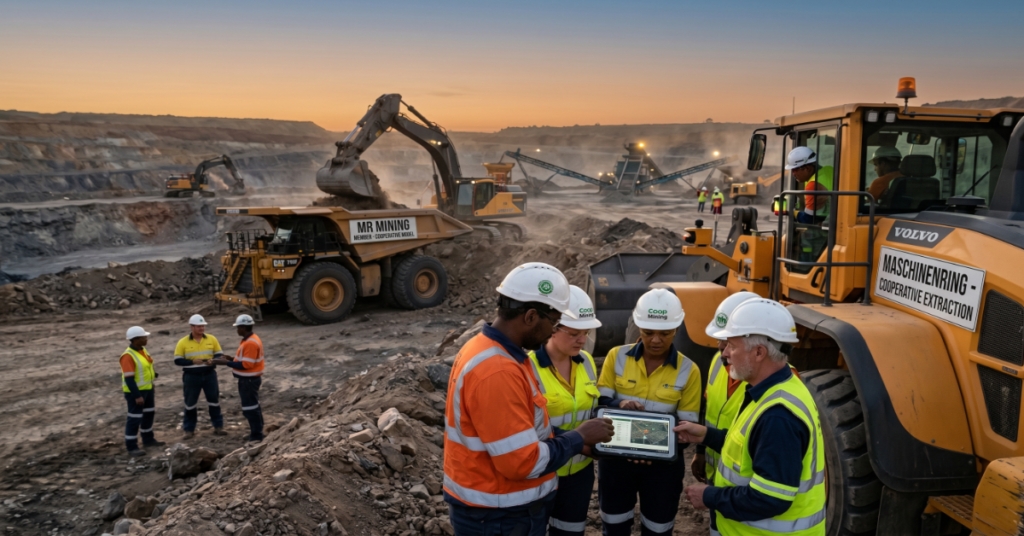
The phrase “maschinenring mining” is not widely recognized as a formal mining industry term. Instead, it appears to describe the adaptation of the Maschinenring cooperative model, originally built for agriculture, into quarrying, extraction, and mining-related operations.
In practical terms, the idea is straightforward. Mining projects require expensive machinery, highly specialized operators, seasonal labor adjustments, and substantial maintenance overhead. Smaller operators often struggle to justify purchasing heavy equipment that may only be used intermittently. The Maschinenring concept addresses that problem through shared access.
Originally developed in Austria and Germany for agricultural cooperation, Maschinenring organizations allow members to pool machinery, labor, and operational services. Farmers gain access to equipment without absorbing the full ownership burden. Applied to mining, the same framework could support excavation equipment, hauling vehicles, drilling systems, environmental management services, and skilled operators.
The concept matters because Europe’s smaller extraction businesses face rising capital costs, stricter environmental compliance rules, and labor shortages. Cooperative infrastructure offers one potential response. Yet the transition from farming support networks to mining applications introduces legal, logistical, and safety complexities that make the model far more difficult to implement than many early discussions suggest.
This article examines how maschinenring mining works, where it may already influence operations, the economic advantages it offers, and the structural risks that could limit wider adoption.
As cooperative business systems continue expanding into industrial sectors, the debate around shared-resource mining models is becoming more relevant for regional operators, regulators, and infrastructure planners alike.
For readers interested in broader cooperative business systems, Postcard.fm’s coverage of rural industrial partnerships and regional infrastructure economics provides additional context on how shared-resource models evolve across sectors.
What Is Maschinenring?
Maschinenring originated in Austria during the 1950s as a machinery-sharing organization for farmers. Over time, the cooperative structure expanded into forestry, municipal services, winter maintenance, landscaping, logistics, and staffing support.
The underlying business principle is simple:
- Members share expensive assets
- Labor can be distributed more flexibly
- Utilization rates increase
- Individual ownership costs decrease
Agriculture was a natural fit because many farming machines are used seasonally. A combine harvester, for example, may sit idle for much of the year. Sharing the asset improves economic efficiency across multiple members.
Mining operations face a similar utilization problem. Excavators, crushers, drilling rigs, and hauling systems are expensive and often underused by smaller extraction sites. Cooperative access can theoretically improve asset productivity.
Why the Mining Sector Became Interested
Several trends have increased interest in cooperative mining support systems:
| Industry Pressure | Impact on Small Operators |
| Rising machinery costs | Lower ability to finance ownership |
| Skilled labor shortages | Difficulty staffing specialized equipment |
| ESG compliance costs | Higher operational overhead |
| Fuel and maintenance inflation | Reduced margins |
| Variable project timelines | Inconsistent equipment utilization |
These pressures are especially visible in regional quarrying, aggregates, and small-scale extraction operations rather than multinational mining corporations.
How Maschinenring Mining Would Work
A mining-focused cooperative model would typically involve several operational layers.
Shared Equipment Pools
Heavy machinery represents the largest capital expense in many extraction operations.
Potential shared assets include:
- Excavators
- Wheel loaders
- Rock crushers
- Screening systems
- Haul trucks
- Drilling rigs
- Water management systems
Instead of ownership by a single operator, the cooperative either leases or owns the machinery collectively.
Labor and Operator Networks
Mining labor shortages have intensified across Europe since 2021. Skilled operators for drilling systems, blasting support, and heavy haulage remain difficult to recruit in regional markets.
A cooperative labor structure could allow operators to rotate between sites depending on demand.
This approach mirrors existing Maschinenring agricultural staffing systems where seasonal workers support multiple members during harvest periods.
Maintenance and Compliance Services
One overlooked area of the maschinenring mining concept is regulatory support.
Mining compliance increasingly involves:
- Environmental monitoring
- Dust suppression systems
- Noise management
- Worker safety audits
- Equipment inspections
- Emissions tracking
Smaller operators often lack internal compliance teams. Shared technical services could reduce administrative duplication.
Comparison: Traditional Mining vs Cooperative Mining Support
| Operational Area | Traditional Ownership Model | Maschinenring Mining Model |
| Equipment ownership | Individual company purchase | Shared cooperative access |
| Capital expenditure | Very high upfront cost | Distributed among members |
| Labor flexibility | Fixed workforce | Shared operator pool |
| Equipment utilization | Often inconsistent | Higher shared utilization |
| Maintenance responsibility | Internal | Cooperative or outsourced |
| Compliance management | Individual handling | Shared services possible |
| Scalability | Easier for large firms | More suited to smaller operators |
| Coordination complexity | Lower | Higher |
The trade-off is clear. Cooperative systems reduce ownership costs but increase operational coordination complexity.
Real-World Context in Austria and Germany
The phrase “maschinenring mining” sometimes creates confusion because Mining is also a municipality in Austria.
Mining is home to regional Maschinenring organizations such as Maschinenring Braunau und Umgebung.
This geographic overlap likely contributed to the phrase appearing online in ways that resemble a formal mining industry term.
However, while agricultural Maschinenring systems are well established, direct large-scale mining cooperative operations remain relatively limited and fragmented.
Existing Industrial Extensions
What does exist today includes:
- Shared excavation contractors
- Cooperative forestry extraction systems
- Municipal infrastructure machinery pools
- Construction equipment cooperatives
- Regional workforce-sharing agreements
These sectors provide the closest operational comparison to what a mining-focused Maschinenring adaptation might become.
Strategic Benefits for Small Mining Operators
Lower Capital Barriers
One of the strongest arguments for maschinenring mining is access.
A mid-sized hydraulic excavator can cost hundreds of thousands of dollars before maintenance, insurance, transportation, and fuel are included.
For seasonal or intermittent quarry operators, ownership economics are often weak.
Shared access changes the equation.
Improved Asset Utilization
Mining equipment frequently sits idle during:
- Permit delays
- Weather disruptions
- Seasonal shutdowns
- Transportation bottlenecks
- Demand slowdowns
Cooperative scheduling can theoretically improve utilization rates across multiple sites.
Workforce Stability
Smaller operations often lose skilled operators because they cannot provide consistent yearly work.
A cooperative labor network could provide steadier employment across multiple projects, improving worker retention.
Environmental Efficiency
Shared infrastructure can reduce duplicated equipment fleets and lower overall emissions intensity per operational site.
That advantage aligns with growing ESG reporting expectations across European industrial sectors.
Risks and Structural Weaknesses
The cooperative concept sounds efficient on paper. In practice, mining operations create complications that agriculture does not always face.
Safety Liability
Mining equipment carries major liability exposure.
Questions quickly emerge:
- Who is responsible after equipment damage?
- Which operator carries insurance liability?
- How are accident investigations handled?
- Who maintains compliance records?
These legal issues become especially sensitive under European workplace safety regulations.
Scheduling Conflicts
Agricultural cycles are relatively predictable. Mining timelines are less stable.
Permit approvals, geological surprises, weather disruptions, and supply-chain delays can suddenly change equipment demand.
Competing scheduling priorities may create friction among cooperative members.
Specialized Equipment Limitations
Unlike tractors or general-purpose loaders, mining machinery is often highly site-specific.
Factors include:
- Geological conditions
- Rock hardness
- Environmental regulations
- Haul road infrastructure
- Site dimensions
Not every asset transfers efficiently between projects.
Financing Challenges
Banks and leasing firms generally prefer clear ownership structures.
Cooperative equipment ownership can complicate:
- Lending
- Asset depreciation
- Insurance underwriting
- Tax reporting
- Cross-border operations
This is one reason many industrial cooperatives remain limited in scale.
Data Snapshot: Why Shared Models Are Being Discussed
| Mining Cost Driver | Industry Trend Since 2021 |
| Diesel fuel | Significant volatility |
| Heavy equipment prices | Sustained inflation |
| Skilled labor availability | Declining in many EU regions |
| Environmental compliance costs | Rising steadily |
| Interest rates | Increased financing costs |
| Supply chain delays | Longer replacement cycles |
These trends create conditions where cooperative operational systems become economically attractive, especially for smaller firms unable to achieve economies of scale independently.
Original Industry Insights Often Missing From Coverage
1. Mining Cooperation Works Better in Aggregates Than Deep Extraction
Most discussions treat mining as a single category. In reality, cooperative systems are far more practical in aggregates and quarrying operations than in underground or highly specialized mineral extraction.
The equipment is more transferable, compliance complexity is lower, and operational schedules are more predictable.
2. Labor Sharing May Matter More Than Equipment Sharing
Many observers focus on machinery costs. Yet Europe’s mining labor shortage could become the more important driver.
A rotating pool of certified operators may provide greater value than shared excavators themselves.
3. ESG Reporting Could Accelerate Cooperative Infrastructure
Environmental reporting rules increasingly penalize underutilized industrial assets.
Shared machinery systems could become attractive not only financially but also from a sustainability accounting perspective.
This angle receives surprisingly little attention in mainstream mining coverage.
The Future of Maschinenring Mining in 2027
By 2027, cooperative infrastructure models are likely to expand selectively rather than universally across mining sectors.
The strongest adoption potential appears in:
- Regional quarrying
- Aggregates production
- Infrastructure excavation
- Municipal resource extraction
- Cross-border rural industrial partnerships
Several factors support this trajectory:
- Rising equipment financing costs
- Persistent labor shortages
- ESG disclosure expansion within Europe
- Pressure for operational efficiency
- Increased automation support services
However, large multinational mining corporations are unlikely to adopt full cooperative structures. Their operational scale and regulatory obligations favor centralized ownership models.
Regulatory direction will also matter. European Union sustainability frameworks and industrial emissions regulations could indirectly encourage shared-resource systems if they demonstrate lower environmental impact per production unit.
Still, several uncertainties remain unresolved:
- Liability standardization
- Insurance structures
- Cooperative financing rules
- Equipment scheduling technology
- Cross-jurisdiction compliance
The most realistic future is hybrid adoption rather than full industry transformation.
Key Takeaways
- Maschinenring mining is best understood as a cooperative operational concept rather than a formal mining company or industry standard.
- Shared machinery models can reduce capital barriers for smaller extraction operators.
- Labor-sharing systems may ultimately become more valuable than equipment pooling alone.
- Quarrying and aggregates operations are more compatible with cooperative infrastructure than highly specialized mining sectors.
- Safety liability and financing complexity remain major barriers to expansion.
- ESG reporting pressure may accelerate interest in shared industrial asset systems.
- The concept is growing from regional operational realities rather than corporate mining strategy.
Conclusion
Maschinenring mining represents an interesting industrial adaptation of a cooperative model that has already proven effective in agriculture and regional services. The logic behind shared machinery, labor flexibility, and pooled operational support is economically compelling, particularly for smaller quarrying and extraction businesses facing rising costs.
Yet mining is not farming. The sector’s regulatory exposure, safety requirements, and equipment specialization create challenges that cooperative systems cannot easily solve through resource sharing alone.
What makes the concept important is not whether it replaces traditional mining ownership structures. It almost certainly will not. Its value lies in offering smaller operators a more flexible operational framework during a period of inflation, labor scarcity, and environmental pressure.
In that sense, maschinenring mining reflects a broader industrial trend: companies searching for collaborative efficiency models as ownership costs become harder to sustain independently.
The next few years will likely determine whether these systems remain niche regional experiments or evolve into a meaningful operational layer within Europe’s extraction economy.
FAQ
What does maschinenring mining mean?
Maschinenring mining refers to applying the Maschinenring cooperative model, originally used in agriculture, to mining or quarry operations through shared machinery, labor, and support services.
Is Maschinenring a mining company?
No. Maschinenring is primarily an agricultural and rural services cooperative network operating in Austria and Germany.
Where is Maschinenring mining most relevant?
The concept is most relevant in smaller-scale quarrying, aggregates production, and regional excavation operations where equipment utilization varies significantly.
What equipment might be shared in a cooperative mining model?
Potentially shared assets include excavators, crushers, loaders, drilling systems, haul trucks, and environmental management equipment.
What are the biggest risks of cooperative mining systems?
Key risks include liability exposure, scheduling conflicts, financing complications, and compliance responsibility allocation.
Could cooperative mining reduce environmental impact?
Possibly. Shared machinery may improve utilization rates and reduce duplicate industrial fleets, which can lower emissions intensity per project.
Is Maschinenring mining common outside Europe?
Currently, most discussions and examples connected to this concept appear within European cooperative and regional industrial frameworks.
Methodology
This analysis was developed using publicly available information on Maschinenring cooperative structures, European rural industrial systems, mining operational economics, and regional labor trends. The article also reviewed organizational information associated with Austrian Maschinenring groups and examined how cooperative resource-sharing models function in adjacent industries such as forestry, construction, and excavation.
No firsthand mining equipment testing or field-site reporting was conducted specifically for this article. Operational observations are based on documented industry patterns, machinery financing structures, and publicly discussed cooperative frameworks.
Limitations include the absence of a universally recognized “maschinenring mining” industry definition and limited formal documentation describing direct mining-sector implementations. The analysis therefore focuses on the cooperative concept rather than claiming the existence of a standardized mining organization model.
References
European Commission. (2023). Critical raw materials and industrial resilience in Europe. European Union Publications Office.
International Labour Organization. (2023). Skills shortages and workforce transitions in industrial sectors. ILO Publishing.
Maschinenring Österreich. (2024). Organization overview and cooperative services. Retrieved from Maschinenring Österreich
OECD. (2024). Industrial cooperation and regional economic resilience. OECD Publishing.
PwC. (2023). Mine 2023: The era of reinvention. PricewaterhouseCoopers.
World Bank. (2024). Minerals for climate action: Infrastructure and extraction trends. World Bank Publications.