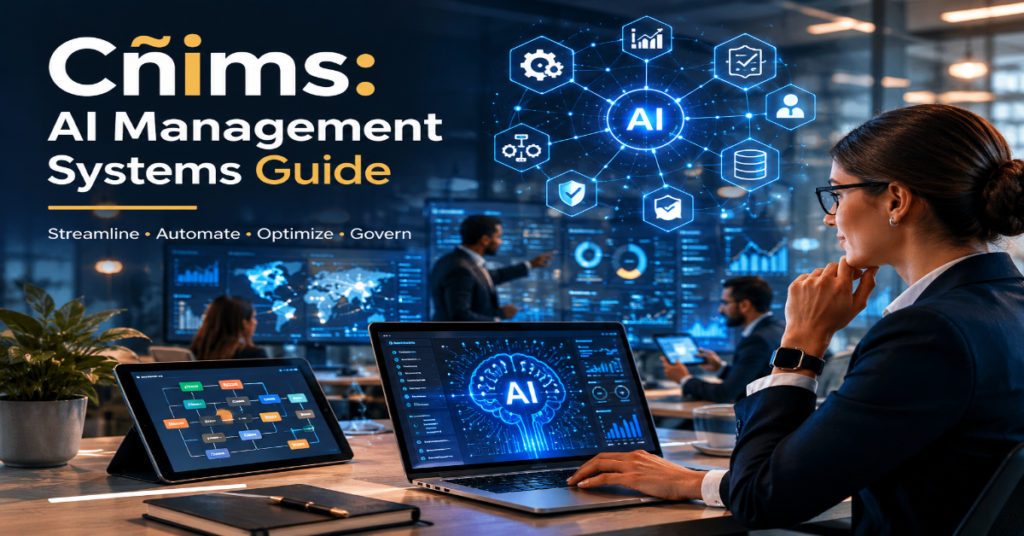
Cñims, often written as CNIMS is commonly described as Coordinated Networked Intelligent Management Systems. In this usage, it refers to an AI-based framework designed to help businesses grow by combining artificial intelligence, real-time data processing, risk assessment, transaction handling and coordinated digital tools.
The key point is simple: cñims is not just another dashboard or automation tool. It describes a management architecture where different systems communicate, learn and act together. A finance team, operations team, compliance unit and customer support center would no longer work from disconnected data streams. They would operate from a shared intelligent layer that updates continuously.
That idea fits the direction enterprise technology is already moving. AI adoption is shifting from isolated experiments toward embedded operational systems. OpenAI’s 2025 enterprise AI report describes AI moving into core infrastructure for complex organizations, while Stanford’s 2025 AI Index notes that inference costs have fallen sharply, making practical AI deployment more accessible.
Still, there is an important caution. Cñims is not yet a universally recognized technical standard. Some recent web coverage uses the term loosely or defines it differently. That means serious readers should treat it as an emerging conceptual framework, not as a certified product category with settled specifications.
What Is Cñims?
Cñims describes a coordinated AI management system built to connect data sources, analyze information in real time and support automated or semi-automated decision-making.
At a practical level, the framework combines five layers:
| Layer | Function | Business Purpose |
| Data ingestion | Collects information from apps, sensors, databases and transaction systems | Builds a live operational picture |
| AI analysis | Detects patterns, anomalies and risks | Supports faster decisions |
| Coordination layer | Connects departments and software tools | Reduces silos |
| Automation engine | Executes approved workflows | Saves time and reduces manual delay |
| Governance controls | Tracks decisions, permissions and audit trails | Improves accountability |
The main idea is not that AI replaces management. The stronger interpretation is that AI helps management see, decide and coordinate faster.
For example, a traditional reporting system may tell a business that inventory is running low after a weekly report. A CNIMS-style system could detect demand changes as they happen, compare them with supplier lead times, adjust procurement recommendations and alert finance about cash flow impact.
Why the Term Needs Careful Handling
A problem with cñims is that public definitions are inconsistent. Some sources describe it as an intelligent management framework. Others treat it as a flexible digital buzzword with no fixed industry definition. That matters for trust.
For editorial accuracy, the safest position is this:
Cñims can be explained as a useful framework for coordinated AI management, but it should not be presented as a mature standard like ISO 27001, ITIL or COBIT.
That distinction protects the article from overstating the term.
The phrase is useful because it captures a real enterprise need: businesses want AI systems that do not sit alone in one department. They want systems that connect strategy, risk, operations and execution.
The name may be new.
The pressure behind it is not.
How Cñims Works in Business Operations
A Cñims framework usually follows a continuous operating cycle.
1. Collect Data
The system gathers information from:
- ERP platforms
- CRM systems
- Payment gateways
- IoT sensors
- Support tickets
- Market feeds
- Compliance logs
- Customer behavior data
2. Process Signals in Real Time
Real-time processing is what separates this model from older reporting systems. Instead of waiting for daily or weekly summaries, the system reacts to current conditions.
This is especially important in areas like fraud detection, logistics, energy management and healthcare monitoring, where late decisions can be expensive.
3. Identify Patterns and Risks
Machine learning models can detect:
- Suspicious transactions
- Equipment failure signals
- Customer churn risk
- Demand spikes
- Resource bottlenecks
- Compliance exceptions
4. Coordinate Action
A mature implementation does not simply show alerts. It coordinates next steps.
That could mean routing a fraud alert to compliance, updating a risk score, pausing a transaction or recommending a new inventory order.
5. Record the Decision
This step is often overlooked.
For regulated industries, every automated recommendation needs context. Who approved it? Which model produced it? What data was used? Was there human oversight?
That is where AI governance becomes central.
NIST’s AI Risk Management Framework emphasizes the need to identify, measure and manage AI-related risks across system design and deployment.
Cñims vs Traditional AI Management Systems
| Feature | Traditional AI Tool | Cñims Framework |
| Primary role | Analysis or automation | Coordinated intelligence |
| Data flow | Often limited to one department | Cross-functional |
| Processing style | Batch, scheduled or request-based | Real-time or near real-time |
| Decision support | Recommendations | Recommendations plus workflow action |
| Governance need | Moderate | High |
| Best use case | Specific task optimization | Enterprise-wide coordination |
The key difference is scope.
A traditional AI tool may optimize customer support responses. A CNIMS-style system would connect support trends with product quality, logistics delays, billing issues and customer retention strategy.
That broader view is where the concept becomes valuable.
How Cñims Is Used in the Financial Sector
Finance is one of the clearest use cases because the sector depends on speed, accuracy and auditability.
A bank or payment company could use cñims for:
- Fraud detection
- Credit risk monitoring
- Liquidity analysis
- Anti-money laundering alerts
- Customer behavior scoring
- Transaction routing
- Compliance reporting
IBM’s z17 platform shows why this direction matters. IBM describes AI capabilities for trusted transactional data, including fraud-detection workloads on mainframe infrastructure.
That does not prove cñims is a specific IBM product. It shows that the broader architecture behind cñims is already visible in real enterprise systems: AI is moving closer to transaction processing, not sitting outside it.
Financial Sector Insight Table
| Problem | CNIMS-Style Response | Operational Value |
| Payment fraud | Real-time anomaly detection | Reduces delayed intervention |
| Credit exposure | Continuous risk scoring | Improves lending decisions |
| Compliance workload | Automated evidence trails | Lowers manual review burden |
| Liquidity pressure | Live cash flow monitoring | Supports treasury decisions |
| Customer churn | Behavioral prediction | Helps retention teams act earlier |
The strongest financial use case is not replacing analysts.
It is giving analysts faster, cleaner and more connected signals.
What Problems Does Cñims Solve in Business Operations?
Cñims is mainly useful where companies suffer from operational fragmentation.
Data Silos
Most organizations use many systems that do not communicate well. Sales, finance, logistics and compliance may each have partial truth.
A coordinated management framework reduces that gap.
Slow Escalation
Manual decision chains are often too slow for modern business conditions. A risk event can move faster than an approval workflow.
Cñims helps shorten that gap by routing events to the right system or person immediately.
Weak Risk Visibility
Many businesses do not see problems until after damage occurs.
A coordinated AI layer can detect early signals, such as rising return rates, payment anomalies or unusual support complaints.
Poor Resource Allocation
Real-time systems can redirect people, inventory or capital before a bottleneck becomes severe.
How Real-Time Data Processing Improves Cñims
Real-time data processing improves cñims because it changes decision timing.
A late insight may still be accurate, but it may no longer be useful.
For example:
| Scenario | Delayed System | Real-Time CNIMS-Style System |
| Fraud detection | Flags suspicious activity after settlement | Scores risk during the transaction |
| Supply chain | Finds shortage after weekly review | Detects demand pressure instantly |
| Healthcare | Reviews capacity after overcrowding | Predicts stress before escalation |
| Smart city traffic | Studies congestion after the fact | Adjusts signals dynamically |
| Customer service | Reports complaints monthly | Detects issue clusters as they emerge |
The business benefit is not speed for its own sake.
It is action before the cost grows.
Industries Beyond Finance That Can Use Cñims
Healthcare
Hospitals could use CNIMS-style systems for bed management, triage support, diagnostic workflow prioritization and supply planning.
The risk is high because healthcare AI must be transparent, clinically validated and carefully supervised.
Smart Cities
Urban systems can benefit from coordinated traffic signals, emergency response routing, energy management and pollution monitoring.
The challenge is public accountability. A city cannot allow opaque algorithms to make infrastructure decisions without oversight.
Manufacturing
Factories can use coordinated AI for predictive maintenance, production scheduling, quality inspection and energy optimization.
Logistics
Delivery networks can use real-time routing, fuel optimization, warehouse coordination and weather disruption planning.
Medicine and Research
Clinical research environments could use connected data systems to monitor trial operations, patient recruitment and safety signals.
The value is coordination.
The risk is sensitive data exposure.
Risks and Trade-Offs
Cñims sounds attractive, but serious implementation comes with hard constraints.
Data Quality Risk
Bad data creates bad decisions. A coordinated system can spread errors faster than a disconnected one.
Explainability Risk
AI decisions must be understandable, especially in finance, healthcare and public infrastructure.
Regulatory Risk
The EU AI Act entered into force on August 1, 2024 and created a risk-based framework for AI regulation in the European Union. Any CNIMS-style system used in high-impact settings may face documentation, transparency and oversight duties.
Infrastructure Cost
Real-time AI can be expensive. It may require cloud processing, edge devices, secure data pipelines, monitoring tools and specialist engineering teams.
Security Risk
A connected system has more integration points. Every API, identity layer and data stream becomes part of the security perimeter.
Three Original Insights for Business Leaders
1. Coordination Can Increase Risk Before It Reduces Risk
When systems become connected, mistakes travel faster. Businesses should not connect every workflow at once. Start with low-risk coordination, then expand.
2. The Best Use Case Is Often Exception Handling
Cñims may deliver the highest ROI by managing unusual events: fraud spikes, inventory shortages, system failures or compliance exceptions.
Routine automation saves time.
Exception intelligence saves money.
3. Governance Should Be Designed Before Automation
Many companies build AI workflows first and add governance later. That order is risky.
Audit trails, human review thresholds, access controls and model monitoring should be part of the first design phase.
The Future of Cñims in 2027
The future of cñims in 2027 will depend on whether the idea matures into a clearer enterprise architecture.
Several trends support the concept.
First, AI inference is becoming cheaper. Stanford’s 2025 AI Index reported a major drop in the cost of running models at GPT-3.5-level performance between November 2022 and October 2024. That improves the economics of real-time AI systems.
Second, enterprises are moving AI into core workflows. The strongest adoption will likely come from finance, logistics, manufacturing and healthcare, where fast decisions have measurable value.
Third, regulation will shape deployment. The EU AI Act and NIST guidance both point toward a future where AI systems need better transparency, documentation and risk controls.
The uncertain part is terminology. By 2027, cñims may become a more common label, or it may remain a niche phrase for a broader movement toward coordinated AI operations.
The underlying need will remain either way.
Businesses want systems that do not merely analyze the past.
They want systems that coordinate the present.
Takeaways
- Cñims should be treated as an emerging AI management concept, not a settled technical standard.
- The framework is built around coordination, real-time data and intelligent workflow action.
- Finance is the strongest early use case because transaction speed and risk visibility matter.
- Healthcare, smart cities, logistics and manufacturing could benefit, but only with strict governance.
- Real-time processing improves timing, not just speed.
- The biggest implementation failure points are poor data, weak explainability, high cost and regulatory exposure.
- By 2027, the term may change, but coordinated AI operations will likely become more important.
Conclusion
Cñims is useful because it gives a name to a real shift in enterprise technology. Businesses no longer need isolated AI tools that produce scattered recommendations. They need connected systems that interpret data, coordinate decisions and help people act before problems become expensive.
The concept is strongest when applied carefully. In finance, it can support fraud detection and risk monitoring. In logistics, it can improve routing and resource planning. In healthcare, it can help manage capacity and workflow pressure.
But cñims should not be sold as magic infrastructure. It depends on clean data, strong governance, secure integrations and human oversight. Without those foundations, coordinated intelligence can become coordinated confusion.
The future belongs to organizations that use AI not only to automate tasks, but to connect decisions across the business.
FAQ
What does cñims mean?
Cñims is commonly described as Coordinated Networked Intelligent Management Systems. It refers to an emerging AI framework that connects data, systems and workflows for real-time business decision-making.
Is cñims a real technology standard?
Not yet. Public definitions vary, so cñims should be treated as an emerging concept rather than a formal technical standard or certified software category.
How is cñims used in the financial sector?
In finance, cñims can support fraud detection, transaction monitoring, liquidity analysis, compliance alerts and risk scoring through real-time data processing.
What problems does cñims solve in business operations?
It helps reduce data silos, slow decision cycles, weak risk visibility and disconnected workflows across departments.
How does real-time data processing improve cñims?
Real-time processing allows the system to detect risks, update models and trigger responses as events happen instead of after reports are generated.
What industries besides finance can use cñims?
Healthcare, smart cities, logistics, manufacturing, energy and research organizations can use CNIMS-style systems where fast coordination matters.
How does cñims compare with other AI management systems?
Traditional AI tools often focus on one task or department. Cñims focuses on connected intelligence across multiple systems, teams and workflows.
Methodology
This article was prepared from the supplied Postcard.fm production brief, which defined the core keyword, keyword detail and required editorial structure.
The analysis was then checked against current public sources on enterprise AI adoption, AI cost trends, AI governance and real-time transaction AI infrastructure. Because cñims does not appear to be a settled technical standard, the article avoids presenting it as an established regulated category. Instead, it treats the term as an emerging framework aligned with real trends in coordinated AI operations.
Known limitations:
- Public definitions of cñims vary.
- There is limited independent benchmarking under the exact CNIMS label.
- Some commercial implementations similar to this framework may use different terminology.
- Human editorial review should verify all citations, internal links and claims before publication.
References
European Commission. (2024, August 1). AI Act enters into force. European Commission.
European Commission. (2026). AI Act. Shaping Europe’s Digital Future.
IBM. (2025). IBM z17. IBM.
National Institute of Standards and Technology. (2024). Artificial Intelligence Risk Management Framework: Generative Artificial Intelligence Profile. NIST.
OpenAI. (2025). The state of enterprise AI in 2025. OpenAI.
Stanford Institute for Human-Centered Artificial Intelligence. (2025). The 2025 AI Index Report. Stanford HAI.