
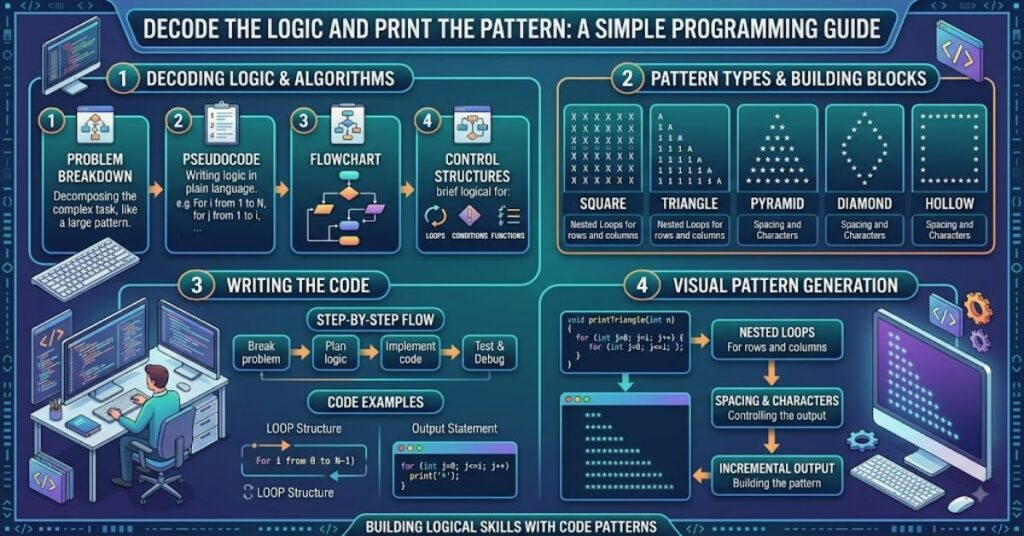
To decode the logic and print the pattern, the most useful approach is to stop looking at the output as one complicated shape. Instead, examine it row by row and split every line into smaller sections. In a common competitive programming pattern, each row contains leading asterisks or symbols, an increasing sequence of numbers, one or more zeroes, and a decreasing sequence that mirrors the numbers on the left.
The challenge is rarely the programming language itself. The real difficulty is identifying what changes from one row to the next.
For example, the number of leading asterisks may decrease as the row number increases. At the same time, the left sequence may grow from 1 to the current row number. The middle section may contain a calculated number of zeroes, while the right sequence decreases back towards 1.
Once these four sections are separated, the entire problem becomes a collection of small loops rather than one confusing piece of logic.
Pattern printing is also useful because it teaches fundamental programming concepts. A beginner must work with nested loops, counters, conditional statements and mathematical relationships between rows and columns. These are the same building blocks used later in arrays, algorithms and structured data processing.
The key is to identify the rule before attempting to write the solution.
Start by Reading the Pattern Row by Row
Consider a simplified pattern:
***1 0 1
**12 001
*123 000321
1234 00004321
The exact spacing may vary depending on the programming question, but the structure can be analysed in the same way.
Each row has four logical parts:
- Leading symbols or spaces
- An increasing sequence
- A central block of zeroes
- A decreasing sequence
The row number controls nearly everything.
For row i, ask:
- How many symbols appear before the numbers?
- Which number does the increasing sequence stop at?
- How many zeroes are required?
- Which number starts the decreasing sequence?
This turns visual analysis into arithmetic.
Breaking the Pattern into Sections
A useful method is to treat every row as an independent formula.
| Section | Typical Logic | Purpose |
| Leading symbols | n – i | Creates the outer shape |
| Increasing sequence | 1 to i | Builds the left side |
| Middle zeroes | Based on n – i or another formula | Creates separation |
| Decreasing sequence | i down to 1 | Builds symmetry |
Here, n represents the total number of rows and i represents the current row.
This structure is easier to understand than trying to create the complete output using a single nested loop.
The Logic Behind Leading Asterisks
Suppose the pattern has n = 5 rows.
On the first row, you may need four leading asterisks. On the second, three. The count continues to decrease.
The formula is:
n – i
If programming languages start the loop at 1, the logic might look like this:
for i = 1 to n
print “*” (n – i) times
The important observation is that the leading section moves in the opposite direction from the increasing number sequence.
As the number sequence grows, the leading symbols shrink.
That relationship creates the diagonal shape visible in many programming patterns.
Printing the Increasing Left Sequence
The next part is usually straightforward.
For row i, print numbers from 1 through i.
For example:
Row 1 → 1
Row 2 → 12
Row 3 → 123
Row 4 → 1234
The pseudocode is:
for j = 1 to i
print j
This is a useful example of a loop whose upper limit depends on the current row.
Instead of using the same fixed range every time, the sequence expands gradually.
Understanding the Zero Section
The zero section is often where beginners make mistakes.
The number of zeroes may depend on the size of the pattern and the current row. A common formula is based on the remaining rows:
2 × (n – i)
This creates a middle area that becomes smaller as the numerical sequences grow.
For example, when n = 5:
| Row | Increasing Numbers | Possible Zero Count |
| 1 | 1 | 8 |
| 2 | 12 | 6 |
| 3 | 123 | 4 |
| 4 | 1234 | 2 |
| 5 | 12345 | 0 |
The exact formula depends on the required output, but the principle remains the same: compare the rows and calculate how the middle section changes.
Printing the Decreasing Right Sequence
The final part mirrors the left side.
If the left side prints:
1234
the right side may print:
4321
The loop therefore moves backwards:
for j = i down to 1
print j
Some patterns require the largest number to appear only once. Others repeat it on both sides. This is why examining a sample output carefully is essential.
A small difference in the starting value of the reverse loop can completely change the result.
Comparison of Common Pattern Strategies
| Strategy | Best For | Common Difficulty |
| One large nested loop | Very simple shapes | Difficult to debug |
| Separate loops for each section | Mixed patterns | More lines of code |
| Mathematical formula approach | Complex symmetric designs | Requires careful analysis |
| Array or string construction | Advanced formatting | Uses additional memory |
For most beginners, separate loops are the clearest option. They allow each part of the row to be tested independently.
A Step-by-Step Algorithm
A general algorithm can be written as follows:
Input n
For each row i from 1 to n:
Print leading symbols
Print numbers from 1 to i
Print the required number of zeroes
Print numbers from i down to 1
Move to the next line
This method makes it easier to decode the logic and print the pattern correctly.
The structure also reduces debugging time. If the output has too many zeroes, the error is probably in the middle loop rather than somewhere else.
Common Mistakes in Pattern Questions
The most frequent mistake is focusing on columns before understanding rows. In complex patterns, the row often provides the main formula.
Another common problem is using incorrect loop boundaries. For example:
j < i
and:
j <= i
produce different outputs. Missing one number can destroy the symmetry of the pattern.
A third issue is forgetting special cases. Some patterns have a single zero or number in the centre rather than a repeated sequence. The final row may also require different handling if the middle zero count reaches zero.
Practical Insights for Competitive Programming
Pattern questions may seem simple, but they develop several useful habits.
First, write the expected output on paper and label each section. This prevents guessing.
Second, create a table showing how every count changes by row.
Third, test the smallest possible input. A pattern that works for n = 5 may still fail for n = 1 or n = 2.
These problems also teach an important lesson about algorithm design: visual complexity does not always mean logical complexity. A complicated-looking pattern can often be reduced to four short loops.
The Future of Decode the Logic and Print the Pattern in 2027
By 2027, introductory programming education will continue to use pattern problems as exercises for teaching loops, control flow and logical decomposition. AI coding tools may generate solutions instantly, but understanding why a loop begins or ends at a particular value will remain important.
The stronger educational approach is likely to focus less on memorising famous patterns and more on explaining how programmers derive formulas from output. This matters because real software development rarely provides a ready-made loop structure. Developers must analyse a requirement, break it into components and construct the logic themselves.
Pattern exercises remain useful because they train exactly that process.
Key Takeaways
- Break each row into independent sections before writing code.
- Identify what increases and what decreases as the row number changes.
- Use separate loops when the pattern contains different types of symbols.
- Check loop boundaries carefully to avoid missing or repeated values.
- Test small inputs before testing larger patterns.
- Mathematical relationships are more useful than memorising a finished solution.
Conclusion
Learning to decode the logic and print the pattern is less about memorising stars and numbers than understanding structure. Every row contains information, and comparing one row with the next reveals the rules behind the output.
The most effective technique is to separate the pattern into manageable sections: leading symbols, an increasing sequence, a central section and a decreasing sequence. Each section can then be represented by a simple loop whose limits are based on the current row.
This approach improves more than pattern-printing skills. It teaches decomposition, indexing and algorithmic thinking. Once a programmer learns to transform a visual problem into a set of repeatable rules, even complicated patterns become easier to manage.
FAQ
What does “decode the logic and print the pattern” mean?
It means analysing a visual output to identify the mathematical or logical rules controlling each row and column, then using loops to reproduce that output in a programming language.
How do I find the logic behind a number pattern?
Compare consecutive rows. Check which elements increase, decrease, repeat or disappear. Writing these changes in a table often reveals the formula.
Why are nested loops used for pattern printing?
Nested loops allow one loop to control rows while inner loops control the characters or numbers printed within each row.
How do zeroes fit into a number pattern?
Zeroes often create spacing or symmetry between an increasing sequence and a decreasing sequence. Their number is usually calculated from the total rows and current row number.
Which language is best for learning pattern printing?
C, C++, Java and Python are all suitable. The underlying logic is the same, although Python can sometimes use shorter syntax.
Why does my printed pattern look uneven?
The most common causes are incorrect loop limits, missing spaces or symbols, and an incorrect formula for the number of elements in each section.
Methodology
This article analyses common competitive programming pattern structures by separating each output row into independent components and expressing their behaviour through loop boundaries and simple mathematical relationships.
The discussion uses generic pseudocode rather than a single language-specific implementation so that the underlying logic can be applied in C, C++, Java, Python and similar languages. Pattern requirements vary between programming questions, so formulas for zeroes, spacing and repeated numbers should always be checked against the exact sample output.
This article was drafted with AI assistance and should be reviewed and verified by a human editor before publication.