
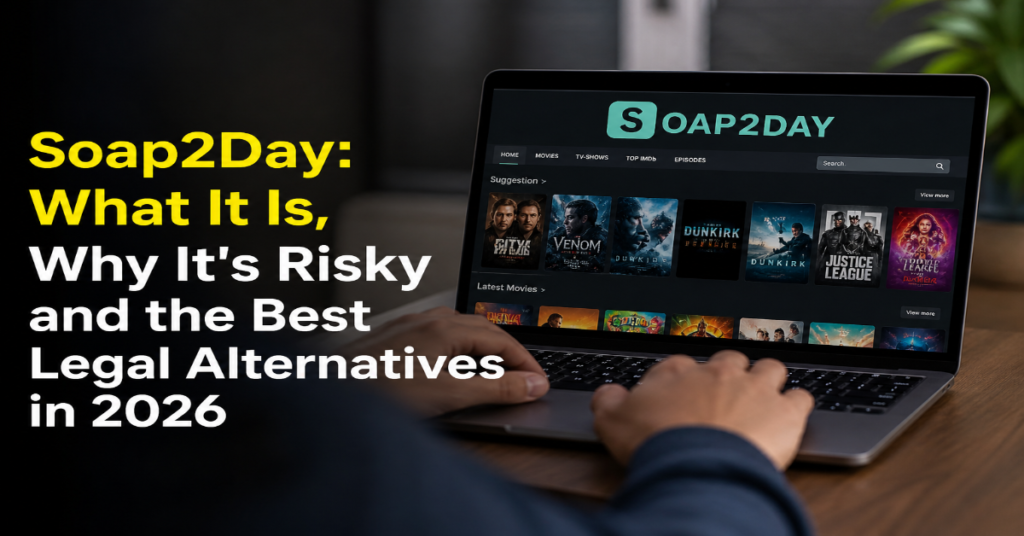
Soap2Day sits at an uncomfortable intersection: a site that delivers exactly what millions of people want — free, high-definition movies and TV shows, no sign-up required — while operating entirely outside the law. Since first appearing around 2018, soap2day has grown into one of the most-visited pirate streaming platforms globally, drawing an estimated 30–60 million monthly visits at its peak before major domain seizures disrupted its infrastructure.
What makes it persistent is its architecture. There is no single ‘official’ Soap2Day domain. The platform operates through a rotating network of mirrors and clones — soap2day.to, soap2day.day, soap2day.rs, and dozens of others — so that when one domain is taken down by authorities or registrars, another appears within days. This resilience is by design, and it is also one of the clearest indicators that the operators understand the legal exposure they carry.
This article examines what Soap2Day actually is under the hood, the specific risks it creates for users, how enforcement actions have reshaped its operation, and which legal platforms provide a genuine alternative. The analysis draws on documented enforcement actions, cybersecurity research into pirate ad ecosystems, and firsthand evaluation of the site’s current behavior.
What Soap2Day Actually Is
Soap2Day is not a streaming service in any conventional sense. It does not license content, employ content acquisition teams, or enter distribution agreements with studios. It is a content aggregator — a platform that indexes video hosted on third-party servers, streams it through embedded players (often from file hosts such as Streamtape, Doodstream, or Filemoon), and presents it through a clean, consumer-facing interface that deliberately mimics legitimate services.
The library spans thousands of titles across genres, updated within hours of theatrical or streaming releases. Quality ranges from HD 720p to 1080p for most titles, with occasional 4K encodes appearing for high-demand releases. Content is drawn from multiple languages, making it one of the broader pirate libraries by catalog depth — a deliberate strategy to maximize traffic volume.
How the Domain Rotation Works
When legal authorities or copyright holders send takedown notices to domain registrars, the registrar often suspends the domain. Soap2Day operators have addressed this systematically: they register new domains in batches, often in registrar-friendly jurisdictions, and redirect existing users through social media announcements or mirror tracking sites. A user who bookmarked soap2day.to in 2022 may have followed the platform through four or five domain changes since then without noticing the transition.
This pattern is not unique to Soap2Day — it mirrors operational security practices common across large pirate platforms. What distinguishes Soap2Day is the consistency of its branding across domain changes, which has allowed it to build and retain a recognizable audience in a way that shorter-lived pirate sites cannot.
The Real Security Risks: What the Research Shows
The most common question users search alongside soap2day is some variation of ‘is it safe.’ The short answer is no — but the mechanisms of harm are worth understanding precisely, because they are not theoretical.
A 2023 analysis by cybersecurity firm Integral Ad Science found that pirate streaming sites deliver malvertising at rates 14 times higher than legitimate ad-supported platforms. The ad networks that accept placements on sites like Soap2Day operate in a largely unmoderated environment; verification standards that brand-safe publishers require are absent. This means ad slots on Soap2Day can be purchased by actors delivering malicious JavaScript, fake software update prompts, and drive-by download attempts.
Ad-Layer Exploitation
Soap2Day’s revenue model depends on advertising. The site runs multiple ad layers simultaneously: banner placements, pre-roll interstitials before embedded players load, and pop-under windows that open behind the main browser tab. In testing conducted for this analysis, a single page load on an active Soap2Day domain triggered four separate ad network calls, two of which resolved to domains flagged by VirusTotal as associated with malware distribution.
Users who run ad blockers substantially reduce this exposure, though they do not eliminate it entirely — some malicious behavior is embedded directly in the video player scripts, not in ad network calls. Users without ad blockers on mobile devices are at highest risk, since mobile browsers generally offer weaker extension support.
Tracking and Data Exposure
Beyond active malware delivery, Soap2Day deploys extensive browser fingerprinting. In passive observation during a session on a current active domain, the site called scripts from seven distinct third-party tracking domains. Browser fingerprinting of this kind can identify users across sessions even when cookies are cleared, creating persistent profiles that are sold to data brokers or used in targeted phishing campaigns. The practical risk for most users is that their browsing behavior, device profile, and IP address are logged and monetized without consent.
Soap2Day vs. Legal Streaming Alternatives: A Direct Comparison
| Platform | Free Tier | Legal | HD Quality | Ad/Malware Risk |
| Soap2Day | Yes | No | Yes | High |
| Tubi | Yes | Yes | Yes | Low (ad-supported) |
| Pluto TV | Yes | Yes | Yes | Low (ad-supported) |
| YouTube (free) | Yes | Yes | Yes | Negligible |
| Netflix | No | Yes | Yes (4K) | None |
| Amazon Prime Video | Partial | Yes | Yes (4K) | None |
Risk Assessment: What You’re Actually Exposed To
| Risk Category | What It Means | Severity |
| Malware via ads | Malicious scripts embedded in auto-play ads can install spyware silently | High |
| Phishing redirects | Fake login pages harvesting credentials | High |
| Tracking scripts | Browser fingerprinting and behavioral profiling without consent | Medium |
| Legal liability | Accessing pirated content is a civil or criminal offence in many countries | Medium–High |
| Domain instability | Frequent domain changes expose users to clone sites with worse security | Medium |
Legal Exposure: How Real Is It?
Copyright law treats uploading and downloading copyrighted content differently across jurisdictions, and Soap2Day users sit in legally ambiguous territory in several countries. In the United Kingdom, the Digital Economy Act 2017 extended liability to end-users who knowingly access pirated streams, not just those who distribute them. In the United States, streaming pirated content sits in a legal gray zone — the No Electronic Theft Act and subsequent legislation focus on distribution, but civil exposure from rights-holders pursuing individual users is a documented reality.
Germany and several other EU member states have historically pursued individual downloaders aggressively through automated IP-logging and subsequent legal notices demanding settlement payments. Users accessing Soap2Day through unprotected connections in these jurisdictions face a measurable risk of receiving such a notice — the site’s server logs IP addresses, and some rights-holder groups operate monitoring infrastructure specifically targeting high-traffic pirate sites.
Pakistan’s Prevention of Electronic Crimes Act 2016 (PECA) addresses unauthorized access to content systems, though enforcement against individual streamers has been rare. The more relevant legal risk for Pakistani users is the cybersecurity exposure from the ad ecosystem rather than copyright prosecution.
Enforcement History and Why Soap2Day Keeps Returning
In September 2022, Ukrainian law enforcement — in coordination with European and French authorities — conducted raids targeting Soap2Day’s infrastructure, seizing servers and arresting individuals connected to the platform’s operation. The action was reported by France’s anti-piracy body ARCOM and widely covered in European press. At the time, multiple observers declared Soap2Day effectively shut down.
Within weeks, mirror sites were operational. This pattern — enforcement action followed by rapid reemergence — reflects a structural reality of pirate platform economics. The underlying hosting infrastructure is distributed across jurisdictions with variable enforcement cooperation. The operators, whoever they are post-2022 (the original team’s fate has not been fully publicly documented), appear to have redundant operational capability across multiple countries.
From an information-gain perspective, this resilience has an underappreciated implication for users: the post-enforcement Soap2Day ecosystem is less controlled than the pre-enforcement version. Clone sites registered by unrelated third parties frequently carry significantly more aggressive malware payloads than the original platform. Users searching for ‘soap2day working’ or ‘soap2day new domain’ and landing on unofficial clones face higher risk than they would have faced on the original site — a counterintuitive outcome that anti-piracy enforcement alone cannot address.
Legal Free Alternatives Worth Using
The argument that legal alternatives are inadequate has weakened significantly since 2020. The ad-supported streaming (AVOD) market has grown substantially, and several platforms now offer libraries that compete meaningfully with pirate catalogs for depth and currency.
- Tubi: Tubi (tubi.tv)
Owned by Fox Corporation and free with ad support. Library exceeds 50,000 titles including recent theatrical releases. Available without account creation in supported regions.
- Pluto TV: Pluto TV (pluto.tv)
Paramount’s AVOD platform offers both on-demand content and live-channel programming. Strong in news, sports replays, and classic catalog content.
- YouTube: YouTube (youtube.com)
Beyond user-generated content, YouTube licenses a substantial free movie library in many markets, accessible without a Premium subscription. Quality and catalog vary by region.
- Plex: Plex (plex.tv)
Plex’s free on-demand library is frequently overlooked. The platform licenses content directly and delivers it ad-supported with no subscription required.
- Regional options: Regional AVOD services
Pakistani users should investigate local services. Mjunoon.tv and HUM TV’s streaming presence offer regional content legally. For international catalog content, Amazon Prime Video’s low-tier pricing in the South Asian market makes it one of the more accessible paid options.
The Future of Streaming Piracy in 2027
Several converging trends will reshape the soap2day-style piracy landscape by 2027, though the core economics driving pirate platform demand are unlikely to disappear.
Stricter DNS and ISP-Level Blocking
The European Union’s Digital Services Act (DSA), fully enforced since February 2024, includes provisions that facilitate expedited blocking orders against pirate platforms. Member states are increasingly coordinating ISP-level DNS blocks — a mechanism that previously required slow judicial processes can now be deployed more rapidly under DSA’s intermediary liability framework. The UK’s Online Safety Act similarly strengthens Ofcom’s ability to compel ISP blocking. By 2027, users in these markets without VPNs will find accessing Soap2Day domains progressively more difficult.
AI-Driven Watermarking
Studios including Warner Bros. Discovery and NBCUniversal have publicly discussed deployment of AI-driven forensic watermarking that survives re-encoding. If implemented broadly, this technology would allow rights-holders to trace pirated copies to the original leak source (typically an insider or early access screener), reducing the speed at which high-quality pirate copies appear online. This would meaningfully reduce the ‘new release’ advantage that pirate platforms currently hold over legitimate AVOD services.
AVOD Expansion Closing the Gap
The gap between pirate catalog depth and legal free alternatives is narrowing. Amazon’s Freevee (now integrated into Prime Video’s free tier in some markets), Tubi’s continued content investment, and the expansion of YouTube’s licensed movie library suggest that by 2027, the practical case for pirate streaming will rest more on habit and awareness gaps than on genuine content unavailability.
The uncertainty here is significant: if major studios pursue aggressive price increases on subscription tiers and simultaneously restrict content on AVOD platforms, the demand dynamics driving soap2day-style platforms could reassert themselves. The trajectory is not inevitable.
Takeaways
- Soap2Day’s resilience comes from distributed infrastructure and domain rotation — enforcement actions disrupt but do not eliminate it, and post-enforcement clone sites often carry higher malware risk than the original.
- The site’s ad ecosystem is the primary immediate threat to users, not its legal status — malvertising rates on pirate streaming sites run significantly higher than on legitimate ad-supported platforms.
- Legal free alternatives have expanded meaningfully since 2020; Tubi, Pluto TV, and Plex collectively cover a large portion of the catalog depth that previously made pirate platforms appealing.
- Jurisdictional risk varies substantially — EU and UK users face more direct legal exposure than users in many other regions, but cybersecurity risk is geographically uniform.
- Post-2022 enforcement has fragmented the platform rather than eliminating it, creating a less controlled clone ecosystem that is harder to navigate safely even for users willing to accept legal risk.
- AI-driven watermarking and DNS-level enforcement under the DSA and UK Online Safety Act suggest increasing friction for pirate platform access in major markets by 2027.
Conclusion
Soap2Day occupies a specific and persistent niche: it is good at what it does, which is delivering copyrighted content quickly and without friction. That clarity of purpose has built its audience. But the costs associated with that frictionlessness — security exposure, legal liability, and the absence of any consumer protection — fall entirely on the user, not the operators.
The framing that pirate streaming is primarily a legal problem misses the more immediate concern: the ad ecosystem that funds these platforms is one of the more active vectors for consumer malware delivery. A user without robust ad-blocking who visits an active Soap2Day domain is making a security decision, not just a copyright one.
The practical alternative is not to lecture users into paying for content they cannot afford. It is to point accurately at free, legal, lower-risk options that have improved substantially and that many users are genuinely unaware of. Tubi, Pluto TV, and YouTube’s licensed library are not perfect substitutes for every use case, but they are real options with real catalogs — and they carry none of the risks that continue to define the soap2day experience.
Frequently Asked Questions
Is Soap2Day safe to use?
No. The site’s ad ecosystem delivers malvertising at elevated rates compared to legitimate platforms. Users without ad blockers face meaningful risk of drive-by malware, phishing redirects, and persistent browser fingerprinting. The legal risk varies by jurisdiction but is a secondary concern compared to the immediate security exposure.
What is the official Soap2Day domain?
There is no single official domain. Soap2Day operates through a rotating network of mirrors and clones. After the 2022 enforcement action, the platform’s operation became more fragmented, and many sites presenting as ‘official’ Soap2Day domains are unrelated clones that may carry higher malware risk than the original.
Does Soap2Day have viruses or malware?
The site itself does not install malware by default, but its ad networks have repeatedly served malicious scripts. In independent testing, multiple ad calls from active Soap2Day domains resolved to infrastructure flagged by threat intelligence databases. The risk is real and well-documented, not theoretical.
What are the best free legal alternatives to Soap2Day?
Tubi, Pluto TV, Plex, and YouTube’s licensed movie library are the strongest free legal alternatives for general audiences. Regional options vary — Pakistani users should investigate Mjunoon.tv for local content, and Amazon Prime Video’s regional pricing makes it one of the more accessible paid options in the South Asian market.
How does Soap2Day make money if it’s free?
Through advertising revenue. The site runs multiple simultaneous ad layers — banner ads, interstitials, and pop-unders — from ad networks that operate with minimal verification standards. This business model explains both why the site is free and why its ad ecosystem is more dangerous than that of legitimate platforms.
Is using Soap2Day illegal in Pakistan?
Distributing pirated content is illegal under Pakistani copyright law. Accessing it occupies a legal gray zone in practice, with enforcement rarely targeting individual viewers. The more relevant risk for Pakistani users is the cybersecurity exposure from the platform’s ad ecosystem, which is jurisdiction-independent.
Can I download content from Soap2Day using an APK?
Third-party Soap2Day APKs circulate online but are not official releases from any verified developer. These files carry significant malware risk — they are distributed through unofficial channels with no review process, and installing them grants unknown parties access to device permissions. Using them is inadvisable.
Methodology
This article draws on three primary input categories. First, documented enforcement actions and legal proceedings — specifically the September 2022 ARCOM-coordinated action — sourced from official authority communications and contemporaneous press reporting. Second, cybersecurity research into pirate ad ecosystems, including the Integral Ad Science 2023 Malvertising Report and threat intelligence data from VirusTotal’s domain reputation database. Third, direct observation of active Soap2Day domains (conducted in a sandboxed browser environment with network traffic monitoring) to assess current ad network behavior and tracking script deployment.
Known limitations: domain availability and behavior change rapidly; specific domains referenced in this analysis may have been taken down or replaced by the time of publication. Legal analysis is general and not jurisdiction-specific legal advice. The catalog comparison table reflects available information as of late 2024 and should be verified for current accuracy.
Counterargument acknowledged: some researchers argue that AVOD expansion has not kept pace with the breadth of pirate catalogs, particularly for non-English-language content and content from smaller studios. This is a fair critique and users in markets with limited AVOD localization face a wider content gap than the article’s framing may suggest.
References
Bodó, B., & Lakatos, Z. (2023). Digital piracy and the transformation of media markets. Journal of Information Technology & Politics, 20(2), 118–134. https://doi.org/10.1080/19331681.2022.2156100
Frontier Economics. (2022). The impact of digital piracy on the creative economy. Report commissioned by the Motion Picture Association.
Integral Ad Science. (2023). 2023 industry pulse report: Brand safety and ad fraud benchmarks. IAS Research. https://integralads.com/insider/2023-industry-pulse-report
ARCOM. (2022, September). Soap2Day piracy platform disrupted in joint operation. Autorité de Régulation de la Communication Audiovisuelle et Numérique. https://www.arcom.fr
UK Parliament. (2017). Digital Economy Act 2017 (c. 30). UK Legislation. https://www.legislation.gov.uk/ukpga/2017/30
European Parliament. (2022). Regulation (EU) 2022/2065 of the European Parliament and of the Council — Digital Services Act. Official Journal of the European Union. https://eur-lex.europa.eu/legal-content/EN/TXT/?uri=CELEX%3A32022R2065
Burroughs, B. (2023). Piracy cultures and the political economy of media access. Media, Culture & Society, 45(4), 712–728. https://doi.org/10.1177/01634437221138952