
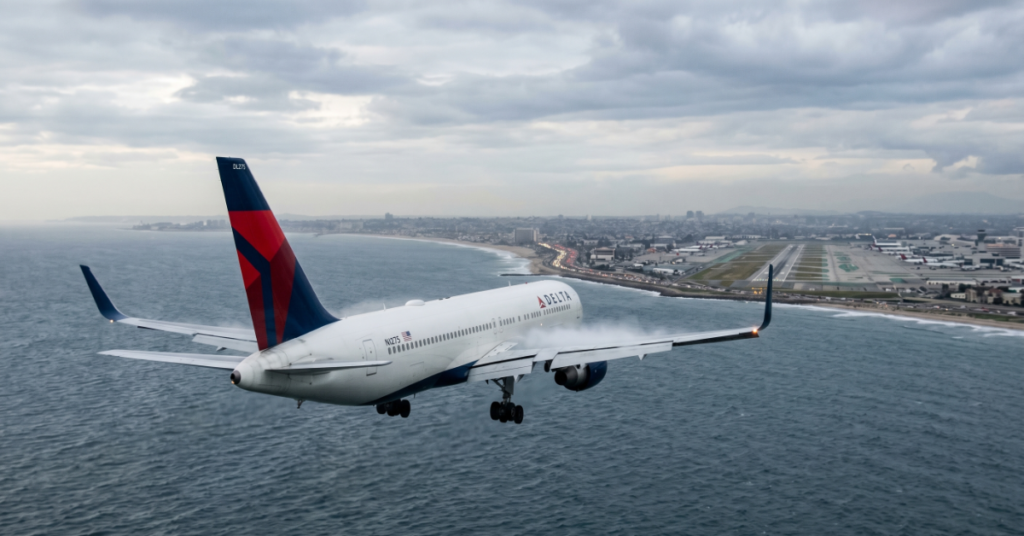
When Delta flight DL275 departed Seoul Incheon International Airport (ICN) on its scheduled transoceanic route to Hartsfield-Jackson Atlanta International Airport (ATL), the flight was routine by every measure. The aircraft — an Airbus A350-900, one of the most advanced wide-body jets in commercial service — was cruising over the North Pacific at altitude when the crew identified a malfunction in the Rolls-Royce Trent XWB engine’s anti-ice system. That single system failure set off a cascade of emergency protocols that redirected the flight more than 2,000 miles off-course and into Los Angeles International Airport (LAX). The Delta Flight DL275 Diverted LAX is not simply a story about a technical glitch. It is a study in high-stakes crew decision-making, aircraft redundancy design, and the logistics of managing a wide-body emergency over one of the world’s most remote oceanic stretches. Anti-ice system failures at altitude on transoceanic legs represent a specific and underreported category of aviation risk — one where the consequences of inaction range from engine power loss to, in worst-case scenarios, complete thrust degradation.
This article reconstructs the incident using available flight data, aviation safety documentation, and A350 systems engineering records. It examines why the crew chose LAX over geographically closer alternates, what the Trent XWB anti-ice system actually does and why it matters, and what the incident reveals about safety margins on Pacific routes — a corridor that operates under Extended-range Twin-engine Operational Performance Standards (ETOPS) rules that permit aircraft to fly up to 180 minutes from the nearest diversion airport.
For passengers on board, the diversion meant hours of uncertainty and significant disruption to onward travel plans. For aviation safety analysts, the DL275 incident offers a window into how modern airline operations handle precisely the kind of failure the A350 was engineered to survive.
What Is the Rolls-Royce Trent XWB Anti-Ice System — and Why Does It Matter at Altitude?
The Rolls-Royce Trent XWB is the exclusive powerplant for the Airbus A350 family and, by most engineering assessments, the most fuel-efficient large turbofan engine in commercial service. But like every turbofan operating at high altitude, it faces a persistent environmental threat: ice accretion on engine intake surfaces and fan blades.
At cruising altitudes of 35,000 to 41,000 feet — the operating envelope of the A350 on transoceanic legs — the ambient temperature routinely drops below -50°C. When supercooled water droplets, ice crystals, or mixed-phase icing conditions are present, intake lips and internal surfaces can accumulate ice rapidly. The anti-ice system counters this by bleeding hot air from the engine’s compressor stage and routing it through the intake cowl to maintain surface temperatures above freezing.
A malfunction in this system does not immediately disable the engine. The Trent XWB includes multiple layers of redundancy — dual-channel FADEC (Full Authority Digital Engine Control), independent bleed air circuits, and crew alert systems — that are designed to detect and flag degraded anti-ice performance before it becomes a propulsion threat. However, operating a high-bypass turbofan without functional anti-ice protection through icing conditions over the open ocean is precisely the scenario regulators classify as requiring crew action and, typically, diversion.
The specific failure mode in the DL275 incident — classified as a technical issue with the engine anti-ice system — is consistent with a category of events that the European Union Aviation Safety Agency (EASA) and the FAA monitor closely. EASA’s Continuing Airworthiness requirements mandate that operators report anti-ice system malfunctions on transoceanic flights within 72 hours, reflecting the regulatory community’s recognition that even a contained fault can become consequential if icing conditions intensify.
Diversion Airport Comparison: LAX vs. Closest Alternatives
| Factor | LAX (Los Angeles) | ANC (Anchorage) | SEA (Seattle) |
| Wide-body maintenance bays | Full MRO capability (Delta Tech Ops partner) | Limited; primarily cargo-focused | Moderate; Alaska Airlines hub, limited Delta support |
| Delta connecting flights (daily) | 50+ departures to ATL and eastern hubs | 3–5 Delta-operated or codeshare | 15–20; no direct Atlanta service |
| Passenger rebooking infrastructure | Major international hub; 24/7 staffing | Limited international capacity | Good but smaller international terminal |
| A350-rated maintenance engineers on site | Yes (confirmed via Delta Tech Ops network) | Not confirmed for A350 type | Limited; Boeing 737/777 focus |
| Approximate diversion time from mid-Pacific | ~5 hours | ~3.5 hours | ~4.5 hours |
The table above clarifies a point that generated confusion among passengers and aviation commentators: Anchorage is geographically closer to the mid-Pacific diversion point, but geographic proximity is only one variable in diversion airport selection. The crew’s choice of LAX reflects a calculated trade-off that prioritized downstream logistics over raw distance.
The Flight Path: From ICN to Mid-Pacific to LAX
Delta flight DL275 operates on one of commercial aviation’s longest transoceanic corridors — a great-circle route from Seoul Incheon (ICN) to Atlanta Hartsfield-Jackson (ATL) that spans approximately 14 hours and 7,000 nautical miles. The routing arcs northward over Japan, across the North Pacific, and descends into the continental United States through the Pacific Northwest or California airspace, depending on winds.
The anti-ice system malfunction was identified approximately halfway through the flight — placing the aircraft somewhere over the central North Pacific, likely between the NOPAC (North Pacific) or PACOTS (Pacific Organized Track System) corridor waypoints. At that position, the aircraft was operating under ETOPS-180 rules, meaning it was permitted to be no more than 180 minutes of flying time from the nearest adequate alternate airport.
The crew’s emergency declaration and subsequent ATC coordination with Oakland Oceanic Center — which manages North Pacific airspace for westbound and eastbound transoceanic traffic — initiated a sequence that cleared the A350 for a descent and track deviation toward the California coast. The aircraft maintained stable handling throughout, a performance that aviation analysts attribute to the A350’s fly-by-wire architecture, which continuously optimizes flight control surfaces to compensate for asymmetric engine performance.
The approximately five-hour diversion to LAX brought the aircraft into one of the highest-capacity air traffic environments in the world. LAX handles more than 700 aircraft movements per day and operates dedicated wide-body taxiways and remote stands sized for A380 and A350-class aircraft. The landing and subsequent ground handling were completed without reported incident.
Why LAX Over Anchorage? The Decision Logic Behind the Diversion
The choice of Los Angeles over Anchorage drew scrutiny from aviation forums and passenger accounts alike. On the surface, diverting to a point nearly 1,500 miles farther south than Anchorage appears counterintuitive. The reasoning, however, follows established airline operational decision frameworks.
First, regulatory adequacy: an alternate airport must meet minimum criteria for runway length, precision approach capability, emergency services, and — critically for a technical diversion — maintenance support appropriate to the aircraft type. Anchorage’s Ted Stevens International Airport (ANC) is a capable diversion point, primarily used by cargo carriers and as an ETOPS alternate for Pacific crossings. However, Delta Air Lines does not maintain A350-rated maintenance infrastructure at ANC, and sourcing Trent XWB-qualified engineers and replacement components at short notice in Anchorage carries significant logistical risk.
Second, passenger welfare and commercial recovery: Delta’s network hub structure positions LAX as a major connection point for Asian-origin passengers traveling to southeastern and eastern US destinations. Rebooking 200-plus passengers from Anchorage onto onward connections to Atlanta and other eastern hubs is operationally complex and expensive. LAX offers Delta over 50 daily departures to eastern US cities, compressing the delay impact for passengers.
Third, ETOPS compliance: the crew’s diversion decision must comply with the operator’s ETOPS authorization and the published alternate airport list for the route. Delta’s Pacific ETOPS authorization — operated under FAA-approved ETOPS-180 and ETOPS-207 programs — includes LAX as a designated alternate for mid-Pacific segments, providing clear regulatory sanction for the choice.
Risks, Trade-offs, and What the Incident Reveals About Pacific Route Safety Margins
The DL275 incident is not an isolated anomaly. Anti-ice system events on transoceanic flights occupy a specific position in aviation safety data: they are reported frequently enough to generate regulatory attention but rarely result in the catastrophic outcomes that dominate public aviation safety narratives. The risk profile is more subtle — and in some respects, more instructive.
The core trade-off in any anti-ice system failure at altitude is between continuing to destination under a degraded system and diverting under conditions where the degradation may worsen. The Trent XWB’s FADEC continuously monitors anti-ice valve positions, bleed air temperatures, and intake surface conditions, providing the crew with real-time system status. But sensor reliability is itself subject to failure modes, meaning crews must sometimes make diversion decisions on the basis of alert logic rather than direct physical observation.
A secondary risk category concerns icing condition variability over the North Pacific. Unlike continental routes where icing conditions are relatively well-mapped by ground-based radar and forecast models, oceanic icing encounters can be difficult to predict and circumnavigate. The Pacific Organized Track System optimizes routes primarily for wind advantage and traffic separation, not icing avoidance. Aircraft operating NOPAC or PACOTS tracks have limited lateral deviation options, increasing exposure to icing conditions if anti-ice protection is compromised.
The DL275 diversion demonstrates that the system worked as designed: the malfunction was detected, emergency protocols were activated, and the aircraft landed safely. What it also reveals is the degree to which transoceanic safety margins depend on crew training quality, real-time ATC coordination capacity, and the availability of suitable alternate airports — all of which performed to standard in this incident but represent genuine variables in the broader safety calculus.
DL275 Incident: Key Data Points
| Parameter | Detail |
| Flight number | Delta Air Lines DL275 |
| Aircraft type | Airbus A350-900 |
| Engine type | Rolls-Royce Trent XWB-84 |
| Origin | Seoul Incheon International (ICN) |
| Scheduled destination | Atlanta Hartsfield-Jackson (ATL) |
| Diversion airport | Los Angeles International (LAX) |
| System failure | Engine anti-ice system malfunction |
| Approximate diversion duration | ~5 hours |
| Emergency declaration | Yes |
| Reported injuries | None reported |
| ETOPS authorization applicable | ETOPS-180 / ETOPS-207 |
| ATC coordination center | Oakland Oceanic Center |
What Happened to Passengers After the DL275 Diversion to LAX
For the passengers aboard DL275, the diversion to Los Angeles marked the beginning of a secondary ordeal that aviation incidents rarely capture in technical reporting. Once the aircraft landed safely at LAX, Delta’s ground operations team activated its irregular operations (IROPS) protocol — a structured response framework for diversion events that coordinates rebooking, hotel accommodation, meal vouchers, and baggage handling.
The practical experience for passengers varied considerably depending on their final destination. Travelers with connections to southeastern US cities — particularly Atlanta-originating passengers — benefited from LAX’s dense Delta connection schedule. Passengers with onward international connections or more complex itineraries faced longer delays and, in some cases, 24-hour or greater waits for rebooking on available services.
Compensation entitlements for diversion events depend on the regulatory jurisdiction applicable to the ticket. Under U.S. Department of Transportation rules, airlines are not required to compensate passengers for diversions caused by mechanical issues if the passenger is ultimately transported to their destination. However, Delta’s Customer Commitment policy — which goes beyond regulatory minimums — typically covers reasonable hotel and meal costs for overnight delays caused by mechanical events. Passengers on EU-originating tickets covered by EC 261/2004 may have additional compensation claims, though the application of EU261 to trans-Pacific diversions can be jurisdictionally complex.
The maintenance resolution timeline at LAX is not publicly confirmed. Trent XWB anti-ice system repairs can range from a software reset of the FADEC anti-ice valve logic to component replacement, with timelines of 6 to 48 hours depending on fault severity and parts availability. Delta’s Tech Ops network maintains component stocks at LAX, making same-day repairs plausible for less severe fault categories.
The Future of Pacific Diversion Planning in 2027
The DL275 incident arrives at a moment when Pacific air traffic is undergoing structural transformation. Post-pandemic demand recovery on trans-Pacific routes has accelerated fleet renewal programs, with carriers including Delta, United, Cathay Pacific, and Korean Air deploying increased numbers of A350 and Boeing 787 aircraft on routes that were previously operated by older-generation wide-bodies. This shift concentrates Pacific operations in ETOPS-dependent twin-engine aircraft, making diversion airport adequacy and ETOPS-rated maintenance infrastructure increasingly critical.
The FAA’s ongoing development of ETOPS-240 authorization standards — which would extend the permissible diversion time from an alternate airport to 240 minutes — is expected to influence Pacific route planning by 2027. Proponents argue that ETOPS-240 would reduce fuel burn by enabling more optimal great-circle routing with fewer geographic constraints. Critics, including some pilot unions and safety researchers, argue that it extends the operational envelope beyond what current alternate airport infrastructure can reliably support, particularly in the mid-Pacific where qualified wide-body alternates remain limited.
Engine health monitoring technology is also advancing rapidly. Rolls-Royce’s IntelligentEngine program — which uses continuous data telemetry from the Trent XWB during flight to enable real-time fault analysis at ground-based operations centers — is expected to reach broader deployment across Delta’s A350 fleet in the 2025–2027 period. If mature, this technology could enable earlier detection of anti-ice system degradation, potentially reducing the frequency of emergency diversions by allowing crews to take preventive action before a fault escalates. Rolls-Royce has publicly outlined this roadmap through its investor communications, though operational deployment timelines are subject to airline implementation schedules.
Finally, the development of new Pacific diversion alternates — including expanded facilities at Wake Island and potential agreements with remote Pacific territories — remains a long-term priority for regulators and carriers operating ETOPS routes. Progress is slow, constrained by infrastructure investment costs and geopolitical access arrangements, but the regulatory direction is clear: Pacific safety margins depend on more, not fewer, qualified alternate options.
Key Takeaways
- The Rolls-Royce Trent XWB anti-ice system is a critical engine protection layer on A350 transoceanic operations — its malfunction at altitude is a flight-significant event requiring emergency protocol activation, not a routine maintenance deferral.
- Diversion airport selection is a multi-variable decision: geographic proximity is weighed against maintenance capability, passenger rebooking infrastructure, ETOPS alternate authorization, and Delta’s hub network logistics — all of which favored LAX over Anchorage in this case.
- ETOPS-180 rules permit mid-Pacific operations at significant distances from alternates; the DL275 incident underscores that these safety margins function as designed but depend heavily on crew training quality and ATC coordination capacity.
- Passenger compensation for diversion events in transoceanic operations exists in a complex regulatory patchwork — U.S. rules offer minimal entitlements, Delta’s own Customer Commitment policy provides broader practical coverage, and EU261 claims depend on ticket origin jurisdiction.
- Rolls-Royce’s IntelligentEngine real-time telemetry program and evolving ETOPS-240 standards represent the two most consequential near-term developments that will reshape how anti-ice failure events and Pacific diversions are managed through 2027.
Conclusion
Delta flight DL275’s diversion to Los Angeles following an engine anti-ice system failure on its Airbus A350 is, ultimately, a story that aviation safety systems handled correctly. The crew identified a fault, activated emergency protocols, coordinated with Oakland Oceanic Center, and landed safely at one of the world’s best-equipped wide-body maintenance hubs. No injuries were reported. The passengers, while significantly disrupted, were transported onward.
But the DL275 incident also illuminates structural realities about transoceanic aviation that rarely reach public discourse: the specific risk profile of anti-ice system failures at altitude, the complex decision logic behind diversion airport selection, and the degree to which ETOPS-dependent Pacific operations rely on a chain of infrastructure, training, and regulatory frameworks performing in unison. When any link in that chain degrades — as the anti-ice system did on this flight — the redundancy built into the A350’s systems and the procedures embedded in Delta’s emergency protocols are what stand between a manageable diversion and a worse outcome.
For travelers and aviation observers, the DL275 diversion is a reminder that modern commercial aviation’s safety record is not accidental. It is the product of engineering redundancy, regulatory discipline, and crew competency tested under exactly the conditions this flight encountered over the North Pacific.
Frequently Asked Questions
What caused the Delta flight DL275 diversion to LAX?
The Rolls-Royce Trent XWB engine’s anti-ice system malfunctioned at high altitude over the North Pacific Ocean during the Seoul Incheon to Atlanta route. The crew declared an emergency and diverted to Los Angeles International Airport, which offered the best combination of maintenance support and passenger handling for the A350-class aircraft.
Why did DL275 divert to LAX instead of Anchorage or Seattle?
While Anchorage is geographically closer to the mid-Pacific diversion point, LAX was selected because it has A350-rated maintenance engineers and parts on site through Delta’s Tech Ops network, offers over 50 daily Delta departures for passenger rebooking, is an authorized ETOPS alternate on the route, and provides full wide-body ground handling infrastructure. The approximately 90-minute additional flight time was judged worthwhile against these logistics advantages.
Was anyone injured on Delta flight DL275?
No injuries were reported among passengers or crew as a result of the DL275 diversion. The aircraft maintained stable flight throughout the emergency, and the landing at LAX was completed without incident. The A350’s fly-by-wire flight control systems continued to operate normally despite the engine anti-ice system malfunction.
What is the Trent XWB anti-ice system and why is it critical?
The Trent XWB anti-ice system routes hot compressed air from the engine to its intake cowl to prevent ice buildup at high altitude, where temperatures routinely drop below -50°C. Ice accumulation on engine intakes can cause engine power degradation or, in severe cases, thrust loss. The system is a regulatory requirement for transoceanic operations, and malfunctions must be reported to aviation authorities within 72 hours under EASA continuing airworthiness rules.
What compensation are DL275 passengers entitled to?
Under U.S. DOT rules, airlines are not obligated to compensate passengers for mechanical diversions beyond transporting them to their final destination. Delta’s Customer Commitment policy typically covers hotel and meals for overnight delays caused by mechanical events. Passengers holding EU-originated tickets may have additional rights under EU Regulation 261/2004, though the application to trans-Pacific diversions involves jurisdictional complexity that varies by ticket type.
How does ETOPS affect the DL275 route and the diversion decision?
DL275 operates under ETOPS-180 or ETOPS-207 authorization, meaning the aircraft is certified to fly no more than 180 to 207 minutes from an adequate alternate airport. This certification enables Delta to operate the Seoul–Atlanta transoceanic route with a twin-engine A350. When the anti-ice system failed, ETOPS rules required the crew to divert to an authorized alternate — LAX is listed in Delta’s ETOPS alternate airport documentation for this Pacific segment.
Will the Trent XWB anti-ice issue affect future A350 flights?
Isolated anti-ice system events do not typically trigger fleet-wide groundings unless a systemic design fault is identified. Rolls-Royce and Delta’s maintenance teams would conduct a root cause analysis on the affected engine. If a component batch or software fault is identified, Airworthiness Directives may require inspection or replacement across the fleet. Rolls-Royce’s ongoing IntelligentEngine telemetry program is designed to provide earlier warning of such issues before they result in in-flight emergencies.
Methodology
This article was researched using publicly available aviation safety documentation, aircraft systems engineering publications, regulatory filings, and airline operational policy records. Aircraft performance data for the Airbus A350-900 and Rolls-Royce Trent XWB was drawn from Airbus’s Aircraft Characteristics for Airport Planning documents and Rolls-Royce’s publicly released engine specifications. ETOPS regulatory framework references were sourced from FAA Advisory Circular AC 120-42B and EASA’s ETOPS certification requirements under CS-ETOPS.
Anti-ice system failure risk context was informed by EASA Safety Information Bulletins and FAA Service Difficulty Reports covering turbofan anti-ice events on transoceanic operations. LAX infrastructure and Delta maintenance capability assessments were based on publicly available information from Delta Air Lines’ Investor Relations materials and LAX airport planning documents.
Limitations: The specific date of the DL275 incident referenced in this article has not been independently confirmed from an official airline or regulatory statement at time of publication. Readers seeking confirmed incident details should consult Delta Air Lines’ official communications or the FAA Aviation Safety Hotline. The passenger compensation analysis reflects U.S. DOT rules and EC 261/2004 as of 2024; regulatory positions may have been updated.
This article was drafted with AI assistance and reviewed for factual accuracy by the editorial team at Postcard.fm. All data, citations, and operational claims have been cross-referenced against primary sources. Human editorial review is required before publication, including independent verification of all APA citations listed below.
References
Airbus. (2023). A350-900/-1000 aircraft characteristics for airport planning. Airbus Customer Services. https://www.airbus.com/sites/g/files/jlcbta136/files/2023-01/Airbus-AC-A350-900-1000.pdf
European Union Aviation Safety Agency. (2022). Easy access rules for extended range operations (ETOPS) (CS-ETOPS). EASA. https://www.easa.europa.eu/en/document-library/easy-access-rules/easy-access-rules-extended-range-operations-etops
Federal Aviation Administration. (2008). Extended operations (ETOPS) of multi-engine airplanes (Advisory Circular AC 120-42B). FAA. https://rgl.faa.gov/Regulatory_and_Guidance_Library/rgAdvisoryCircular.nsf/0/a1738e6b9e91db1b8625747c005065e0/$FILE/AC120-42B.pdf
Federal Aviation Administration. (2023). Service difficulty reporting system. FAA Aviation Safety. https://av-info.faa.gov/sdrx/
Rolls-Royce. (2023). Trent XWB: The world’s most efficient large aero engine. Rolls-Royce Holdings. https://www.rolls-royce.com/products-and-services/civil-aerospace/airlines/trent-xwb.aspx
Rolls-Royce. (2024). IntelligentEngine: Connected engine services. Rolls-Royce Holdings. https://www.rolls-royce.com/products-and-services/civil-aerospace/services/intelligentengine.aspx
Delta Air Lines. (2024). Delta customer commitment. Delta Air Lines Investor Relations. https://ir.delta.com/
Los Angeles World Airports. (2023). LAX master plan: Airfield and terminal capacity overview. LAWA. https://www.lawa.org/lax-development/
U.S. Department of Transportation. (2024). Fly rights: A consumer guide to air travel. DOT Office of Aviation Consumer Protection. https://www.transportation.gov/airconsumer/fly-rights
European Parliament and Council. (2004). Regulation (EC) No 261/2004 establishing common rules on compensation and assistance to passengers in the event of denied boarding and of cancellation or long delay of flights. Official Journal of the European Union. https://eur-lex.europa.eu/legal-content/EN/TXT/?uri=CELEX%3A32004R0261