
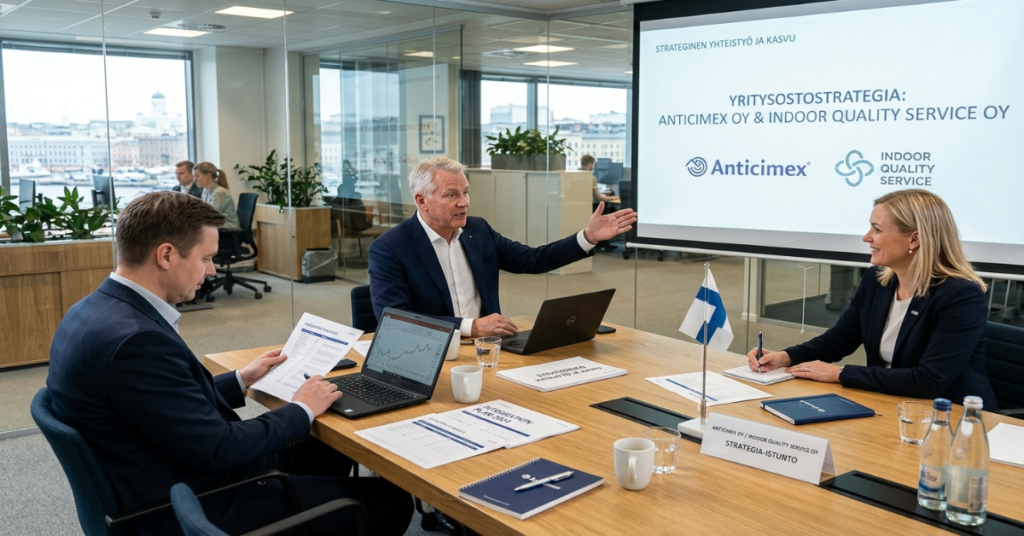
The Anticimex Indoor Quality Service acquisition strategy represents a structural shift in how built environment health services are delivered in Finland. Instead of operating as a traditional pest control provider, Anticimex is expanding into a platform model that combines indoor air quality monitoring, moisture and mold remediation, radon analysis, and predictive maintenance under a unified service architecture.
At the center of this transformation is Indoor Quality Service Oy, whose expertise in IAQ diagnostics and environmental measurement strengthens Anticimex’s position in the Finnish market. The combined model is designed to scale across the “Healthy Buildings” concept, where buildings are treated as continuously monitored health environments rather than static physical assets.
This strategy is not only operational but also structural. It relies on integrating technicians, CRM systems, and sensor-driven analytics into a single workflow. The Anticimex Indoor Quality Service acquisition strategy also reflects broader European trends where environmental health, ESG reporting, and digital building intelligence are converging into a single service category.
In Finland, where issues like moisture damage and indoor air quality concerns are both regulatory and cultural priorities, this approach has strong market relevance. However, execution complexity remains high due to system integration challenges, workforce utilization constraints, and data governance requirements. The strategy’s success depends on whether Anticimex can convert fragmented SME capabilities into a scalable, data-driven platform.
Systems Analysis of the Acquisition Model
The Anticimex Indoor Quality Service acquisition strategy functions as a platform consolidation model rather than a simple corporate expansion.
Key system components include:
- Service unification across pest control, IAQ, radon, and moisture diagnostics
- Technician route optimization through shared scheduling systems
- Centralized CRM and customer lifecycle management
- Sensor and monitoring data aggregation into predictive maintenance models
The operational goal is to reduce fragmentation in building health services. Instead of separate vendors for pests, air quality, and structural issues, the model pushes toward a single accountable service provider.
PV=nRTPV = nRTPV=nRT
PPP
VVV
nnn
TTT
This type of sensor-driven environmental monitoring increasingly depends on standardized measurement frameworks that can be aggregated across buildings and regions.
A key structural insight is that value creation is no longer service-based alone. It is increasingly data-based, where long-term contracts depend on continuous environmental monitoring rather than one-time inspections.
Strategic Implications for Market Positioning
The Anticimex Indoor Quality Service acquisition strategy strengthens market positioning in three areas:
- Vertical expansion: Moving from pest control into IAQ, radon, and moisture remediation
- Platform consolidation: Creating a single service ecosystem across building health categories
- Recurring revenue transformation: Shifting from episodic services to subscription-style monitoring contracts
This aligns with broader European building safety trends, where indoor environmental quality is becoming a regulated and audited domain rather than an optional service.
A major implication is increased customer lock-in. Once buildings are integrated into sensor-based monitoring systems, switching costs rise significantly due to historical data dependency and compliance continuity.
Integration Synergies and Operational Model
The success of the strategy depends heavily on integration efficiency between acquired companies.
Service Integration Comparison
| Area | Before Acquisition | After Integration |
| Technician deployment | Separate teams per service | Shared multi-skilled workforce |
| Data systems | Fragmented reporting tools | Unified IAQ and CRM platform |
| Customer contracts | Single-service agreements | Multi-service bundled contracts |
| Maintenance cycles | Reactive interventions | Predictive maintenance model |
Indoor Quality Service contributes specialized expertise in IAQ diagnostics, which enhances Anticimex’s ability to standardize measurement protocols across Finland.
The Anticimex Indoor Quality Service acquisition strategy relies heavily on cross-utilization of technicians, which increases efficiency but also introduces training and certification challenges.
Risks and Trade-Offs in Execution
Despite its strategic logic, the model carries significant operational risks.
- Integration complexity: Merging technical systems and field operations can reduce short-term efficiency
- Margin dilution risk: Lower-margin SME acquisitions may not align with Anticimex’s profitability targets
- Data governance exposure: IAQ data handling must comply with GDPR and long-term storage regulations
- Workforce scalability: Multi-disciplinary technician training increases operational costs
Another structural challenge is cultural integration. SME-level environmental service firms often operate with localized expertise, which may conflict with standardized platform processes.
The Anticimex Indoor Quality Service acquisition strategy therefore depends on balancing standardization with technical flexibility.
Market Impact in Finland
Finland’s built environment market is particularly sensitive to indoor air quality issues due to climate conditions and building insulation standards.
Key market effects include:
- Increased consolidation of IAQ service providers
- Rising demand for integrated environmental health platforms
- Greater regulatory focus on indoor environment reporting
- Expansion of ESG-linked building certification systems
The strategy positions Anticimex as a central consolidator in a fragmented market where many SMEs operate in isolation.
Continuous monitoring reduces uncertainty in building health assessments, which increases long-term contract stability.
ESG and Regulatory Value Creation
The Anticimex Indoor Quality Service acquisition strategy is strongly aligned with ESG reporting frameworks.
Key ESG drivers include:
- Reduction of indoor environmental health risks
- Improved energy efficiency through optimized ventilation
- Data-driven compliance reporting for buildings
- Long-term sustainability tracking of building performance
EU-level regulatory trends increasingly emphasize indoor environmental quality as part of occupational health and safety compliance. This creates structural demand for integrated monitoring platforms.
GDPR compliance is also critical, particularly when IAQ data is linked to occupancy patterns or behavioral analytics.
The Future of the Strategy in 2027
By 2027, the Anticimex Indoor Quality Service acquisition strategy is likely to evolve into a fully integrated “building intelligence platform.”
Expected developments include:
- AI-driven predictive maintenance models for IAQ and moisture risks
- Expansion into full Building Management System (BMS) integration
- Increased regulatory standardization of indoor air quality thresholds
- Growth of subscription-based “building health as a service” models
However, constraints remain in sensor interoperability and cross-border regulatory harmonization within Europe. The success of scaling depends on whether acquired SMEs can be fully standardized without losing technical depth.
Key Takeaways
- Acquisition strategy is shifting toward platform-based building health services
- Indoor Quality Service strengthens technical IAQ and environmental monitoring capability
- Data integration is the primary driver of long-term competitive advantage
- ESG and regulatory frameworks are accelerating market consolidation
- Operational risks center on integration, compliance, and workforce scalability
- The model is transitioning toward predictive, subscription-based service delivery
Conclusion
The Anticimex Indoor Quality Service acquisition strategy illustrates how traditional environmental service companies are evolving into data-driven platforms. Rather than focusing solely on pest control or isolated building issues, the model integrates multiple dimensions of indoor environmental health into a unified system.
This approach reflects broader changes in how buildings are managed, where continuous monitoring replaces periodic inspection and data becomes a core asset. In Finland, where indoor air quality has both regulatory and cultural significance, this transition is particularly impactful.
The long-term success of the strategy depends on execution discipline. Integration complexity, data governance, and workforce alignment will determine whether the platform scales effectively or remains a fragmented network of services.
Structured FAQ
What is the Anticimex Indoor Quality Service acquisition strategy?
It is a consolidation model where Anticimex acquires and integrates indoor air quality and environmental service firms to build a unified “Healthy Buildings” platform.
Why is Indoor Quality Service important in this strategy?
It adds specialized expertise in IAQ, radon, and moisture diagnostics, strengthening Anticimex’s technical capabilities in Finland.
How does the strategy improve efficiency?
By combining technician routes, CRM systems, and monitoring data into a single platform, reducing operational fragmentation.
What are the main risks of the strategy?
Integration challenges, regulatory compliance risks, and margin alignment issues across acquired SMEs.
How does ESG influence this acquisition model?
ESG frameworks increase demand for indoor environmental monitoring and reporting, supporting long-term contract growth.
What is the future direction of this strategy?
It is expected to evolve into a predictive building intelligence platform with AI-driven maintenance systems.
Methodology
This analysis is based on publicly available corporate strategy descriptions, Anticimex corporate sustainability disclosures, industry reports on indoor air quality in Northern Europe, and EU regulatory frameworks related to building health and environmental monitoring.
No proprietary internal company data was used. Observations reflect industry-wide consolidation patterns in environmental services and publicly documented acquisition strategies.
Limitations include the absence of confidential integration metrics, financial performance breakdowns, and post-acquisition operational KPIs for Indoor Quality Service Oy.
References (APA)
European Commission. (2023). Indoor air quality and health in the EU. https://environment.ec.europa.eu
Anticimex Group. (2024). Annual and sustainability report 2023–2024. https://www.anticimex.com
World Health Organization. (2023). WHO guidelines on indoor air quality. https://www.who.int
Finnish Institute of Occupational Health. (2023). Indoor air quality and occupational health risks. https://www.ttl.fi
ISO. (2022). ISO 16000 indoor air standards overview. https://www.iso.org